


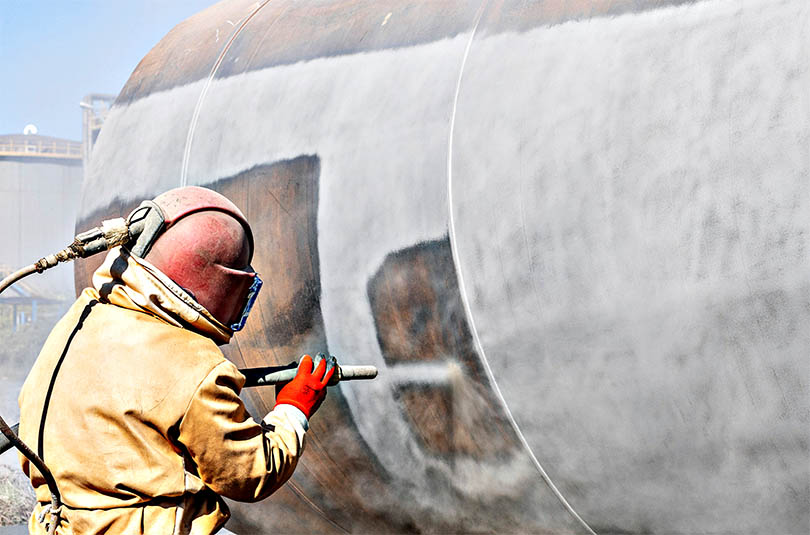
High-vacuum solutions for collecting spent abrasives, grit, flakes, metal residues and dust generated during abrasive blasting and surface preparation.
Abrasive blasting generates residues with widely varying weight, particle size, abrasiveness and composition. At the end of the process, the following may be present: abrasive that can still be recovered, fractured or spent abrasive, steel grit, corundum, garnet, glass beads, rust flakes, paint fragments,
Read more
coating residues, fine dust, waste, metal particles and material contaminated by the treated surface. Collecting these residues requires industrial vacuum cleaners with adequate vacuum pressure, abrasion-resistant piping, replaceable internal protection and separation systems capable of limiting the amount of heavy particles reaching the filter. Dust generated by abrasive blasting may simultaneously contain substances originating from the abrasive, the substrate, the removed coating and contamination from previous operations. The assessment must therefore consider the entire collected mixture.
FEVI industrial vacuum cleaners and dust collectors suitable for abrasive blasting
The compatibility shown below is application-based. Final performance and wear-resistant configurations must be validated by the FEVI technical department according to the bulk density of the abrasive used.
Criteria for selecting the abrasive-recovery system
The selection and correct configuration of FEVI machines must be defined by analysing three fundamental areas of the blasting cabinet:
1. Density and Wear
Assessment of the bulk density of the abrasives, including steel grit, corundum, garnet and glass beads, and their high wear effect on metal components.
2. Piping-Network Configuration
Calculation of the total flexible-hose length, vertical height differences or lifting height, inlet diameter and simultaneous-use factor.
3. Toxicity and ATEX
Assessment of risks associated with crystalline silica or heavy metals such as lead and chromium in removed coatings, together with verification of ATEX explosion risks involving fine metal dust.
Nature of the residues generated during abrasive blasting
Heavy abrasive deposited on floors: Steel grit, garnet, corundum and high-density abrasives accumulate on floors, in cabinet corners, beneath gratings, inside hoppers or in collection pits. Conveying these materials requires an industrial vacuum cleaner capable of generating high vacuum pressure and maintaining it consistently through long piping, bends and vertical height differences while overcoming substantial pressure losses. Airflow alone is not sufficient for these residues. The vacuum pressure required to lift materials with a high bulk density is essential.
Lightweight abrasive and fine fraction: Sodium bicarbonate, fine glass beads, mineral dust, paint residues and fractured spent abrasive generate a lightweight fraction that rapidly reaches the filter chamber. In these cases, a large filter surface area, PTFE-membrane cartridges, cyclonic separation and automatic sequential cleaning are essential. Even the most powerful industrial vacuum cleaner is unsuitable when the filter clogs rapidly and restricts airflow.
Steel grit and recirculation: Steel grit and metallic beads are dense and highly abrasive materials. The configuration must take abrasive recirculation, bend protection and fine-dust separation into account. When the grit is to be recovered for another cycle, the system must be designed to separate the reusable fraction from dust and contaminants.
Health-risk factors: crystalline silica and heavy metals
Using abrasives containing crystalline silica can generate respirable dust and create a severe silicosis risk. Alternative abrasives also produce dust and must be assessed according to the chemical composition of the collected mixture. Abrasive blasting and the removal of old protective primers or paint from metal structures generate oxide flakes, rust, fragments and surface contaminants that affect residue management. The presence of lead, chromium, nickel, beryllium or other hazardous toxic substances depends exclusively on the workpiece and the coating being removed. Abrasive-blasting operations can generate highly hazardous dust even when the original abrasive is environmentally compatible. Extraction must be combined with suitable containment systems and a closed, protected collection system to prevent airborne dispersion. Manual sweeping and compressed-air blowing resuspend dust and are strongly prohibited.
Technology classification: Industrial Vacuum Cleaner, Dust Collector or Centralised System
To operate with maximum efficiency and safety, FEVI divides its solutions into three separate families:
- High-Vacuum Industrial Vacuum Cleaner: The appropriate solution for recovering heavy abrasive from floors, cleaning beneath gratings, collecting steel grit, extracting material from deep hoppers and vertically conveying solids over a distance through small-diameter flexible hoses.
- High-Airflow Dust Collector: The specific architecture for capturing and filtering fine airborne dust clouds. It is flanged to enclosed cabinets, abrasive-transfer stations, screening systems, sieves or open hoods that require the continuous movement of substantial air volumes. It does not collect grit from floors.
- Centralised Facility System: Implemented when several cabinets or extraction points must be served simultaneously over long distances, eliminating the need to move mobile units continuously. It uses a heavy-duty central vacuum unit, such as a two-stage blower, connected to fixed abrasion-resistant piping, in-line cyclonic pre-separators, hoppers and Big Bag or Longopac discharge systems.
Wear-protection systems and advanced filtration
Abrasion-resistant piping and Vulkollan linings: Grit, corundum and garnet rapidly wear conventional flexible hoses. FEVI uses thick abrasion-resistant polyurethane hoses, reinforced rubber hoses with crush-resistant spirals and large-radius bends. The sections of the structure most exposed to direct impact from the material flow are protected with replaceable internal wear-resistant rubber linings or Vulkollan elements, including inlets, cyclone walls and hopper impact points, to limit wear on the metal structures.
photodiodeCyclonic effect and ICLEAN cleaning: The tangential inlet gives the airflow a continuous rotating movement inside the chamber, providing preliminary separation of the heavier particles and reducing their direct impact on the cartridges. Fine dust and fractured abrasive are retained by PTFE-membrane cartridges that limit deep penetration into the filter media. These are supported by the automatic ICLEAN system, which operates cyclically to promote dust release and maintain stable airflow. Avoid the claim “the filter never clogs”. The effectiveness of absolute HEPA stages must be verified in relation to the overall sealing performance of the machine.
Abrasive recovery, screening and system integration
The FEVI industrial vacuum cleaner can be integrated effectively into a complete abrasive-recovery circuit. Material collected under high vacuum pressure is conveyed to cyclonic separators, mechanical screens, sieves, magnetic separators or air classifiers before being returned to the blasting machine. The actual possibility of reusing the abrasive depends on its remaining particle size, degree of breakdown, presence of spent dust and contamination by rust, oils or toxic paint. Collection alone does not make the material reusable. When the material contains fragments of heavy paint or hazardous metals, the spent abrasive must be characterised and disposed of in accordance with the applicable procedures. Flange-mounted industrial pre-separators equipped with hoppers, rotary discharge valves, forklift-compatible tipping containers or Big Bags with capacities of up to 1,000 litres may be required to protect the filters and manage the actual material weight.
Quick configuration selection guide
Recovery of heavy solids and grit
- Large-scale recovery of steel grit, corundum or garnet from floors: FEVI HDC 155 BASIC in the B configuration, combined with abrasion-resistant polyurethane hoses and internal protection;
- Heavy abrasive mixed with large quantities of fine dust: FEVI HDC 355 ICLEAN in the high-vacuum S configuration, with an in-line abrasion-resistant pre-separator installed upstream;
- Large quantities of abrasive to be stored or regenerated: Combine the industrial vacuum cleaner with a cyclonic pre-separator or tipping hopper discharging into a 1,000-litre Big Bag.
Fine dust, airborne particles and ATEX areas
- Fine dust from abrasive blasting or sanding for mobile or single-phase use: FEVI TDC30 ICLEAN for three-phase applications or FEVI 350 ICLEAN for 230 V single-phase applications;
- Capturing and filtering suspended dust inside a cabinet: FEVI DTX 1500 BASIC for a single source or the automatic FEVI DTX 2500 AIRCLEAN dust collector;
- Airborne combustible metal dust in Zone 22: FEVI DTX 2500 AIRCLEAN ATEX 2-22, dust group IIIC;
- Localised cleaning and maintenance in ATEX Zones 22 or 21: Pneumatic FEVI S PN ATEX range or three-phase FEVI WT 75 BASIC ATEX range.
Key parameters to verify before configuration
Before defining the proposal, we assess the abrasive-blasting variables together: type of abrasive and its bulk density, including grit, corundum, garnet, glass and sodium bicarbonate; particle size, density and percentage of spent fine dust; nature of the treated surface and toxicity of the removed coating, including lead, chromium, zinc and heavy metals; need for recovery and screening for reuse; line parameters, including abrasion-resistant hose length, diameter, large-radius bends and vertical lifting height; daily operating hours and cycle; usable drum or Big Bag capacity; electrical supply, whether 230 V or 400 V, or pneumatic supply; and any risk of live sparks or ATEX-classified areas.
Request a sizing assessment for your system
Do you need to recover abrasive or metal waste after abrasive-blasting operations?
Describe the type of abrasive used, the hourly quantity to be conveyed, dust particle size, grit bulk density, percentage of spent fine fraction, linear distance from the extraction point, total piping length and any vertical height differences, the type of coating removed from the surfaces, any ATEX classification of the departments and whether the material must be reused in the process. Our engineering department will assess the correct vacuum-pressure and airflow parameters, the configuration of Vulkollan abrasion-resistant protection, filtration class and the most suitable separation and discharge systems. Contact us to configure the ideal extraction and recovery system for your abrasive-blasting installation.
Abrasive Blasting and Abrasive Recovery Solutions FAQ
Which industrial vacuum cleaner is required to recover steel blasting grit?
Read more
A high-vacuum industrial vacuum cleaner equipped with a reinforced structure, tangential inlet to reduce direct impact, thick abrasion-resistant polyurethane piping and filter-protection plates is required. For substantial hourly quantities, an in-line cyclonic pre-separator must be installed.
Why is vacuum pressure so important in this application?
Read more
Abrasives such as steel grit, corundum and garnet have a very high bulk density. High operating vacuum pressure, generated by two-stage blowers, is required to overcome the weight of the column of solids, vertical height differences and substantial pressure losses within the piping.
Is the three-phase FEVI HDC 155 BASIC suitable for abrasive recovery?
Read more
Yes. The B configuration, equipped with a tangential inlet and a 100-litre industrial drum, is specifically developed to collect dry abrasive, grit and heavy flakes from floors or beneath gratings when combined with wear-resistant piping and internal protection.
In which workshop scenarios should the FEVI HDC 355 ICLEAN be selected?
Read more
It is suitable when grit or heavy abrasive is accompanied by a substantial fraction of extremely fine airborne dust, including removed fillers and fractured spent abrasive, and the consistent performance of a 5.5 kW three-phase blower supported by HEPA/PTFE cartridges and continuous automatic cleaning is required.
Can FEVI TDC30 ICLEAN be used to recover grit?
Read more
FEVI TDC30 ICLEAN is specifically engineered to handle fine, lightweight dry dust. It can collect small compatible mixed residues during routine cleaning, but it is not the correct or primary choice for recovering large quantities of high-density steel grit.
What is the fundamental difference between an industrial vacuum cleaner and a dust collector in abrasive blasting?
Read more
An industrial vacuum cleaner operates at high vacuum pressure to lift, convey and collect heavy solid abrasive deposited on floors through small-diameter flexible hoses. A dust collector instead operates at high airflow to capture and filter fine airborne dust clouds inside cabinets through hoods or extraction arms.
Can a FEVI DTX centrifugal dust collector collect abrasive from the floor?
Read more
No. DTX units are high-airflow, low-vacuum dust collectors designed exclusively for suspended airborne dust. A high-vacuum industrial vacuum cleaner is required to lift and convey heavy abrasive granules accumulated on floors.
Can collected metal or mineral abrasive be reused immediately?
Read more
Reuse is permitted only when the remaining particle size, degree of particle breakdown and contamination by rust or toxic paint remain compatible with the required finish. The collected material must first be conveyed through separation, sieving and magnetic or mechanical screening systems.
When does installing a pre-separator become useful or essential?
Read more
A pre-separator becomes necessary when industrial quantities of abrasive would fill the machine drums within minutes, when the material is so abrasive that protected discharge is required before the filters or when reusable abrasive must be stored separately from spent dust inside Big Bags or tipping hoppers.
Which type of flexible hose should be used for these operations?
Read more
Thick abrasion-resistant polyurethane hoses or reinforced rubber hoses equipped with crush-resistant metal spirals and grounding continuity must be used. The diameter must be calculated accurately: a hose that is too narrow causes blockages, while an excessively large hose reduces conveying velocity.
Is a secondary absolute HEPA filtration stage always required?
Read more
No. The HEPA configuration depends on the hazards associated with the dust generated. It becomes particularly important when abrasive blasting is carried out on components coated with old toxic paints containing hazardous substances such as lead or chromium, or where respirable crystalline silica is present. The suitability of the complete filtration and sealing system must be verified.
Is spent dust generated by abrasive-blasting processes hazardous?
Read more
Yes. It can present significant health risks. The collected mixture may include microscopic particles of fractured abrasive, iron-oxide flakes, chemical-primer dust and heavy metals removed from the treated surfaces. It must therefore be stored inside closed containers or sealed Longopac bags.
When does an ATEX-certified configuration become mandatory?
Read more
An ATEX configuration becomes mandatory when the risk assessment identifies the formation of potentially explosive flammable atmospheres dispersed in air, such as during intensive abrasive blasting of aluminium or magnesium components that generates fine conductive dust. The machine must have a group marking, such as IIIB or IIIC, compatible with the substance.
How does the pneumatic FEVI S PN ATEX unit operate, and where is it used?
Read more
The unit uses a Venturi system powered by an Admissions compressed-air supply and has no onboard electrical motors or components. It is suitable for localised cleaning and maintenance in ATEX-classified areas, including Zones 22, 21, 2 and 1, provided that the pneumatic network supplies approximately 1500 l/min at a constant pressure of 4-6 bar.
Is it permitted to collect live sparks or hot residues immediately after cutting or abrasive blasting?
Read more
No. This is strictly prohibited with standard workshop machines. Incandescent sparks and hot slag entering the drum can overheat and ignite organic material or paint accumulated inside the container. Mechanical spark separators or dedicated settling chambers are required under these conditions.

