

Solutions for collecting dust, residues and process materials during printing, depowdering, finishing and 3D-printer maintenance.
Additive manufacturing uses widely differing technologies and materials, ranging from plastic filaments and resins to polymer, ceramic and metal powders. Each process generates residues with specific characteristics. For this reason, there is no single industrial vacuum cleaner suitable for every 3D printer. Industrial vacuum cleaners can be used to
Read more
remove residues from build chambers, clean manufactured components, manage powders during post-processing and keep the working area clean. Additive manufacturing can expose operators to airborne particles, chemicals, metal powders and, in certain processes, specific fire or explosion risks.
FEVI industrial vacuum cleaners suitable for Additive Manufacturing
The compatibility shown below is application-based and must be confirmed case by case. Not all models are suitable for combustible powders or classified environments.
Criteria for selecting the extraction system
The ideal vacuum system configuration should be designed by analyzing three key areas of the additive manufacturing process:
1. Material Analysis
Assessment of the type of material used, particle size and the total quantity of powder handled.
2. Safety Factors
Verification of possible substance toxicity, electrical conductivity, combustibility and any ATEX classification of the area.
3. Process Logistics
Definition of whether the material must be recovered for subsequent cycles, the frequency of operations and the required collection system.
Applications of industrial vacuum cleaners in Additive Manufacturing
Build-chamber cleaning
At the end of the cycle, powders, granules or residues may remain inside the chamber. Vacuum cleaning allows the material to be removed safely from difficult-to-reach areas, mechanical components and internal surfaces. When the powder must be recovered, the entire system must be configured to limit cross-contamination between different materials, alloys or production batches.
Depowdering manufactured components
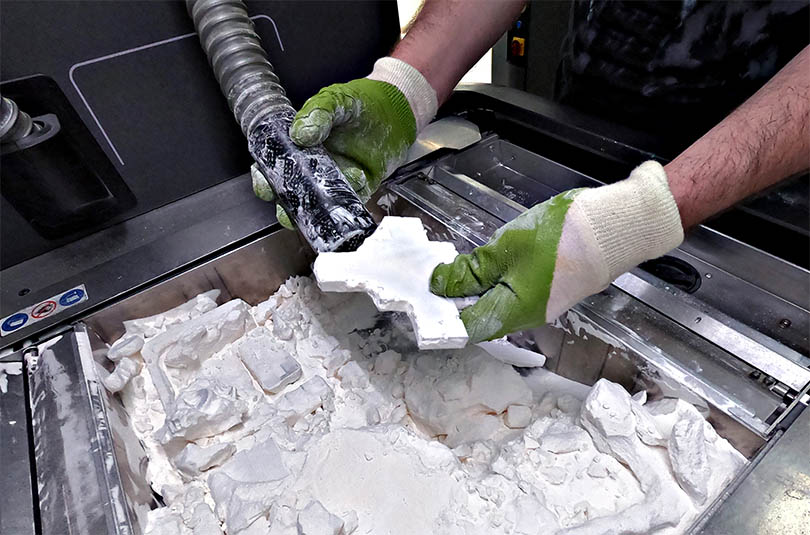
In powder-bed processes, the printed component is removed from a mass of unconsolidated material. The industrial vacuum cleaner can be used to: remove loose powder; clean cavities and internal geometries; collect material during brushing; remove residues from the depowdering station; and transfer the material to a collection system. Any reuse of the powder must be established by the production process. Collection does not automatically guarantee that the material retains the particle size, purity and characteristics required for another cycle.
Post-processing cleaning and finishing
After production, brushing, grinding, sanding, abrasive blasting, finishing and support-removal operations may be required. These processes can generate dust that differs from the original printing material. The industrial vacuum-cleaner configuration must therefore also consider the actual residues produced during post-processing.
Workstation and environmental cleaning
Powder can settle on floors, work surfaces, tools and equipment. Collection must be carried out using a machine compatible with the material. A generic industrial vacuum cleaner may be completely unsuitable where extremely fine, toxic, combustible or reactive powders are present.
Direct connection to industrial equipment
In certain industrial processes, the industrial vacuum cleaner can be connected directly to: depowdering stations; sieving systems; finishing cabinets; sanding tools; post-processing equipment; and localised extraction points. When the connection to the production line is permanent or the operating cycle is prolonged, a three-phase blower-powered industrial vacuum cleaner or a correctly sized dust collector should be considered.
Different printing technologies require different solutions
Filament printing (FDM/FFF): Filament processes do not normally use a powder bed, but they can generate ultrafine particles, fumes and solid residues during printing and subsequent finishing. An industrial vacuum cleaner can be used to collect plastic fragments, removed supports, sanding dust and residues generated during finishing. Fumes and airborne particles may require a localised capture system separate from the industrial vacuum cleaner used to collect deposited residues.
Resin printing (SLA/DLP): Liquid-resin systems generate residues and hazards that are completely different from powder-based printers. An industrial vacuum cleaner for dust must never be used to collect liquid resin, solvents or cleaning products without a specific compatibility assessment. Vacuum cleaning can instead be considered for collecting dust generated while sanding or finishing polymerised components.
Polymer powder-bed printing (SLS/MJF): Polymer powder-bed systems require careful collection of unconsolidated material remaining inside the chamber and around the components. The powder may be extremely fine, lightweight and prone to caking. Cartridge filtration, an adequate filter surface area, effective filter cleaning, optional absolute HEPA filtration and a collection system that limits dispersion are essential in this configuration.
Metal-powder printing (DMLS/SLM): Aluminium, titanium, magnesium and other alloy powders can present significant fire and explosion risks when finely divided and dispersed in air. The unit cannot be selected solely according to the power of the industrial vacuum cleaner. Chemical assessment of the powder, classification of the environment and a system compatible with the specific risk are required.
Correct classification of additive-manufacturing powders
To guide the selection towards the correct technological architecture, powders used in the AM sector must be mapped according to the following principal risk categories.
1. Non-combustible or non-explosive powders
A non-combustible powder must not automatically be considered harmless. Even non-explosive powders can present risks including operator inhalation, toxicity, irritation, heavy-metal content, respirable particles, product contamination and harmful effects on final print quality. Compact industrial vacuum cleaners with suitable filtration can be used for these applications, provided that compatibility is verified through the material safety data sheet and the process characteristics.
2. Combustible or potentially explosive powders
The requirement to use ATEX-certified machinery arises exclusively from the possibility that an explosive atmosphere may form, not simply from the electrical conductivity of the powder. Explosive atmospheres can be generated by combustible dust dispersed in air at a sufficient concentration and in the presence of an ignition source. The area must be correctly classified by the user, and the equipment must have a compatible category and marking. The selection must consider: combustibility; Kst value; maximum explosion pressure; minimum ignition energy (MIE); minimum cloud and layer ignition temperatures; resistivity; particle size; concentration; internal and external ATEX zones; dust group; and the maximum surface temperature of the machine.
3. Management of special reactive metal powders
Certain metal powders require dedicated systems in which the collected material is immersed in an inerting liquid. This solution must not be presented as a simple variation of a conventional ATEX industrial vacuum cleaner. It is a dedicated system that must be designed according to the powder, liquid used, material reactivity and the complex discharge and disposal procedures. Certain combustible and conductive powders may require a wet-collection system using immersion in an inerting liquid such as paraffin oil.
Key parameters to verify before configuration
Before recommending the final model, we assess the AM-process variables together: printing technology used; nature and safety of the material according to its MSDS; particle size and bulk density of the powder; volumes generated per cycle and operating frequency; need for recovery or sieving; risk parameters, including Kst, Pmax, MIE and conductivity; facility ATEX-zone classification; absolute HEPA-filtration requirements; discharge method, whether a rigid drum or Longopac®; available power supply, including single-phase, three-phase or compressed air; and the presence of hoods or direct extraction points.
Request a compatibility assessment for your 3D-printing system
Do you need to collect or capture powder from a 3D printer or additive-manufacturing process?
Describe the printing technology used, the specific material, the quantity of powder handled during each cycle, particle size, cleaning frequency, any ATEX classification of the area, whether the material must be recovered and the preferred collection system. Our technical department will assess the FEVI model, filtration class, filter-regeneration method and suitable accessories. Contact us to configure the ideal extraction system for your additive-manufacturing process.
Additive Manufacturing Solutions FAQ
Which industrial vacuum cleaner is required for a 3D printer?
Read more
There is no single answer because the selection depends on the technology and material. A filament printer, such as FDM, a liquid-resin printer, such as SLA, and an industrial powder-bed system, such as SLS or DMLS, require completely different construction and filtration solutions.
Is an ATEX-certified industrial vacuum cleaner always mandatory?
Read more
No. The requirement to use ATEX machinery applies only when the user’s risk assessment and environmental classification identify the possible formation of an explosive atmosphere. The choice does not depend solely on the presence of powder.
Is a non-combustible or non-explosive powder always harmless?
Read more
No. Even when it is not explosive, a powder may be respirable, irritating or toxic, or contain metals and chemicals that are hazardous to operators. Every material must be assessed carefully through its material safety data sheet and the process data.
Which FEVI model is suitable for a small laboratory printer?
Read more
For limited quantities of non-explosive powder, compact FEVI PULSE 11XM or 11XA models can be considered, together with FEVI 220 ICLEAN equipped with a rigid drum.
Which model is suitable for combustible powder in Zone 22?
Read more
FEVI BSL 120 BASIC ATEX 22 is the compact brushless model most directly associated with additive-manufacturing applications. Its marking must nevertheless be validated against the specific characteristics of the powder.
When is a pneumatic model from the FEVI S PN ATEX range preferable?
Read more
When a pneumatic configuration without onboard electric motors is preferred, or when the facility classification specifically requires a higher-category machine suitable for Zone 21 or Zone 1.
When is the Longopac® continuous-bag collection system useful?
Read more
It is particularly useful when fine or toxic powder must be collected, bagged and sealed while minimising direct operator contact during the removal of spent material.
Can collected polymer or metal powder be reused immediately?
Read more
Reuse is possible only when permitted by the production-process procedures and protocols, and after verifying that the purity, particle size and chemical and physical properties of the powder remain unchanged and compliant.
Does installing an absolute HEPA filter make the industrial vacuum cleaner safe under all conditions?
Read more
No. An absolute HEPA filter provides high particle-capture efficiency, but it is only one part of the configuration. ATEX marking, overall sealing integrity, collection system, grounding, equipotential bonding and the use of conductive accessories must also be assessed.
Can aluminium or titanium powder be collected using a conventional standard ATEX industrial vacuum cleaner?
Read more
Not automatically. Certain finely divided metal powders can be highly reactive and may, for example, generate hydrogen when exposed to moisture. They may require a special wet-collection system using immersion in an inerting liquid or other dedicated safety measures.
Are an industrial vacuum cleaner and a dust collector the same?
Read more
No. An industrial vacuum cleaner operates at high vacuum pressure to collect deposited material or convey it through a small-diameter flexible hose. A dust collector instead operates at high airflow and low vacuum pressure to move and filter large volumes of air, capturing lightweight airborne dust through hoods or extraction arms.

