Industrial dust collectors
FEVI industrial dust collectors are extraction and filtration systems designed to capture fine, lightweight and airborne dust close to where it is generated. They can be connected to hoods, extraction arms, workbenches and production machinery, with capture arrangements sized for the process.
The range includes dust collectors with manual filter cleaning, automatic AIRCLEAN systems and ATEX configurations . Selection requires an assessment of airflow, pressure losses, filtration, dust load and operating duty.
Read more
How an industrial dust collector works
A fan creates airflow through the capture point. Dust-laden air is conveyed to the filtration chamber, where the material is separated and collected. Performance also depends on hood design and position, ductwork and filter condition.
The DTX units presented here prioritise high airflow and localised capture. Collecting heavy debris or liquids instead requires a suitable industrial vacuum cleaner: dust collectors and high-vacuum machines serve different applications.
How to select a dust collector for your process
- Dust: composition, particle size, production rate, moisture and potential hazards or combustibility.
- Capture: hood dimensions, distance from the source, connected machinery and simultaneously active extraction points.
- Airflow and pressure losses: duct length, diameter, bends and filter resistance. Motor power alone is insufficient.
- Filtration: filter media, available surface area and any additional filtration stages required.
- Duty and collection: cycle duration, opportunities to stop for cleaning and emptying frequency.
Manual cleaning, automatic cleaning and ATEX configurations
Dust collectors with manual filter cleaning can be considered when the process allows scheduled stops. Dust collectors with automatic filter cleaning help manage filter loading during frequent operations and more demanding cycles.
For classified areas and combustible dust, selection requires verification of the marking and compatibility of the complete configuration. Explore FEVI ATEX dust collectors : an antistatic filter alone does not make a standard machine ATEX certified.
Compare FEVI dust collectors
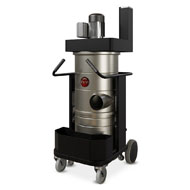
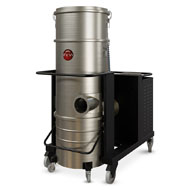
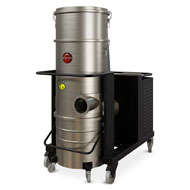
| Feature | FEVI DTX1500 BASIC | FEVI DTX2500 AIRCLEAN | FEVI DTX2500 AIRCLEAN ATEX 2-22 |
|---|---|---|---|
| Power | 2.2 kW | 4 kW | 4 kW |
| Power supply | 400 V three-phase | 400 V three-phase | 400 V three-phase |
| Declared airflow | 1,500 m³/h | 2,500 m³/h | 2,500 m³/h |
| Declared vacuum pressure | 34 mbar | 43 mbar | 43 mbar |
| Filter surface area | 30,000 cm² | 80,000 cm² | 80,000 cm² |
| Filter cleaning | Manual shaking | Automatic compressed-air cleaning | Automatic compressed-air cleaning |
| Collection | 50-litre drum | 100-litre drum | 100-litre drum |
On mobile devices, scroll the table horizontally. Data-sheet values do not replace sizing at the operating point: available airflow also depends on system pressure losses and filter condition.
- DTX1500 BASIC: for localised capture and processes compatible with manual filter cleaning.
- DTX2500 AIRCLEAN: for higher airflow requirements and automatic filter cleaning.
- DTX2500 AIRCLEAN ATEX 2-22: a configuration to assess against the classified area, dust and required marking.
Industrial dust collector FAQs
How is a dust collector sized?
Selection starts with the airflow required for capture and the pressure losses in the circuit. Information is needed on the hood, ductwork, simultaneous extraction points, material and operating duty. The number in the model name is not sufficient for selection.
Which filter should be used in a dust collector?
The dust collector filter should be selected according to the dust, concentration and operating conditions. Check the filter media, surface area, cleaning system and any additional stages, distinguishing filter specifications from the classification of the complete machine.
Does AIRCLEAN filter cleaning require compressed air?
AIRCLEAN uses compressed air to clean the filters. Whether an integrated circuit or an external supply is provided, together with the relevant pneumatic requirements, must be checked in the documentation for the supplied configuration.
When should an ATEX dust collector be considered?
When the environment or material requires an explosion-risk assessment. Selection must consider the area classification, dust properties and machine marking, without extending the suitability of one configuration to other models.
How much does an industrial dust collector cost?
The price depends on airflow, filtration, filter cleaning, collection, accessories and configuration. Comparable quotations should also include the required connections, any pneumatic requirements and operating conditions.
Request an assessment for your workstation
Tell FEVI about the process, dust, hood dimensions, ductwork and extraction points. Our ADARS method — listening, dialogue, analysis, research and solution — helps identify the configuration to assess for your process.