


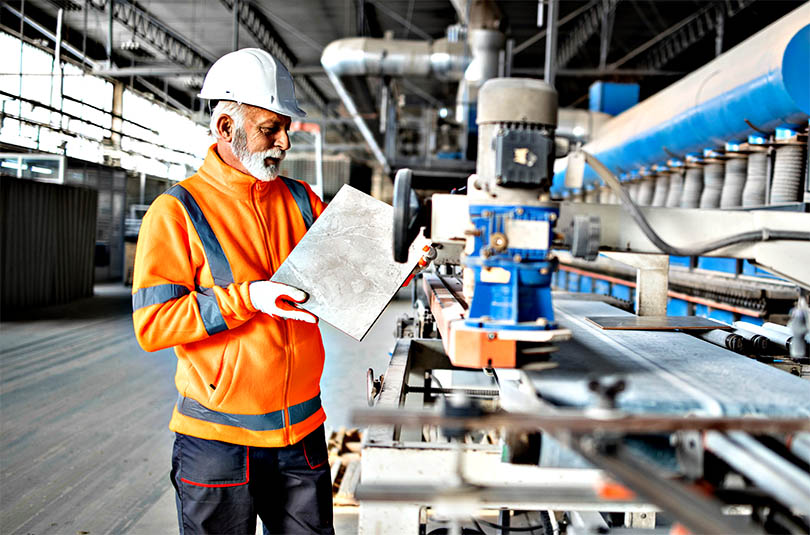
Solutions for collecting fine dust, clays, pigments, glaze residues, granules and materials generated during preparation, forming, finishing and maintenance.
Ceramic production includes a wide range of processes, from raw-material handling and body preparation to forming, drying, glazing, decoration, firing and product finishing. These operations can generate: clay dust; quartz and silica sand; feldspars;
Read more
alumina; oxides and pigments; glaze dust; plaster residues; granular material; ceramic fragments; grinding and rectification residues; dry ceramic bodies; sludge, slips and compatible liquids. Material characteristics change significantly from one stage to another. For this reason, there is no single industrial vacuum cleaner suitable for every ceramic process.
FEVI industrial vacuum cleaners and dust collectors suitable for the ceramic industry
The compatibility shown below is purely application-based. The final configuration must be validated by the FEVI technical department according to the specific nature of the dust and the facility risk map.
Criteria for selecting the ceramic extraction system
The selection and correct configuration of FEVI machines must be defined by analysing three fundamental areas of the ceramic department:
1. Chemical and Physical State
Assessment of dust composition, particle size, the abrasiveness of hard materials and whether the material is dry, damp or fluid, such as ceramic slips.
2. Operating Requirements
Calculation of hourly volumes, cycle duration, extraction distance and piping length and the need to prevent cross-contamination between colours.
3. Safety and Control Measures
Assessment of personnel exposure to respirable crystalline silica and verification of ATEX risks associated with the use of organic binders or additives.
Respirable crystalline silica in the ceramic industry
Crystalline silica may be present in quartz, sand and other raw materials used in the production of ceramics, bricks, sanitaryware and refractory products. When silica-containing materials are handled, cut, ground, sanded or processed dry, they can generate extremely fine respirable particles. Respirable crystalline silica can reach the deepest parts of the lungs and is associated with silicosis, lung cancer and other respiratory diseases. Ceramic activities requiring specific control measures may also include slip casting, dry finishing, kiln loading and unloading and the application of glazes and colours. However, it is incorrect to state that every type of ceramic dust consists exclusively of silica or always presents the same level of risk. The assessment must consider: raw-material composition; silica percentage and form; particle size; respirable fraction; airborne concentration; exposure duration; processing method; and the containment measures already installed. Some stages of ceramic production can generate dust containing respirable crystalline silica. The filtration and extraction system must be defined according to the actual composition of the material and the exposure assessment.
Prevention of airborne risks: Removing dust with conventional brooms or compressed air can resuspend large quantities of material. In areas containing cement, clay and silica-bearing materials, industrial vacuum cleaning, localised capture, closed systems and controlled collection procedures are preferable. Dry cleaning through manual sweeping can produce high concentrations of airborne dust.
Main process stages and capture solutions
Raw-material storage and handling
Clays, feldspars, quartz, sands and alumina are handled using bags, Big Bags, silos, hoppers, conveyor belts, screw conveyors, pneumatic systems or dosing equipment. Dust accumulations and clouds may form during bag opening, unloading and transfer. Deposited dust must be collected using an industrial vacuum cleaner, while clouds generated during unloading must be captured through a hood connected to a dust collector.
Ceramic-body preparation and forming
Preparation includes weighing, dosing, mixing, grinding, sieving, dry preparation, ceramic slips and pigments. During mould filling and the handling of unfired pieces, body dust and dry fragments can accumulate around the presses. An industrial vacuum cleaner cleans the area, but when a press continuously generates airborne dust, a fixed capture system connected to a dust collector is required.
Slip casting and plaster-mould processing
Slip-casting processes use liquid ceramic bodies and plaster moulds. Dust produced by the moulds must be assessed separately: plaster must not automatically be described as crystalline silica. Mould preparation, finishing and maintenance generate plaster dust, clay residues, dry material, ceramic slips and fragments. The choice of machine depends on the physical state of the material.
Dry finishing, deburring and sanding
The finishing of unfired or fired pieces generates large quantities of fine dust through deburring, sanding, rectification, abrasive finishing, drilling, cutting and edge finishing. In these applications, the dust should preferably be captured directly from the machine or tool. The correct configuration depends on the airflow required by the equipment, the available vacuum pressure, hose length and filtration capacity.
Glazing, decoration and colour changes
The application of glazes and pigments generates dust during weighing, mixing, spraying, dry application and booth cleaning. Cross-contamination between pigments can compromise the aesthetic quality of the product. Dedicated machines, separate drums, identified hoses, distinct accessories, closed containers or Longopac collection can be used to reduce colour transfer. Stainless steel facilitates cleaning and reduces the risk of internal coating detachment, but it does not prevent contamination on its own unless combined with rigorous procedures.
Kilns, rectification and post-firing finishing
Handling pieces and refractory supports releases ceramic dust and fragments. Before collection, it is necessary to verify that the material has cooled sufficiently: incandescent residues must never be collected. Rectification of fired tiles and sanitaryware generates extremely fine abrasive dust, requiring maximum attention to piping wear, cartridge protection and automatic cleaning systems.
Technology classification of FEVI systems
To respond precisely to the different factory requirements, FEVI organises its range into three separate families:
- Industrial Vacuum Cleaner (High Vacuum): Suitable for floor cleaning, collection from machinery, direct connection to portable tools and the removal of granular material and small heavy ceramic fragments during maintenance. It provides the vacuum pressure required to convey solids through small-diameter piping.
- Dust Collector (High Airflow / Low Vacuum): The specific architecture for managing airborne dust clouds. It is used on hoppers, mixers, presses, glazing booths, sanding hoods and dosing or packaging points requiring the evacuation of large volumes of air. It does not replace an industrial vacuum cleaner for collecting fragments or heavy waste from floors.
- Centralised Production System: Implemented when several departments or numerous extraction points must be served simultaneously over long distances. It uses a heavy-duty three-phase central vacuum unit connected to cyclonic separators, dedicated fixed piping networks, discharge hoppers and high-capacity systems such as Longopac or Big Bags with capacities of up to 1,000 litres to reduce the load on the filters.
Regulatory framework and ATEX explosion risk
The need for an ATEX configuration does not depend simply on the company belonging to the ceramic sector. Clays, quartz and many mineral materials must not automatically be described as explosive dust. However, the same facility may contain: organic additives, binders, polymer powders, fuels, metal dust or specific decorative products with combustible properties. Not all dust present in working environments is flammable, and the risk must be determined using actual substance data and the precise process conditions. When the assessment identifies a classified zone, our certified units can be considered: FEVI DTX 2500 AIRCLEAN ATEX for airborne dust, FEVI WT 753 BASIC ATEX for compatible dry materials and liquids, or the pneumatic FEVI S PN ATEX Venturi range when a Zone 21 configuration is required or electric motors are to be avoided. Marking, dust group, ignition temperature, external zone and internal classification must be rigorously verified for the specific application.
Quick configuration selection guide
Fine dust, clays and glazes
- Small workshop or localised work on moulds: FEVI PULSE 11XM, 11XA or FEVI 220 ICLEAN;
- Frequent mobile cleaning of medium volumes using single-phase power: FEVI 350 ICLEAN, or FEVI 221 PULSE for Longopac containment;
- Grinding machines and continuous industrial production lines: FEVI TDC30 ICLEAN, or FEVI HDC 355 ICLEAN for maximum distances and loads.
Airborne dust, fluids and ATEX areas
- Capturing airborne clouds from weighing, pigment or press operations: FEVI DTX 1500 BASIC for a single source or FEVI DTX 2500 AIRCLEAN;
- Collection of ceramic slips, fluid spillages and sludge: FEVI WM 375 BASIC for single-phase applications or FEVI WT 753 BASIC for three-phase applications;
- Areas classified due to the presence of organic additives or binders: FEVI DTX 2500 AIRCLEAN ATEX or the pneumatic FEVI S PN ATEX range;
- Large volumes of fragments or abrasive dust: Industrial in-line pre-separators, hoppers or Big Bag discharge systems with capacities of up to 1,000 litres must be integrated in coordination with the FEVI technical department.
Key parameters to verify before configuration
Before recommending the final model, we assess the ceramic-process variables together: type of product and specific stage of the production line; raw-material composition, including the presence of quartz or crystalline silica; nature of the waste, such as fine dust, granules, heavy fragments or fluid ceramic slips; particle size, abrasiveness and hourly quantities; temperature of pieces removed from the kilns; tendency to clog and frequency of colour changes; system parameters, including piping length, diameter, bends, simultaneous operation and daily operating hours; HEPA-filter or PTFE-cartridge requirements; discharge and containment system, including drum, Longopac or 1,000 L Big Bag; and any ATEX classification.
Request a ceramic-process sizing assessment
Do you need to collect dust or residues during a ceramic process?
Describe the type of product manufactured, the specific processing stage, dust composition and particle size, quantities generated per cycle, the exact prepared extraction point, the total piping run and length, daily operating-cycle duration, possible presence of coloured pigments, fluid glazes or ceramic slips and the ATEX classification of the environment. Our engineering department will assess whether to implement an industrial vacuum cleaner for fine dust with automatic cleaning, a high-airflow dust collector, a multi-purpose solids-and-liquids machine, a Longopac containment system or a customised centralised system. Contact us to configure the most suitable extraction system for your ceramic process.
Ceramic Industry Solutions FAQ
Which industrial vacuum cleaner should be used for ceramic dust?
Read more
For small operations and craft workshops, the compact FEVI PULSE 11XA or FEVI 220 ICLEAN models can be considered. For larger industrial quantities and intensive grinding departments, the higher-capacity FEVI 350 ICLEAN, TDC30 ICLEAN or HDC 355 ICLEAN models are considerably more suitable.
Does dust generated on ceramic production lines always contain crystalline silica?
Read more
Not necessarily in the same percentage or form. The presence of crystalline silica depends closely on the raw materials and body formulations used, such as quartz and sands. The actual chemical composition of the material must be analysed to map the risk correctly.
What is the fundamental difference between silicon and silica in the industrial sector?
Read more
Silicon is a pure chemical element in the periodic table. In the ceramic sector, the occupational respiratory risk is associated with respirable crystalline silica, or silicon dioxide, a microscopic fraction present in mineral dust that can penetrate deep into the pulmonary alveoli.
Which type of industrial vacuum cleaner should be connected to a tile or sanitaryware grinding machine?
Read more
For prolonged and continuous machine-mounted use, the three-phase blower of the FEVI TDC30 ICLEAN model is preferable. Where piping networks are very long, pressure losses are high and quantities of fine abrasive dust are substantial, the higher-capacity FEVI HDC 355 ICLEAN is more suitable.
Which FEVI system should be used to capture ceramic dust suspended in the air?
Read more
In this scenario, a high-airflow industrial dust collector must be connected directly to hoods, articulated extraction arms or containment booths. The compact FEVI DTX 1500 BASIC is suitable for individual workstations, while FEVI DTX 2500 AIRCLEAN is designed for more demanding processes.
Is the installation of an absolute HEPA filter always mandatory in the ceramic industry?
Read more
No. The correct filtration class must be defined according to the actual particle size, chemical composition of the dust, personnel-exposure assessment and the specific system configuration, without automatically applying a HEPA stage.
Why are PTFE-membrane cartridges particularly useful in this sector?
Read more
Le particelle microscopiche tendono ad aderire e compattarsi sui tessuti filtranti per l'effetto combinato di umidità e cariche elettrostatiche. La membrana in PTFE riduce la porosità del filtro, limitando la penetrazione profonda e facilitando il distacco della polvere durante i cicli di pulizia.
Which extraction architecture should be used to manage pigments and colours?
Approfondisci
To prevent cross-contamination and simplify colour changes, a machine with a Longopac system, separate interchangeable drums and dedicated conductive accessories is ideal. A dust collector is instead required to capture airborne dust generated during weighing or spraying operations.
Does a stainless-steel structure completely eliminate the risk of colour cross-contamination?
Read more
Not on its own. A stainless-steel finish considerably simplifies internal washing and eliminates the risk of protective paint flakes detaching, but it must be integrated into a strict protocol that includes cleaning or separating hoses, filters, containers and accessories.
Which industrial vacuum cleaner should be used to collect liquid ceramic slips or damp residues?
Read more
The multi-purpose solids-and-liquids models FEVI WM 375 BASIC, single-phase, FEVI WT 753 BASIC, three-phase with central inlet and deflector, or FEVI HDC W 155 BASIC can be considered. The viscosity, density, abrasiveness and chemical composition of the ceramic slips must be verified in advance.
Can hot residues or refractory materials be collected directly from kilns?
Read more
No, not with a standard machine when the material temperature is incompatible with the thermal resistance of flexible hoses, seals and filters. The residues must be allowed to cool on the floor, or a special high-temperature configuration must be requested.
Does the ceramic industry always require ATEX-certified machinery?
Read more
No. An ATEX configuration is not automatic because pure minerals such as clay and quartz are not explosive. Safety marking becomes necessary only when the risk assessment identifies flammable organic additives, polymer binders, metal dust or combustible decorative products.

