


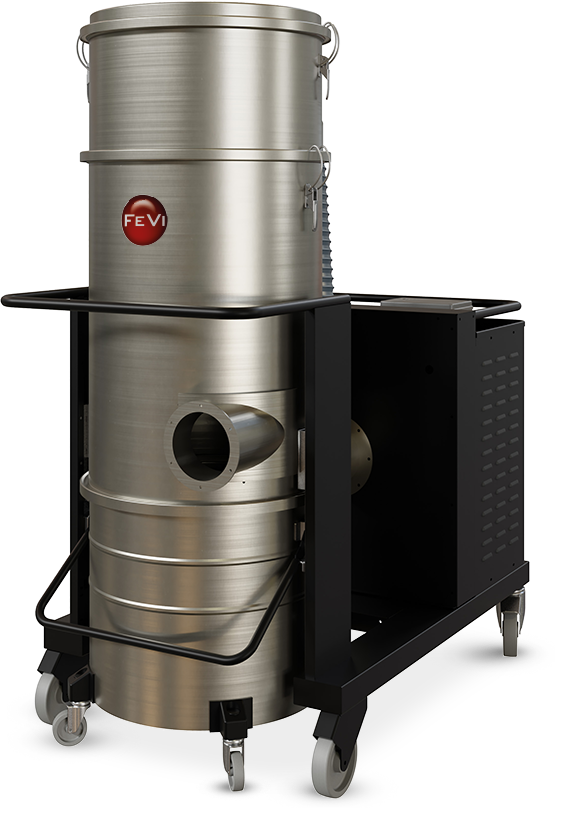


The FEVI DTX 2500 AIRCLEAN industrial dust collector is designed to capture dust-laden air before the dust can spread throughout the working environment.
It can be connected to: extraction hoods; articulated extraction arms; workbenches; machine enclosures; production lines; hoppers; dosing stations; sanding systems; and machinery that generates lightweight and airborne dust.
The capture inlet must be positioned as close as possible to the source. Airflow, piping diameter, route length and number of bends must be carefully sized according to the process.
Ideal Application: Localized source capture and extraction of fine, light, and volatile airborne dust paired with extraction hoods, articulated arms, downdraft benches, or sanding lines.
Key Advantages: Patented solenoid system for the sequential isolation of the cartridges, combined with the AIRCLEAN automatic compressed air pulse-jet cleaning technology via an integrated circuit.
Model Selection: Heavy-duty 260 kg industrial unit featuring a 4 kW three-phase (400 V) centrifugal fan, ideal if you require a constant high nominal airflow performance (2500 m³/h).
Not Suitable For: Specific machine engineered for airborne dust at low vacuum pressure (43 mBar). It is not suitable for floor collection of heavy solids, metal swarf, or standard ATEX areas.
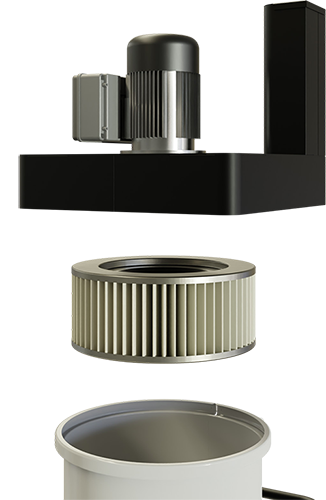
Total Filtration: MULTI-filter assembly consisting of 5 conductive Class M cartridges developing an extended surface area of 80,000 cm² with electrostatic dissipation properties.
Acoustic Engineering: Fully enclosed and paneled fan housing structure combined with an integrated standard exhaust silencer to ensure maximum noise reduction in the plant.
Product features
- 4 kW centrifugal fan for high airflow
- The configuration is suitable for prolonged industrial operation with scheduled maintenance
- Integrated acoustic silencer to reduce airflow noise
- Option to install an articulated extraction arm
- Dust collector for extracting dust generated during production processes
- Dust collector for extracting very fine and airborne dust
- Patented solenoid system for temporarily closing and isolating the cartridge during cleaning to improve efficiency
- MULTI-filter system consisting of No. 5 conductive Class M filter cartridges with a total surface area of 80,000 cm²
- Dust collector with automatic compressed-air filter cleaning that maintains extraction through the cartridges not involved in the cleaning cycle
- No dedicated external pneumatic connections are required for filter cleaning
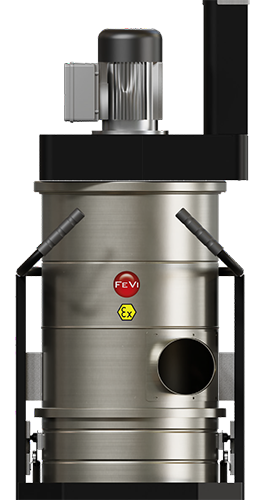
- Type E 150 mm tangential air inlet
- The internal protection installed in front of the filters helps limit the impact of abrasive particles and improve preliminary separation
- Panelled fan enclosure designed to reduce noise and simplify external cleaning of the machine
- Highly customisable model according to the specific requirements of the application
- Option to manufacture the machine or parts of the structure entirely from stainless steel
Who it is recommended for
FEVI DTX 2500 AIRCLEAN can be considered for: manufacturing industries; production departments; machining operations; woodworking; plastics processing; the paper industry; mineral-material processing; sanding and grinding; surface preparation; material-transfer stations; mixing activities; small centralised systems; and machinery that generates dust during its operating cycle. Suitability must be verified by considering the particle size, concentration, temperature, humidity, abrasiveness, hazardous nature and potential combustibility of the dust.
Discover the main application sectors
- Mechanical workshops and structured turning departments;
- Surface finishing, grinding and sanding departments;
- Chemical, pharmaceutical and food industries in material-transfer areas;
- Joinery workshops and facilities processing lightweight wood materials;
- Plastic extrusion and moulding lines;
- Paint-production facilities, cement plants and volatile mineral-material dosing operations;
- Craft workstations for component assembly or finishing.
Main applications
Permanent connection to production machinery
FEVI DTX 2500 AIRCLEAN is particularly suitable when dust is generated as part of a machine’s normal operating cycle. The airflow of 2500 m³/h makes it possible to manage more demanding collection points than compact models. The automatic cleaning system significantly reduces the shutdowns required for manual cartridge regeneration. Before connection, we assess: the airflow required by the machine, connection diameter, piping length, number of bends, pressure loss, quantity of dust, cycle duration and simultaneous operation of multiple points.
Wide-area capture through a hood
The dust collector can be connected to a hood installed above, beside or around the process. An effective hood must capture the contaminated airflow before the dust spreads throughout the environment. The size and position of the hood directly affect the required airflow: a hood that is too open or positioned too far from the source may require more air than the system can provide.
Connection to an extraction arm
An articulated extraction arm can be installed to position the capture inlet close to the exact emission point. Sizing must consider: arm diameter, length, number of joints, distance from the source, inlet position, air velocity, pressure loss and air movement within the environment. The extraction arm is an accessory that must be configured according to the process.
Sanding, grinding and powder transfer
The model can be considered for workstations that generate significant quantities of fine dust during sanding, grinding, finishing, surface preparation, abrasive processes or composite-material processing, as well as during the transfer and dosing of powdered materials where localised emissions are generated. The five cartridges and automatic compressed-air cleaning make this model more suitable than a BASIC configuration with a star filter and manual shaking. When the material is combustible or toxic, the filtration system, environmental classification and maintenance procedures must be carefully assessed.
Why choose FEVI DTX 2500 AIRCLEAN
Airflow of 2500 m³/h: The high airflow makes it possible to move large volumes of air through hoods, extraction arms and machine connections. This is particularly important when the dust is lightweight and tends to remain suspended in the working environment.
4 kW centrifugal fan: The centrifugal fan is powered at 400 V and provides a vacuum pressure of 43 mBar. The machine prioritises airflow rather than material-conveying force and must therefore be presented as a high-airflow dust collector rather than an industrial vacuum cleaner for heavy swarf or compact materials.
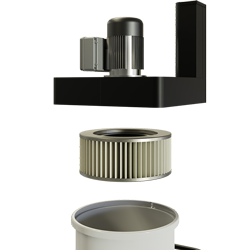
Five conductive Class M filter cartridges: The MULTI-filter system includes five cartridges with a total filter surface area of 80,000 cm². Dividing the filtration across several units allows the cartridges to be cleaned sequentially while the other filters remain operational. The cartridges are identified as conductive Class M filters. This configuration supports dust management and charge dissipation, but does not automatically make the dust collector suitable for ATEX environments or every hazardous type of dust.
Automatic AIRCLEAN system: It uses compressed-air pulses to help release dust accumulated on the cartridges. The automatic cycle reduces the need for manual intervention and allows extraction to remain active during cleaning. The configuration described does not require dedicated external connections for filter cleaning: the commercial documentation must clearly explain how the compressed air is generated or managed, avoiding the need for the customer to infer the system configuration.
Sequential cartridge isolation and solenoid system: The system uses a solenoid device to temporarily exclude the cartridge undergoing cleaning. This allows the pulse to act on the selected filter while the other cartridges continue to provide extraction. Regeneration takes place sequentially across the five cartridges: the filter concerned is temporarily isolated while the remaining cartridges maintain the airflow. This wording is more precise than the generic claim “without stopping the machine”.
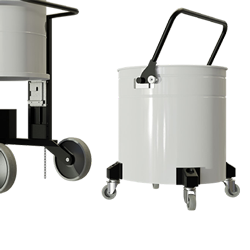
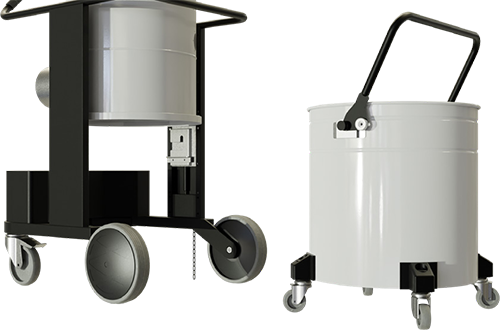
150 mm tangential inlet and 100-litre drum: The 150 mm Type E inlet introduces the airflow laterally into the 560 mm filter chamber. The rotating movement helps to: separate some of the particles before they reach the filters, reduce direct impact on the cartridges, promote the fall of material into the drum and distribute the airflow throughout the chamber. The separated material is collected in a 100-litre drum equipped with a quick-release system that allows the container to be removed without dismantling the filter chamber.
Optional HEPA filter and customisation: The secondary HEPA filter is available as an option and is not included in the standard configuration. Its integration must be assessed by considering particle size, hazardous nature, dust concentration, required air quality and additional pressure loss. The model can be configured according to the application and can also be manufactured with a stainless-steel structure. Customisations must be defined during the design stage, specifying which parts are to be manufactured from stainless steel.
How the AIRCLEAN system works
The dust collector’s operating cycle can be divided into five functional stages:
1. Extraction: The centrifugal fan draws dust-laden air through the hood, extraction arm or machine connected to the system.
2. Preliminary separation: The airflow enters through the 150 mm tangential inlet. The cyclonic movement causes the heavier particles to lose velocity and fall towards the collection drum.
3. Filtration: The air passes through the five conductive Class M cartridges, which capture and retain the fine dust.
4. Sequential automatic cleaning: The system temporarily isolates one cartridge through the solenoid and activates the compressed-air cleaning pulse. The released dust falls into the lower 100-litre container.
5. Filter reactivation: The cleaned cartridge immediately returns to operation and the cycle continues sequentially across the remaining units. During this sequence, the cartridges not involved in cleaning continue to maintain a stable airflow.
Technical Comparisons and Range Configurations
The DTX 2500 dust-collection family offers different approaches to cartridge-filter cleaning technology to address different types of filter clogging.
1. Difference between the DTX 2500 family configurations: AIRCLEAN vs ICLEAN
The configurations share: a 4 kW fan; airflow of 2500 m³/h; vacuum pressure of 43 mBar; five cartridges; filter surface area of 80,000 cm²; 150 mm inlet; 100-litre drum; and optional HEPA filter. The main difference concerns the cleaning technology.
| Model Version | Cleaning Mechanism and Technology | Main Application |
|---|---|---|
| DTX 2500 AIRCLEAN | Uses targeted compressed-air pulses to clean the cartridges sequentially. | Suitable when dust adheres to the filter surface and requires pneumatic impact to promote its release. |
| DTX 2500 ICLEAN | Uses the automatic mechanical ICLEAN system | Regeneration is performed through the proven automatic system dedicated to the cartridges, without relying solely on compressed-air cleaning. |
| DTX 2500 ICLEAN + AIR | Combines mechanical ICLEAN technology with compressed-air pulses. | The most complete and advanced configuration in the range, designed for particularly fine, agglomerating or difficult-to-release dust. This version uses automatic cleaning through micro-vibrations and compressed air. |
2. Difference compared with the DTX 2500 BASIC version
| Model Configuration | Filtration System and Management | Recommended Operating Scenario |
|---|---|---|
| DTX 2500 BASIC | Single conventional star filter with a manual shaking system and optional semi-automatic cleaning. Simpler configuration. | Suitable only when the dust load generated by the process is limited and periodic manual cleaning is compatible with process shutdowns. |
| DTX 2500 AIRCLEAN | Five cartridges with a total surface area of 80,000 cm² and automatic sequential compressed-air cleaning without stopping general extraction. | More suitable for fine dust, requiring less manual intervention and providing an ideal configuration for continuous connection to production machinery. |
3. Difference compared with the compact DTX 1500 model
The FEVI DTX 2500 AIRCLEAN provides: higher airflow, a larger filter surface area, five cartridges, a 100-litre drum, a 150 mm inlet, greater capacity for managing complex production processes, and larger overall dimensions and weight. A DTX 1500 is more suitable for individual workstations, smaller hoods and less demanding connections. Selection must be based on the calculated airflow requirement and system pressure losses.
4. Fundamental difference compared with an industrial vacuum cleaner
The FEVI DTX 2500 AIRCLEAN dust collector provides high airflow and limited vacuum pressure. An industrial vacuum cleaner generally generates higher vacuum pressure and is more suitable for collecting material through narrow hoses or nozzles placed directly against a surface. In summary: airborne dust captured through a hood or extraction arm requires a dust collector; floor cleaning and the transport of heavy solids, residues and metal swarf require an industrial vacuum cleaner.
Selection guide: When to configure this model
Choose FEVI DTX 2500 AIRCLEAN when:
- You need to capture fine and lightweight airborne dust before it spreads throughout the department;
- The production process generates dust frequently or continuously;
- You want to connect the dust collector permanently to production machinery;
- You require exactly 2500 m³/h of airflow and have a 400 V three-phase power supply available;
- An operating vacuum pressure of 43 mBar is suitable and you require automatic compressed-air cleaning;
- You want to reduce manual filter maintenance and the 100-litre drum is suitable for the material load;
- Five cartridges and a filter surface area of 80,000 cm² are appropriate for the process and the machine will not operate in an ATEX-classified zone.
Consider another FEVI model when:
- DTX 2500 ICLEAN: When you prefer the efficiency of the automatic mechanical ICLEAN system rather than relying solely on pneumatic cleaning;
- DTX 2500 ICLEAN + AIR: When the dust is extremely fine, highly adhesive or electrostatic and you want to combine both cleaning technologies;
- DTX 2500 BASIC: When the dust load is limited and manual cleaning of the star filter is compatible with the operating cycle;
- DTX 1500: When lower airflow, smaller overall dimensions and reduced drum capacity are sufficient;
- ATEX dust collector: Required when the dust is combustible or the environment is classified as having an explosion risk;
- Industrial vacuum cleaner: When heavy solids, coarse debris or floor cleaning must be handled;
- Centralised system: When several production machines must be connected simultaneously to a shared piping network.
Configuration recommendations and system parameters
Before selecting the system, we assess together all its chemical, physical and geometric factors: type of dust; particle size; quantity produced; behaviour on the filter; tendency to clog; temperature; humidity; abrasiveness; hazardous nature; potential combustibility; airflow required by the machine; hood dimensions; piping diameter; route length; number of bends; number of connected points; operating hours; need for an absolute HEPA filter; need for a stainless-steel structure; and any ATEX classification.
Request technical sizing for your process
Do you need to connect a dust collector to a machine that generates fine dust?
Describe the process in detail, together with the chemical and physical characteristics of the dust, required airflow, prepared connection diameter, total piping length, cycle duration and number of points to be extracted simultaneously. We will assess whether FEVI DTX 2500 AIRCLEAN is the appropriate configuration or whether an ICLEAN, combined, ATEX or different-airflow version would be preferable. Contact us to size the dust collector according to your production process.
Technical Data
| Material to be extracted / captured | Fine and lightweight airborne dust |
| Motor / Unit technology | Three-phase centrifugal fan |
| Rated motor power | 4 kW |
| Voltage / Power supply | 400 V |
| Mains frequency | 50 Hz |
| Current draw | 10 A |
| Nominal airflow | 2500 m3/h |
| Operating vacuum pressure | 43 mBar |
| Inlet | Type E tangential Ø 150 mm |
| Overall dimensions | 146 x 84 x h175 cm |
| Total empty weight | 260 kg |
| Residue collection system | Removable drum with quick-release system |
| Collection-container capacity | 100 L |
| Filter chamber diameter | Ø 560 mm |
| Filter configuration | MULTI-filter system with No. 5 filter cartridges |
| Filter properties and class | Conductive Class M with charge-dissipation properties |
| Total filter surface area | 80.000 cm2 |
| Filter-cleaning technology | Automatic sequential compressed-air pulses controlled by solenoid |
| Internal pneumatic circuit | Integrated circuit (No dedicated external compressor connection required) |
| Secondary absolute filtration | Optional (HEPA filter not supplied as standard) |
| Enclosure and acoustic insulation | Panelled fan enclosure with integrated silencer |
| Structural customisation | Available to order (Full or partial stainless-steel construction) |
FEVI DTX 2500 AIRCLEAN FAQ
What is FEVI DTX 2500 AIRCLEAN?
Read the answer
It is a high-airflow three-phase industrial dust collector designed to capture and separate fine, lightweight and airborne dust before it spreads throughout the working environment.
What is the power rating of the ventilation unit?
Read the answer
It uses a 4 kW three-phase industrial centrifugal fan.
What is the stated nominal airflow?
Read the answer
The stated airflow is 2500 m³/h, optimised for moving large volumes of contaminated air.
What vacuum pressure does it provide?
Read the answer
It provides a vacuum pressure of 43 mBar. As it prioritises airflow, the machine operates as a dust collector rather than an industrial vacuum cleaner for compact or heavy solids.
What type of electrical power supply does it require?
Read the answer
The unit requires a 400 V three-phase industrial power supply.
How many filters does it use and what is their total surface area?
Read the answer
The MULTI-filter system uses five filter cartridges, providing a total filter surface area of 80,000 cm².
What filtration class and properties do the cartridges have?
Read the answer
The cartridges are Class M certified and have conductive properties that support the management of electrostatic charges.
How are the five cartridges cleaned?
Read the answer
Cleaning is performed fully automatically through timed compressed-air pulses directed onto the filters.
Is the airflow completely interrupted during the cleaning cycle?
Read the answer
No. Extraction does not stop completely. The solenoid device temporarily isolates and cleans the individual cartridge concerned, while the other four continue to maintain the airflow.
Does the system require an external pneumatic connection or compressor?
Read the answer
The configuration described does not require dedicated external pneumatic connections for cleaning because it independently manages the required air through an integrated circuit. The final documentation will specify the circuit details.
Is the secondary absolute HEPA filtration stage included as standard?
Read the answer
No. The secondary HEPA filtration stage is an optional accessory that must be assessed according to the hazardous nature of the material and the required air quality.
What is the capacity of the dust-collection drum?
Read the answer
The lower drum has a volumetric capacity of 100 litres and is equipped with a quick-release system that avoids dismantling the filter chamber.
Can the machine be combined with an articulated extraction arm?
Read the answer
Yes. The unit can be configured and connected to an articulated arm after calculating the airflow, diameter and pressure losses of the piping.
Is this dust collector suitable for heavy metal swarf or construction debris?
Read the answer
No. It is not the correct model for these materials. The machine prioritises airflow for airborne and volatile dust; heavy residues or floor cleaning require a high-vacuum industrial vacuum cleaner.
Is it suitable for very fine or difficult dust?
Read the answer
Yes, subject to verification of chemical and physical compatibility. For fine dust with an extremely high tendency to clog the filters, we recommend the combined **ICLEAN + AIR** version, which uses micro-vibrations and compressed air.
Can the standard version operate in ATEX-classified environments?
Read the answer
The standard version must not be used in classified areas. Operation in zones with an explosion risk requires the dedicated **ATEX** configuration.
Is the machine suitable for prolonged industrial shifts and operation?
Read the answer
Yes. The centrifugal fan and AIRCLEAN system automation support prolonged and continuous industrial use, provided that the required routine maintenance is carried out.

