


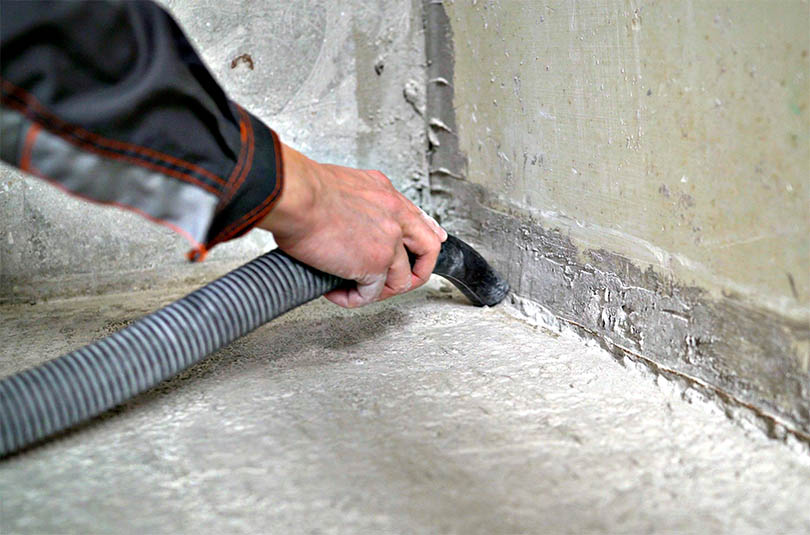
Industrial vacuum solutions for collecting fine dust, clinker, solid residues, and airborne materials generated during cement production, material handling, plant maintenance, and packaging processes.
Cement production generates dust during many stages of the process: raw-material handling, crushing, grinding, conveying, firing, clinker cooling, storage and bagging. Dust can accumulate continuously on machinery, beneath conveyor belts, inside bucket elevators, close to mills,
Read more
in loading areas, beneath hoppers, in packaging departments, on floors and structures and inside mechanical-maintenance areas. Effective and safe plant management requires different systems to be selected according to the specific point of intervention within the facility.
FEvi industrial vacuum cleaners and dust collectors suitable for the cement industry
The compatibility shown below is application-based. The final configuration must be validated by the FEVI technical department according to the specific nature of the dust and the facility risk map.
Criteria for selecting the extraction-system architecture
The selection and correct configuration of FEVI machines must be defined by analysing three fundamental areas of the cement plant:
1. Residue Properties
Assessment of the dust particle size, including extremely fine and clogging dust, clinker abrasiveness and the large quantities generated during each hour of operation.
2. System Configuration
Calculation of horizontal and vertical piping runs, pressure losses, operating-cycle duration and the available electrical power supply.
3. Safety and Zone Risks
Assessment of occupational exposure to respirable crystalline silica and verification of the ATEX explosion risk associated with the use of organic fuels.
Why cement dust is difficult to manage
Extremely fine particle size and filter clogging: Cement dust consists of microscopic particles capable of rapidly reaching the filter and penetrating every part of the machine. A generic filter with a limited surface area quickly becomes clogged, causing reduced airflow, loss of extraction performance, an increase in manual maintenance, continuous interruptions to work and greater thermal and mechanical stress on the vacuum unit. Large-surface-area filter cartridges are essential for frequent applications.
Strong tendency to cake on the filter media: The dust tends to adhere to the filter surface, particularly in the presence of residual moisture or temperature fluctuations. When the material compacts on the filter, simple manual cleaning is insufficient and frequent cycle shutdowns are required. Cartridges with a PTFE membrane promote effective dust release and limit deep penetration into the filter material, while automatic cleaning systems help maintain stable airflow throughout the operating cycle.
High accumulation volumes: In a cement plant, the problem does not concern only the fineness of the dust. Tonnes of material can accumulate near conveyor belts, elevators, hoppers and loading points, rapidly filling conventional containers. Under these conditions, cyclonic pre-separators, hoppers, tipping containers, Longopac discharge systems or industrial separators for Big Bags with capacities of up to 1,000 litres must be integrated, significantly reducing the load on the primary filtration system.
Health risks and controlled containment
Dust generated in cement plants can irritate the eyes, skin and respiratory system. Depending on the raw materials and process, it may also contain respirable crystalline silica. The configuration of the industrial vacuum cleaner and filtration system must be defined according to the risk assessment and the characteristics of the dust. Crystalline silica is present in sand, stone, concrete and mortar. The respirable fraction can reach the deepest parts of the lungs, and prolonged exposure is associated with silicosis and other serious respiratory diseases. For this reason, removal using brooms or compressed air is strongly discouraged, as it resuspends large quantities of material and produces high concentrations of airborne dust. Closed industrial vacuum systems or localised capture systems must be used.
Main applications within a cement plant
Receiving and unloading raw materials
During the unloading of limestone, clay, sand and corrective materials, material falls, airborne dispersion and accumulation beneath hoppers and conveyor belts can occur. Material already deposited on the floor requires a high-vacuum industrial vacuum cleaner with adequate capacity. The airborne cloud generated during unloading instead requires a containment hood connected to a high-airflow dust collector.
Crushing, grinding and milling
Crushers and mills continuously generate extremely fine dust and residues with different particle sizes. Extraction is used for cleaning machinery, removing deposited material, periodic maintenance, cleaning surrounding areas and providing localised connection to emission points. When dust production continuously accompanies the process, a fixed capture system is preferable.
Conveyor belts and bucket elevators
Spillages accumulate beneath conveyor belts, around rollers, at transfer points, close to tensioning systems and in drop zones. These residues can include fine dust, granules and heavy fragments. In bucket elevators, material settles at the bottom or escapes from loading points. The hose diameter and FEVI vacuum pressure are sized to clean these lower areas without generating further dispersion, using pre-separators to manage large volumes.
Clinker cooling and bagging
Clinker generates highly abrasive dust and fragments. Temperature, particle size, abrasiveness and bulk density must be carefully assessed before selecting hoses and accessories. Materials that are still hot or incandescent must never be collected using a standard machine. On bagging and packaging lines, a dust collector connected to a hood captures airborne dust above filling and weighing outlets, while an industrial vacuum cleaner is used to clean the machinery and floors.
Selecting the technology: Industrial Vacuum Cleaner, Dust Collector or Centralised System
To operate at maximum efficiency, FEVI divides its industrial solutions into three separate categories:
- High-Vacuum Industrial Vacuum Cleaner: This technology is suitable for cleaning floors, collecting substantial accumulations beneath conveyor belts and elevators, removing heavy granular material and carrying out plant-maintenance operations. It operates efficiently with narrow piping and transports solids over linear distances.
- High-Airflow Dust Collector: This architecture is specifically designed to capture airborne and volatile dust. It is permanently connected to hoods, extraction arms, hoppers, transfer points, filling outlets and automatic bagging lines that require large volumes of air to be evacuated.
- Centralised Plant System: This is the ideal solution when several departments must be served simultaneously over long distances, when several operators use the connection points at the same time or when material quantities are extremely high. The system uses a single three-phase central vacuum unit connected to fixed piping networks, separators, discharge hoppers and centralised Big Bag collection.
ATEX area classification in cement plants
Cement dust in its pure state is not generally classified as combustible dust. An ATEX risk may instead be present in departments that use or store: coal, lignite, pet coke, alternative fuels, biomass, shredded plastic materials or other combustible carbon-based or organic products. Coal, lignite and petroleum coke are among the materials capable of forming combustible dust clouds when dispersed in air. An ATEX industrial vacuum cleaner is not automatically required for ordinary cement dust. It must be assessed in departments where coal, pet coke, alternative fuels or other combustible substances may form explosive atmospheres. In these areas, the marking of the selected unit, whether the FEVI DTX 2500 AIRCLEAN ATEX centrifugal dust collector or the FEVI S PN ATEX pneumatic range, must be rigorously compared with the zone classification, dust group and ignition temperature of the actual material.
Quick system-selection guide
Fine-dust collection and maintenance
- Localised work on external components or electrical panels: FEVI PULSE 11XM, 11XA or FEVI 220 ICLEAN;
- Professional mobile cleaning of medium volumes: FEVI 350 ICLEAN, or FEVI 221 PULSE for Longopac discharge;
- Continuous use or fixed piping networks: FEVI TDC30 ICLEAN, or FEVI HDC 355 ICLEAN for maximum distances.
Heavy solids, airborne dust and ATEX areas
- Accumulations of clinker, granules and heavy waste: FEVI HDC 155 BASIC family combined with abrasion-resistant piping;
- Capturing dust clouds from hoppers or bagging machines: FEVI DTX 1500 BASIC for a single source or FEVI DTX 2500 AIRCLEAN;
- Coal, pet-coke or biomass storage departments: FEVI DTX 2500 AIRCLEAN ATEX for airborne dust or FEVI S PN ATEX for localised cleaning;
- Large quantities of material generated in line: Custom-designed cyclonic pre-separators, tipping hoppers or Big Bag discharge systems with capacities of up to 1,000 litres must be integrated by the FEVI technical department.
Key parameters to verify before configuration
Before recommending the final model, we assess the cement-plant variables together: the exact point in the production process; nature of the residue, including cement, raw meal, clinker or carbon-based fuel; particle size, density and moisture content of the dust; operating temperatures and solid abrasiveness; presence of respirable crystalline silica and tendency to clog; ATEX zone classification and flammable substances used; line parameters, including hose length and diameter, bends and simultaneity factor; and the required discharge system, including drum, Longopac, pre-separator or 1,000 L Big Bag.
Request technical sizing for your cement plant
Do you need to collect dust or residues inside a cement plant?
Describe the specific process stage in detail, such as grinding, conveying or bagging, together with the exact type of material to be collected, dust particle size, hourly quantity produced, total piping length and distance from the collection point, prepared piping diameter, daily operating hours, any ATEX classification of the departments and the preferred discharge system. Our engineering team will assess whether to implement a mobile high-vacuum industrial vacuum cleaner, a heavy-duty three-phase blower, a process dust collector, an in-line pre-separator or a complete customised centralised system. Contact us to configure the most suitable solution for your plant.
Cement Plant Solutions FAQ
Which industrial vacuum cleaner should be used for cement dust?
Read more
For small quantities and localised maintenance, the compact FEVI 220 ICLEAN or FEVI PULSE 11XA models can be considered. When volumes increase and the machine is used over long industrial shifts, the three-phase FEVI 350 ICLEAN, TDC30 ICLEAN or HDC 355 ICLEAN models are more suitable.
Why does cement dust clog conventional filters so quickly?
Read more
Because of its extremely fine particle size and strong tendency to adhere to and compact on the filter surface in the presence of moisture, drastically reducing airflow. PTFE-membrane cartridges and continuous automatic cleaning systems are essential for addressing this issue.
Is an absolute HEPA filter always mandatory in cement plants?
Read more
No. The filtration stage must be selected according to the type of dust, occupational-exposure assessment and intended operating method. In applications involving respirable crystalline silica, a HEPA filter provides a useful second level of protection, but its suitability must be assessed case by case.
What is the functional difference between the ICLEAN and AIRCLEAN cleaning systems?
Read more
The ICLEAN system performs timed automatic mechanical cleaning directly on the industrial vacuum cleaner’s filter cartridges. The AIRCLEAN system instead uses powerful sequential compressed-air pulses inside the dust collector filters. The selection depends on the behaviour of the dust and the type of machine.
Which extraction system should be installed beneath conveyor belts?
Read more
Removing material deposited on the floor, spillages and heavy fragments requires the conveying force of a high-vacuum industrial vacuum cleaner. When very large quantities of material are present, installing a cyclonic pre-separator to protect the filters is strongly recommended.
Which system is suitable for controlling dust from a hopper?
Read more
A high-airflow dust collector connected directly to a flanged hood or the hopper emission point is suitable for capturing airborne and volatile dust generated while material is falling.
Can dust be discharged and collected directly in a Big Bag?
Read more
Yes. To manage large quantities of material, an industrial separator with a coordinated discharge system for Big Bags with capacities of up to 1,000 litres can be integrated into the line. The system is configured according to the bulk density of the residue and the adopted conveying method.
Is cement classified as explosive dust under ATEX regulations?
Read more
No. Pure cement in its natural state is not classified as combustible dust. Within cement plants, the ATEX risk is concentrated in departments where fuels such as coal, lignite, pet coke, biomass and shredded plastic materials are stored, ground or transferred.
When does the use of an ATEX-certified machine become mandatory?
Read more
An ATEX industrial vacuum cleaner is required only when the facility risk assessment identifies and classifies an area as having a potentially explosive atmosphere, such as coal or pet-coke lines. In this case, the machine must have a category and marking compatible with the installation zone.
Is it permitted to clean machinery and floors using compressed air?
Read more
No. The use of compressed-air blowing or conventional brooms is strongly discouraged because it immediately resuspends fine dust and crystalline silica, increasing operator exposure. Closed-loop extraction systems should always be used instead.
Which FEVI models should be selected for prolonged operating cycles and shifts?
Read more
The three-phase FEVI TDC30 ICLEAN and FEVI HDC 355 ICLEAN models equipped with side-channel blowers are specifically designed to support prolonged and continuous industrial operating cycles, providing more stable performance than single-phase bypass motors.
Can an industrial dust collector be used to collect clinker from the floor?
Read more
No. It is not the primary solution. A dust collector moves large volumes of air to capture airborne dust, whereas clinker, abrasive granules and heavy solid residues accumulated on the floor require the high vacuum pressure provided by an industrial vacuum cleaner for solids.

