


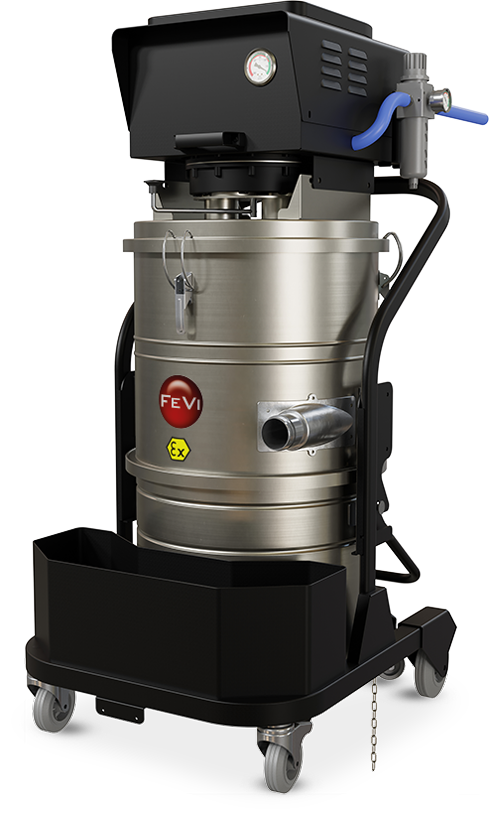

 , ATEX


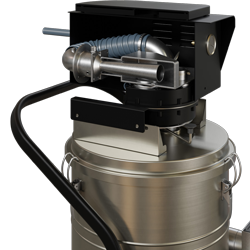
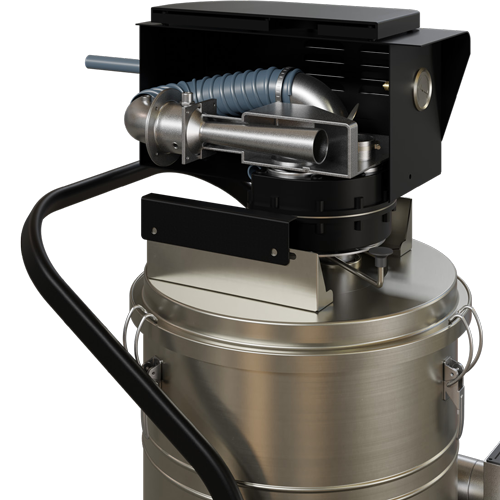
The Venturi system converts the compressed-air flow into vacuum pressure, generating suction without using an electric motor. FEVI S PN ATEX requires a compressed-air supply pressure of between 4 and 6 bar and consumes approximately 1,500 litres of air per minute, providing a stated airflow of 380 m³/h, an operating vacuum pressure of 280 mBar and a stated maximum vacuum pressure of 380 mBar. The compressor must be sized to provide the required airflow at the operating pressure, also taking into account piping length, pressure losses and the simultaneous use of other pneumatic equipment. The value of 4–6 bar must not be described as “power”: the correct term is compressed-air supply pressure.
Ideal Application: Industrial cleaning and localized collection of combustible dust, dry residues, or liquids in classified hazardous areas (Zones 2-22 or Zones 1-21).
Key Advantages: Pneumatic compressed air power supply (4–6 bar) via an integrated Venturi system, semi-automatic pneumatic-mechanical piston cleaning, and standard AISI 304 stainless steel construction.
Model Selection: Flexible 64 kg unit with a 50-liter drum, customisable as the compact S PN version (13,000 cm² filter for Zones 2-22), MAXI 2-22 (18.000 cm²), or MAXI 1-21 (specifically for dust in Zone 1-21).
Not Suitable For: Not suitable for facilities lacking a compressed air network capable of constantly supplying 1,500 l/min, or for vacuuming liquids when using the specific MAXI 1-21 configuration.
Use in ATEX environments
ATEX Directive 2014/34/EU regulates equipment and protective systems intended for use in potentially explosive atmospheres. The industrial vacuum cleaner must be selected according to the classification of the workplace, the substance present and the related explosion-protection documentation. FEVI S PN ATEX versions are distinguished by their external marking.
3G/3D configuration for Zones 2 and 22
Stated marking: II 3G Ex h IIB T6 (T85 °C) Gc / II 3D Ex h IIIC T60 °C Dc. This configuration is intended for Zone 2 for gases, vapours or mists and Zone 22 for combustible dust. According to the European classification, Category 3G corresponds to Zone 2 and Category 3D to Zone 22.
2G/2D configuration for Zones 1 and 21
Stated marking: II 2G Ex h IIB T6 (T85 °C) Gb / II 2D Ex h IIIC T60 °C Db. This configuration is intended for Zone 1 and can also be used in Zone 2, and for Zone 21 and can also be used in Zone 22. Categories 2G and 2D provide a higher level of protection than Categories 3G and 3D.
Internal and external zones of the industrial vacuum cleaner
When combustible dust is collected, a dust concentration may form inside the filter chamber that differs from the concentration present in the surrounding environment. The range is configured with internal Zone 20 inside the collection and filtration chamber, external Zones 2/22 for Category 3GD versions and external Zones 1/21 for the Category 2GD version. The term “internal Zone 20” does not mean that the machine can be positioned externally in a Zone 20 area. An external environment classified as Zone 20 would require equipment with an external category compatible with that zone.
The absence of an electric motor does not eliminate every risk
Pneumatic power eliminates the electric motor as a possible ignition source, but it does not automatically make the industrial vacuum cleaner suitable for every substance or process. The following must still be checked: accumulation of electrostatic charges, electrical continuity of the machine, correct grounding, compatibility of accessories, material temperature, possible sparks caused by impact or friction, presence of glowing materials, explosive characteristics of the dust and maintenance of pneumatic and mechanical components. European guidance requires equipment used in classified zones to be compatible with the zone and requires grounding, maintenance and repairs to preserve the ATEX characteristics over time.
Who it is recommended for
FEVI S PN ATEX is suitable for companies with an adequately sized compressed-air network that need to collect materials in classified zones. Suitability must be verified according to the area classification and the actual characteristics of the material. It can be considered for:
Discover the main application sectors
- Chemical and pharmaceutical industries;
- Food-processing companies and the production and processing of flour and organic powders;
- Processing of plastics and resins, mixing departments and dosing areas;
- Painting systems and the metalworking industry;
- Maintenance in ATEX environments and the collection of combustible dust;
- Cleaning machinery and floors;
- Operations where electrical motorisation is preferably avoided.
Main applications
Collection of combustible dust
FEVI S PN ATEX can be configured to collect combustible dust compatible with the marking of the selected version. The conductive filter cartridge, metal construction and equipotential bonding help dissipate electrostatic charges. Before selecting the machine, we need to know: particle size, electrical resistivity, minimum ignition energy, minimum ignition temperature, explosive concentration, any dust St class, quantity collected, internal and external zones and material temperature.
Collection of solids and liquids
The 60 mm tangential inlet makes it possible to collect solid residues and granular materials compatible with the piping, filter and drum. The tangential inlet promotes cyclonic movement inside the chamber and helps separate heavier particles before they reach the filter. The S PN ATEX 2-22 and S PN MAXI ATEX 2-22 configurations include the collection of compatible dust and liquids. The S PN MAXI ATEX 1-21 version is instead identified for dust collection.
Preliminary assessment for liquids
Before collecting a liquid, we must verify: flash point, temperature, compatibility with AISI 304 stainless steel, seals and filter, gas or vapour group, temperature class, potential generation of electrostatic charges, emptying method and instructions contained in the manual. ATEX marking does not automatically make the machine suitable for every flammable liquid or chemical substance.
Industrial cleaning in classified zones
The compact design and 64 kg weight make it possible to move the industrial vacuum cleaner between different workstations, in accordance with company procedures for bringing equipment into ATEX zones. The hose, fittings, nozzles and accessories must maintain electrical continuity and be compatible with the ATEX configuration.
Why choose FEVI S PN ATEX
No electric motor: The Venturi system generates suction using compressed air and does not require an electric motor installed on the machine. This solution is particularly suitable when electricity is unavailable, electrical equipment is preferably avoided in the zone, a pneumatic network is already available or the industrial vacuum cleaner operates close to sensitive processes.
Suitable for prolonged use: The Venturi generator has no carbon brushes or electrical windings. It can therefore support prolonged operation, provided that the compressor guarantees constant airflow and pressure, the system does not overheat and the circuit, filter and drum are inspected. The expression “maintenance-free 24/7 operation” should not be used, because the filter, cleaning piston, seals, valves, Venturi tube and connections still require periodic checks.
Class M cartridge filter: The filter has conductive and aluminised characteristics, with a surface area of 13,000 or 18,000 cm² depending on the version. A secondary HEPA filter is available as an option to increase the filtration level, but it does not automatically modify the machine’s ATEX marking.
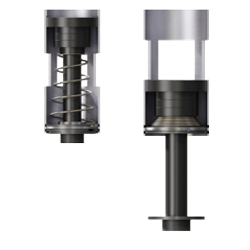
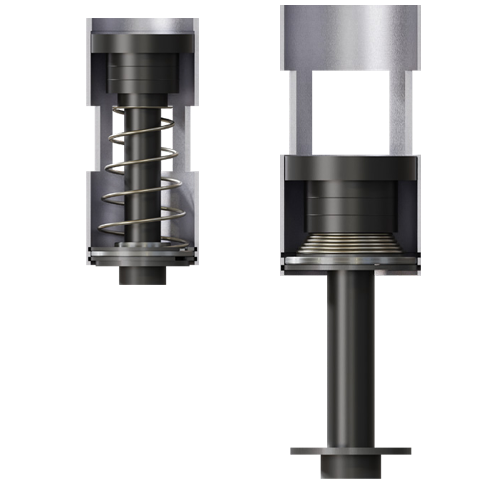
Semi-automatic filter cleaning: The system uses a pneumatic-mechanical piston to shake the cartridge and help release the dust. The same compressed-air network that powers the Venturi system also operates the cleaning system, reducing manual intervention.
Cartridge protection and AISI 304 construction: The internal protection limits the direct impact of abrasive materials, distributes the airflow and promotes cyclonic movement. The lid, filter chamber and container are made of AISI 304 stainless steel. Chemical compatibility must still be verified for solvents, acids and corrosive substances.
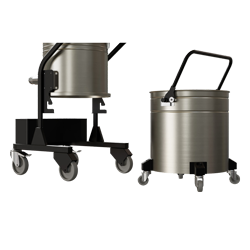
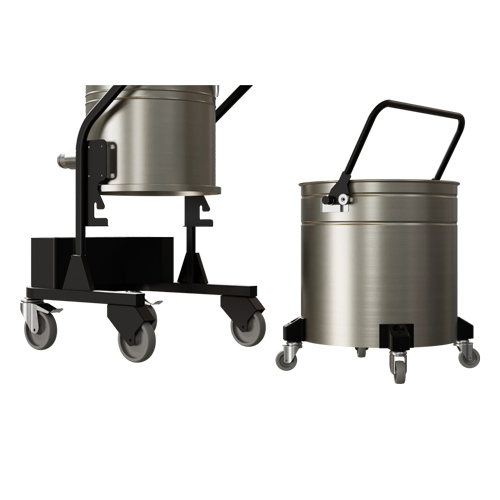
50-litre drum: The quick-release container provides a capacity of 50 litres and allows the collected material to be removed without dismantling the entire filter chamber. Emptying must be carried out in accordance with the procedures established for the substance and the zone.
Available versions in the range
FEVI S PN ATEX 2-22
Compact configuration for external Zones 2 and 22. Suitable for compatible dust and liquids, with 3G/3D marking, a height of 115 cm, a 13,000 cm² cartridge, a 50-litre drum and an optional HEPA filter.
FEVI S PN MAXI ATEX 2-22
Enlarged configuration for external Zones 2 and 22. Suitable for compatible dust and liquids, with 3G/3D marking, a height of 125 cm, an 18,000 cm² cartridge providing a larger filter surface area, a 50-litre drum and an optional HEPA filter.
FEVI S PN MAXI ATEX 1-21
Specific configuration for external Zones 1 and 21. Developed for dust collection, with 2G/2D marking, a height of 125 cm, an 18,000 cm² cartridge, a 50-litre drum and an optional HEPA filter.
Version comparison table
| Feature | S PN ATEX 2-22 | S PN MAXI ATEX 2-22 | S PN MAXI ATEX 1-21 |
|---|---|---|---|
| Power supply | Compressed air | Compressed air | Compressed air |
| Vacuum system | Venturi | Venturi | Venturi |
| External gas zone | Zone 2 | Zone 2 | Zone 1 |
| External dust zone | Zone 22 | Zone 22 | Zone 21 |
| Internal dust zone | Zone 20 | Zone 20 | Zone 20 |
| ATEX category | 3G / 3D | 3G / 3D | 2G / 2D |
| Material | Dust and liquids | Dust and liquids | Dust |
| Air pressure | 4–6 bar | 4–6 bar | 4–6 bar |
| Air consumption | 1.500 l/min | 1.500 l/min | 1.500 l/min |
| Airflow | 380 m³/h | 380 m³/h | 380 m³/h |
| Vacuum pressure | 280 mBar | 280 mBar | 280 mBar |
| Maximum vacuum pressure | 380 mBar | 380 mBar | 380 mBar |
| Inlet | Tangential 60 mm | Tangential 60 mm | Tangential 60 mm |
| Dimensions | 80 × 60 × H 115 cm | 80 × 60 × H 125 cm | 80 × 60 × H 125 cm |
| Weight | 64 kg | 64 kg | 64 kg |
| Drum capacity | 50 litres | 50 litres | 50 litres |
| Filter type | Cartridge | Cartridge | Cartridge |
| Filter properties | Aluminised conductive Class M | Aluminised conductive Class M | Aluminised conductive Class M |
| Filter surface area | 13.000 cm² | 18.000 cm² | 18.000 cm² |
| Cleaning system | Pneumatic-mechanical piston | Pneumatic-mechanical piston | Pneumatic-mechanical piston |
| HEPA filter | Optional | Optional | Optional |
| Longopac® | Not available | Not available | Not available |
The technical values are common to all versions, except for height, filter surface area, materials that can be collected and ATEX category.
Comparison with other ATEX technologies
Difference compared with an electric ATEX industrial vacuum cleaner
The pneumatic S PN ATEX model operates using compressed air through a Venturi system, without any electrical components installed on the machine, and consumes 1,500 l/min of air. It is ideal where a suitable pneumatic network is already available and offers versions for Zones 2/22 and 1/21. An electric ATEX industrial vacuum cleaner requires a mains power supply, uses a certified motor or blower, does not require a dedicated compressor and may be more energy-efficient during prolonged continuous use.
Difference compared with FEVI WT 753 BASIC ATEX
WT 753 BASIC ATEX uses an electric blower and a central inlet with a deflector, making it more suitable for standard versatile collection of dry materials and liquids. S PN ATEX instead uses a pneumatic Venturi system, a tangential inlet and a cartridge filter cleaned by a pneumatic-mechanical piston. It also provides a more compact structure and is available in a version for Zones 1 and 21. Choose S PN ATEX when the absence of an electric motor is essential.
Selection guide and alternative models
Choose the S PN ATEX range when:
- You operate in Zones 2/22 or 1/21 and have an adequate compressed-air supply;
- You prefer an industrial vacuum cleaner without an electric motor and need to collect compatible combustible dust;
- You require a compact and easy-to-handle machine with a conductive Class M cartridge and semi-automatic cleaning;
- You require a 50-litre stainless-steel drum and an airflow of 380 m³/h is suitable for the application;
- The internal and external classifications correspond to the company’s ATEX assessment.
Consider another FEVI model when:
- Electric ATEX industrial vacuum cleaner: When a compressor capable of supplying 1,500 l/min is unavailable or the cost of compressed air makes operation uneconomical.
- FEVI S PN MAXI: When a larger filter surface area of 18,000 cm² is required compared with the compact model.
- 1-21 version: When the external environment has the more restrictive classification of Zone 1 for gases or Zone 21 for dust.
- ATEX industrial vacuum cleaner with automatic cleaning: When the dust is very fine, adhesive or present in quantities that would rapidly clog a cartridge with semi-automatic cleaning.
- ATEX dust collector: When the priority is to capture airborne dust from hoods, workbenches or hoppers.
Configuration recommendations and preliminary assessment
Before proposing FEVI S PN ATEX, we assess together: the required external and internal zone classification, type of gas, vapour or dust, explosion group, ignition temperature, minimum ignition energy, particle size, resistivity, material documentation, product temperature, presence of liquids, chemical compatibility, compressor airflow, pressure available at the point of use, pneumatic-line length, operating frequency, need for a HEPA filter, ATEX characteristics of the hose and accessories, emptying procedures and maintenance.
Collection system and operation
How the S PN ATEX range works
The Venturi generator uses compressed air from the company network to create the vacuum required for collection. The airflow and materials enter through the 60 mm tangential inlet, which creates a rotating path and separates heavier particles through a cyclonic effect.
Solids and liquids fall directly into the lower 50-litre container, while the air rises through the conductive Class M filter cartridge. When accumulated dust reduces performance, the operator can activate the pneumatic-mechanical piston to shake the filter and restore airflow.
Importance of the correct pneumatic supply
To ensure a constant vacuum pressure of 280 mBar and an airflow of 380 m³/h, the industrial vacuum cleaner requires a continuous compressed-air supply strictly between 4 and 6 bar, with a minimum volume of 1,500 l/min at the machine inlet.
Incorrect compressor sizing, excessively long flexible piping or reduced fitting diameters inevitably generate pressure losses, reducing the efficiency of the Venturi system and compromising the effectiveness of the entire cleaning operation.
Request a pneumatic sizing assessment
Do you need to collect dust or residues in an ATEX environment without using an electric motor?
Send us the zone classification, the material safety data sheet, the quantity to be collected, the duration of the operating cycle, the compressed-air pressure and airflow available at the point of use, any presence of liquids and the distance from the extraction point.
Together, we will assess the most suitable configuration from S PN ATEX 2-22, S PN MAXI ATEX 2-22 and S PN MAXI ATEX 1-21 to verify the full compatibility of the industrial vacuum cleaner with your working environment.
FEVI S PN ATEX FAQ
Does FEVI S PN ATEX use an electric motor?
Read the answer
No. Suction is generated exclusively by compressed air through an integrated Venturi system.
How much compressed air does it require?
Read the answer
The stated air consumption is approximately 1,500 litres per minute, with a constant pneumatic supply pressure of between 4 and 6 bar.
Can it be used in Zone 22?
Read the answer
Yes. Versions with external 3D/Dc marking are intended for use in environments classified as Zone 22 for combustible dust.
Can it be used in Zone 21?
Read the answer
Yes, by selecting the specific S PN MAXI ATEX configuration with Category 2D/Db marking for Zone 21.
Can it be used in Zone 1?
Read the answer
Yes. The S PN MAXI ATEX 1-21 version has Category 2G/Gb marking and is fully compatible with environments classified as Zone 1 and Zone 2.
What exactly does internal Zone 20 mean?
Read the answer
It means that the internal filtration and collection chamber is designed considering the frequent or prolonged presence of a combustible dust cloud. It does not mean that the industrial vacuum cleaner can be positioned externally in a Zone 20 environment.
Can it also collect liquids?
Read the answer
The versions intended for Zones 2 and 22 are configured for compatible dust and liquids. The MAXI 1-21 version is intended exclusively for dust. Before collecting fluids, their flammability and chemical compatibility must be verified.
What is the capacity of the collection container?
Read the answer
The AISI 304 stainless-steel quick-release drum has a capacity of 50 litres.
What type of filter is installed?
Read the answer
It uses a Class M filter cartridge with conductive properties and an aluminised finish, providing a surface area of 13,000 cm² or 18,000 cm² depending on the selected version.
How is the cartridge filter cleaned?
Read the answer
Cleaning is semi-automatic and uses the same compressed-air supply through an integrated pneumatic-mechanical piston that shakes the cartridge.
Can a safety HEPA filter be installed?
Read the answer
Yes. A secondary outlet HEPA filter is available as an optional accessory to increase the machine’s filtration efficiency.
Can it operate continuously over several shifts?
Read the answer
As the Venturi generator has no electrical components or brushes subject to overheating, it supports prolonged operation provided that the pneumatic network guarantees stable airflow and pressure. Periodic checks for wear on seals, valves and filters remain necessary.
Does the absence of an electric motor eliminate every ignition risk?
Read the answer
No. It eliminates the electrical ignition source, but residual electrostatic charges, material friction, the thermal suitability of the product and the full efficiency of the equipotential grounding circuit must still be monitored and managed.

