



 , Solid
 , Liquid


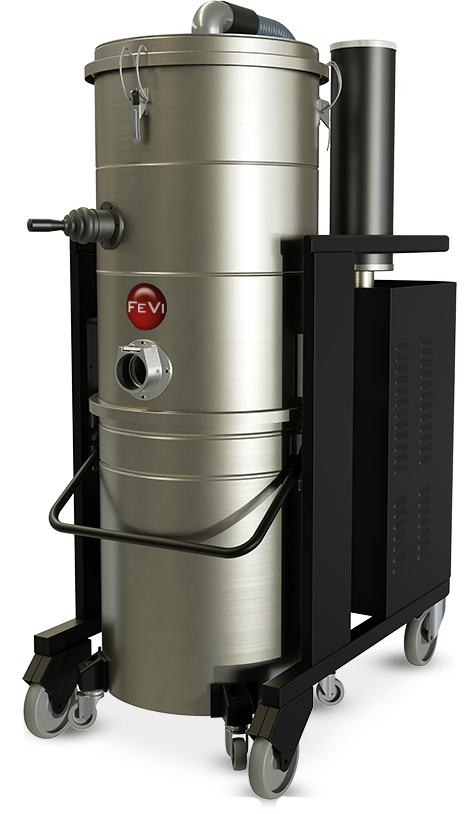
The FEVI HDC 155 BASIC industrial vacuum cleaner range uses a two-stage three-phase side-channel blower with thermal protection, suitable for applications in which the vacuum cleaner must operate for prolonged periods or be connected to machinery, workstations and vacuum systems.
Unlike conventional single-phase bypass motors, the side-channel blower does not use carbon brushes subject to normal wear.
The machine is still subject to the routine maintenance required for filters, seals, the safety valve, piping and the collection system. With a power rating of 5.5 kW, the HDC 155 BASIC range provides a more substantial solution than FEVI three-phase industrial vacuum cleaners rated at 3 kW.
Ideal Application: Designed for heavy-duty, prolonged (24/7) integration with industrial machinery, workstations, and medium-to-long pipe networks for collecting ordinary dust, solids, or liquid spills.
Key Advantages: Modular and interchangeable collection system (100-liter rigid quick-release drum or Longopac® continuous bag system), integrated safety valve, and customizable star filter media.
Model Selection: High-end 5.5 kW double-stage three-phase (400 V) motorization, customisable either as the 155 P version (High Airflow) or 155 S version (High Vacuum up to 530 mBar for severe pressure drops).
Not Suitable For: Heavy-duty configuration engineered for robust industrial waste. It is not suitable for continuous suction of massive amounts of ultra-fine airborne dust, or for ATEX areas without a specific custom layout.
Who it is recommended for
FEVI HDC 155 BASIC is suitable for professionals and companies requiring a robust, centralised or continuous vacuuming system:
Discover the main application sectors
- Manufacturing industries;
- Mechanical workshops and metalworking companies;
- Production departments and industrial maintenance;
- Professional cleaning companies;
- Cement plants and mineral processing;
- Companies producing solid residues and applications involving ordinary dust;
- Collection of liquids and mixed materials;
- Direct connection to industrial machinery and systems;
- Vacuuming through medium-length or long piping systems.
Main applications
Dust collection
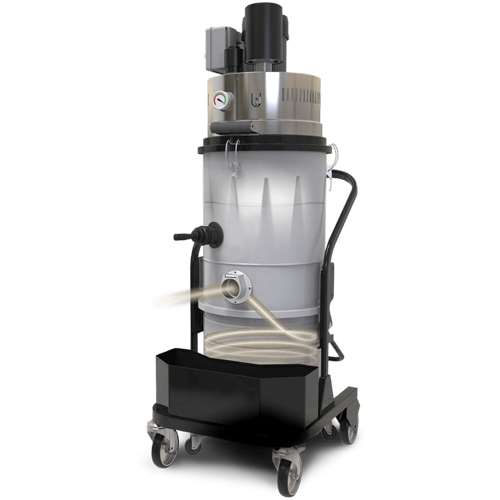
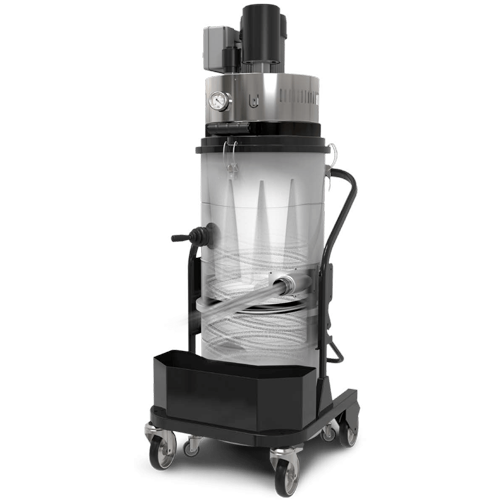
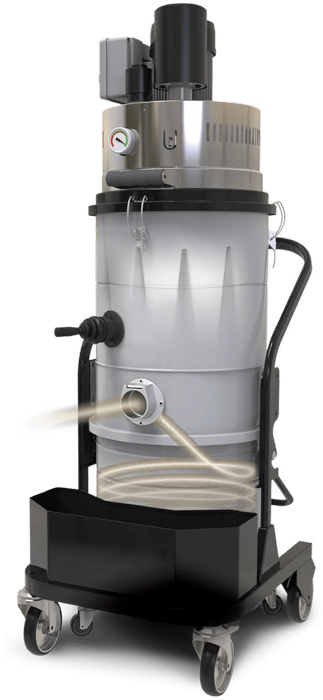
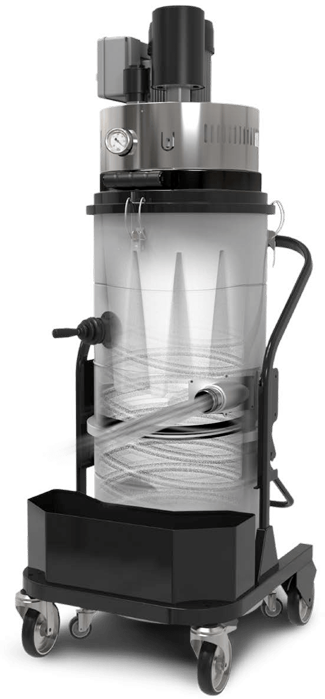
B 155 versions with a tangential inlet are particularly suitable when the predominant material consists of dust or dry residues. The side inlet generates a rotating movement inside the chamber, helping particles fall towards the collection system before they reach the filter directly. This cyclonic effect helps reduce the load on the filter surface and makes the B configuration more effective for dust than a traditional central inlet.
Collection of solids and residues
FEVI HDC 155 BASIC can be used to collect processing residues, granular material, small production waste, industrial debris and deposited dust compatible with the piping diameter. The exact configuration must be selected by carefully considering the weight, dimensions, abrasiveness and quantity of the material.
Liquid collection
W 155 versions use a central inlet with a deflector, designed to direct the flow towards the lower part of the container and limit direct contact between the liquid and the filter. This configuration is ideal for collecting liquids, alternating dry materials and liquids, cleaning tanks and managing spills.
Connection to production machinery
The 5.5 kW blower makes it possible to consider direct connection to machinery, systems or workstations that produce material during the operating cycle. Before defining the final configuration, parameters such as the required airflow, necessary vacuum pressure, piping length, number of bends and simultaneous operation of multiple extraction points must be analysed.
Vacuuming through long piping systems: P and S versions
The S versions, characterised by higher vacuum pressure, are particularly suitable when material must be transported through longer piping systems, smaller diameters or routes that generate greater pressure losses.
The P versions, with higher airflow, are more suitable when large volumes of air must be moved through wider piping or when lightweight airborne material must be captured.
Why choose FEVI HDC 155 BASIC
5.5 kW two-stage three-phase blower: Makes it possible to obtain configurations with different ratios between airflow and vacuum pressure, choosing a version more focused on air volume or on transporting material under high-resistance conditions.
Four available configurations: The range includes the B 155 P series (tangential/high airflow), W 155 P (central/high airflow), B 155 S (tangential/high vacuum pressure) and W 155 S (central/high vacuum pressure).
Polyester star filter: Primary filter available with a standard surface area of 20,000 cm² or an enlarged surface area of 30,000 cm². Antistatic, PTFE-coated and high-temperature filter media can be selected.
Manual or semi-automatic cleaning: The standard shaking system is manual, but a semi-automatic shaking system can be integrated to facilitate dust release during intensive operations.
Optional secondary HEPA filter: Can be integrated when the application requires an additional level of absolute secondary filtration, according to the nature of the dust and environmental requirements.
Integrated safety: The safety valve protects the blower against accidental blockages, thermal protection monitors prolonged operating cycles and the silencer reduces noise within the department.
Difference between the W configuration and the B configuration
HDC W 155 BASIC (Liquids and Mixed Materials)
The W configuration uses a central inlet with a deflector. The flow is directed downwards, reducing the impact of liquids on the filter fabric. Recommended for liquids, mixed residues and operations where versatility is a priority.
HDC B 155 BASIC (Dust and Solids)
The B configuration uses a tangential inlet. The air enters from the side, generating a stable cyclonic movement that separates dust before it reaches the filter. Recommended for dust, dry residues and granular solid waste.
Difference between the P version (High Airflow) and the S version (High Vacuum Pressure)
P Version: Higher Airflow
Provides an airflow of 520 m³/h with a maximum vacuum pressure of 320 mBar. It is suitable for moving large volumes of air, using wide piping or collecting bulky but lightweight materials.
S Version: Higher Vacuum Pressure
Provides a nominal vacuum pressure of 450 mBar, with a maximum of 530 mBar, and an airflow of 320 m³/h. It is ideal for transporting heavy materials, overcoming significant pressure losses and working with long piping systems or distant extraction points.
Technical Data
HDC B / W 155 P BASIC
| Material to be collected | Dust and liquids |
| Motor | Two-stage three-phase side-channel blower |
| Power | 5,5 kW |
| Voltage | 400 V 3P+E |
| Frequency | 50 Hz |
| Current | 10,4 A |
| Airflow | 520 m3/h |
| Nominal vacuum pressure | 250 mBar |
| Maximum vacuum pressure (valve) | 320 mBar |
| Vacuum inlet | Tangential 60 mm (B version) / Central 70 mm (W version) |
| Dimensions | 105x60 h151 cm |
| Weight | 150 kg |
| Collection system | Modular trolley for quick-release drum or Longopac® |
| Collection capacity | 100 L / Longopac® continuous bag |
| Filter chamber diameter | Ø 460 mm |
| Filter type | Polyester star filter (optional antistatic, PTFE or high-temperature versions) |
| Filter surface area | 20.000 cm2 - 30.000 cm2 enlarged configuration |
| Cleaning system | Manual shaking / Optional semi-automatic system |
| Secondary HEPA filtration | Optional |
HDC B / W 155 S BASIC
| Material to be collected | Dust and heavy liquids / Long piping systems |
| Motor | Two-stage three-phase side-channel blower |
| Power | 5,5 kW |
| Voltage | 400 V 3P+E |
| Frequency | 50 Hz |
| Current | 10,4 A |
| Airflow | 320 m3/h |
| Nominal vacuum pressure | 450 mBar |
| Maximum vacuum pressure (valve) | 530 mBar |
| Vacuum inlet | Tangential 60 mm (B version) / Central 60 mm (W version) |
| Dimensions | 105x60 h151 cm |
| Weight | 150 kg |
| Collection system | Modular trolley for quick-release drum or Longopac® |
| Collection capacity | 100 L / Longopac® continuous bag |
| Filter chamber diameter | Ø 460 mm |
| Filter type | Polyester star filter (optional antistatic, PTFE or high-temperature versions) |
| Filter surface area | 20.000 cm2 - 30.000 cm2 enlarged configuration |
| Cleaning system | Manual shaking / Optional semi-automatic system |
| Secondary HEPA filtration | Optional |
Collection system and operation
How the HDC 155 BASIC range works
The material enters the chamber through the selected inlet. In the B configuration, the tangential inlet creates a rotating movement for cyclonic separation. In the W configuration, the central deflector directs the airflow and liquids directly towards the bottom of the container.
The air rises through the polyester star filter, which retains solid residues, before reaching the 5.5 kW two-stage blower. Collection systems can be interchanged thanks to the modular trolley.
100-litre drum or Longopac® system
100-litre drum: Suitable when the material must be handled inside a rigid container, in the presence of liquids or heavy residues, with emptying carried out at a designated point within the facility.
Longopac® system: Optimised for dust and dry materials. It allows residues to be bagged directly and sealed at the required length, minimising direct operator contact with airborne dust. It is not suitable when liquids are the predominant material.
Comparison with FEVI BT / WT 753 BASIC (3 kW)
The 753 BASIC model uses a 3 kW three-phase blower for standard applications. HDC 155 BASIC increases this to a 5.5 kW two-stage blower and is required when the piping system is extensive, pressure losses are high, the material being transported is heavy or a precise engineering choice between high airflow (P) and high vacuum pressure (S) is required.
Comparison with FEVI TDC30 ICLEAN
TDC30 ICLEAN, rated at 3 kW, is a specialised unit for very fine dust, equipped with three HEPA cartridges and timed automatic cleaning. HDC 155 BASIC, rated at 5.5 kW, is a considerably more powerful and versatile machine for complex solids and liquids, but it uses a star filter with manual or semi-automatic shaking. Choose HDC 155 for power and distance, and TDC30 for fine dust and automated filter cleaning.
Do you need to choose between HDC W, HDC B, the P version or the S version?
Describe the material to be collected, the exact distance from the collection point, the piping diameter, the presence of liquids and the expected duration of the operating cycle.
Together, we will assess the ideal combination of inlet configuration—central W or tangential B—performance—high-airflow P or high-vacuum S—and collection system to configure the HDC 155 BASIC unit best suited to your actual application.
Contact us to size your new industrial vacuum system correctly.
FEVI HDC 155 BASIC FAQ
Is FEVI HDC 155 BASIC single-phase or three-phase?
Read the answer
It is a three-phase industrial vacuum cleaner powered at 400 V and equipped with a powerful 5.5 kW two-stage blower with built-in thermal protection.
What is the difference between HDC W and HDC B?
Read the answer
The W version uses a central inlet with an internal deflector, optimised for liquids and mixed residues. The B version uses a side tangential inlet, ideal for generating the cyclonic effect required for dust separation.
What is the difference between the P version and the S version?
Read the answer
The P version is configured to provide high airflow of 520 m³/h, making it ideal for wide piping and lightweight materials. The S version is configured to provide high vacuum pressure of up to 530 mBar, making it ideal for overcoming significant pressure losses, transporting heavy materials or working through very long piping systems.
Can it collect liquids?
Read the answer
Yes, the industrial vacuum cleaner is versatile. When the main application involves liquids or mixed spills, the recommended configuration is the W version with a filter-protection deflector.
Can it collect fine dust?
Read the answer
It can collect common industrial dust, but for large volumes of extremely fine, airborne or clogging dust, it is preferable to consider the specialist ICLEAN or PULSE ranges equipped with continuous automatic cartridge-cleaning systems.
What is the collection-system capacity?
Read the answer
The trolley is modular and can accommodate either a rigid 100-litre quick-release drum or the Longopac® continuous bag system.
How is the filter cleaned?
Read the answer
The standard configuration includes a mechanical manual shaking system. An optional semi-automatic shaking kit can also be requested.
Is a HEPA filter available?
Read the answer
Yes. A secondary HEPA absolute filter can be integrated as an optional accessory to increase the safety of the discharged air.
Is an ATEX-approved version available?
Read the answer
The standard BASIC range is not ATEX, but a dedicated ATEX configuration is available upon request, subject to a careful technical assessment of the working environment and the dust generated by the process.

