


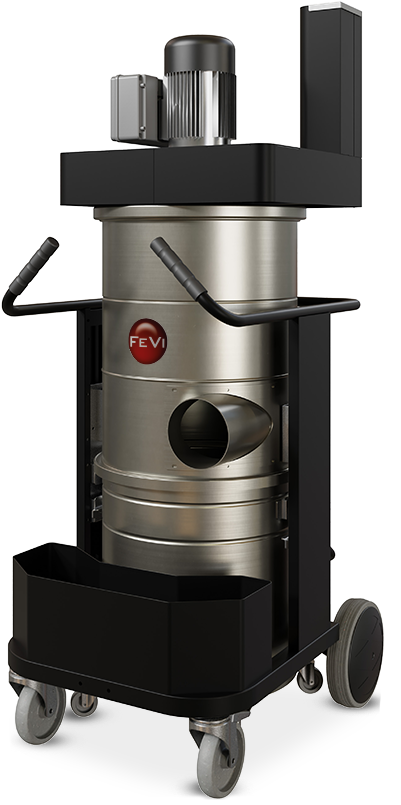


Modern industry requires advanced solutions to ensure safe, contamination-free working environments, particularly when airborne dust is involved. Lightweight dust can remain suspended in the air and spread throughout the department before settling on machinery, structures and floors. The FEVI DTX 1500 BASIC industrial dust collector is designed to provide maximum efficiency in the removal of fine airborne dust, meeting the requirements of a wide range of industrial sectors. The unit can be connected directly to: extraction hoods; extraction arms; workbenches; machine enclosures; localised emission points; small production lines; workstations that generate airborne dust. Capture must take place as close as possible to the point of generation, with the hood, piping diameter, air velocity and distance from the source correctly sized.
Ideal Application: Designed for heavy-duty, prolonged (24/7) integration with industrial machinery, workstations, and medium-to-long pipe networks for collecting ordinary dust, solids, or liquid spills.
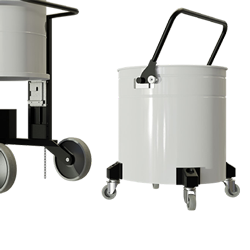
Key Advantages: Modular and interchangeable collection system (100-liter rigid quick-release drum or Longopac® continuous bag system), integrated safety valve, and customizable star filter media.
Model Selection: High-end 5.5 kW double-stage three-phase (400 V) motorization, customizable either as the 155 P version (High Airflow) or 155 S version (High Vacuum up to 530 mBar for severe pressure drops).
Not Suitable For: Heavy-duty configuration engineered for robust industrial waste. It is not suitable for continuous inline collection of massive amounts of ultra-fine or clogging dust, or for ATEX areas without a specific custom layout.
Not Suitable For: Heavy-duty configuration engineered for robust industrial waste. It is not suitable for continuous inline collection of massive amounts of ultra-fine or clogging dust, or for ATEX areas without a specific custom layout.
Not Suitable For: Heavy-duty configuration engineered for robust industrial waste. It is not suitable for continuous inline collection of massive amounts of ultra-fine or clogging dust, or for ATEX areas without a specific custom layout.
Features of the FEVI DTX 1500 BASIC Industrial Dust Collector
- Motorised dust collector with a 2.2 kW centrifugal fan for high airflow
- The configuration is suitable for prolonged industrial operation with scheduled maintenance
- Integrated acoustic silencer
- Dust collector for extracting light and airborne dust during production processes
- Option to install and connect an articulated extraction arm
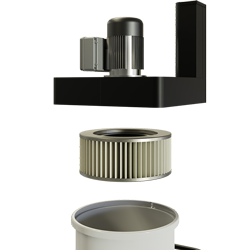
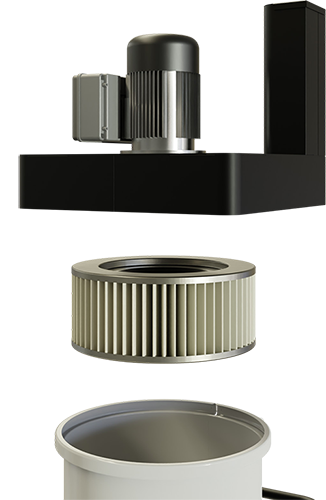
- 30,000 cm² antistatic Class L polyester star filter
- Integrated manual filter cleaning through mechanical shaking
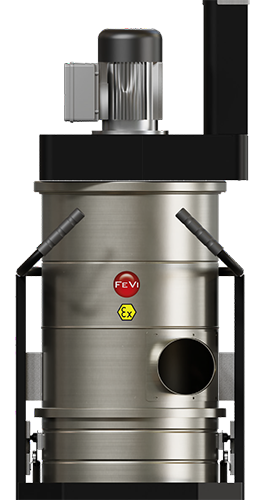
- 120 mm tangential air inlet
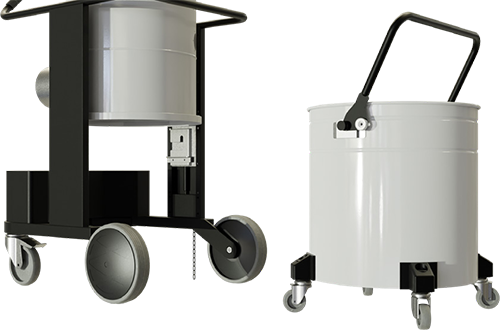
- Version with a 50-litre collection drum for convenient emptying
- Thermal-magnetic switch supplied as standard for electrical motor protection
Who it is recommended for
FEVI DTX 1500 BASIC can be considered for: workshops; manufacturing departments; machining operations; sanding and grinding; woodworking; plastics processing; mineral-material processing; craft activities; preparation benches; material-transfer stations; small production lines; and industrial maintenance. Suitability must be assessed in advance by considering the hourly quantity, particle size, chemical hazard, temperature and potential combustibility of the dust.
Discover the main application sectors
- Mechanical workshops and structured turning departments;
- Surface finishing, grinding and sanding departments;
- Chemical, pharmaceutical and food industries in material-transfer areas;
- Joinery workshops and facilities processing lightweight wood materials;
- Plastic extrusion and moulding lines;
- Paint-production facilities, cement plants and volatile mineral-material dosing operations;
- Craft workstations for component assembly or finishing.
Main applications
Localised capture through an extraction arm
FEVI DTX 1500 BASIC can be configured with an extraction arm to capture dust close to the process. The arm allows the capture inlet to be positioned close to the exact emission point and repositioned when the operating scenario changes. Correct performance depends on: distance from the source, arm diameter and length, number of joints, required airflow, air movement within the environment and direction of dust emission. The extraction arm is an optional configuration and must be sized together with the dust collector.
Direct connection to a containment hood
The dust collector can be connected to a hood installed above or beside the process. The hood must contain and direct the contaminated airflow towards the piping. A hood positioned too far away or with an excessively large opening may require greater airflow than is available, reducing the effective capture velocity.
Connection to production machinery
It can be connected directly to a machine when the process generates lightweight dust and primarily requires air movement. Before connection, we assess: the airflow required by the machine, the diameter specified by the manufacturer, hose length, number of bends, simultaneous operation of collection points, quantity of dust, frequency of use and total pressure loss.
Sanding, grinding and material-transfer workstations
The model can be considered for workstations that generate dust during sanding, grinding or surface preparation, as well as during the transfer and dosing of powdered materials where localised emissions are produced. A correctly positioned hood or arm captures the cloud at the point where it forms. The BASIC configuration with a star filter and manual cleaning is suitable when the quantity of dust is manageable and periodic shutdowns are possible. Compatibility must be verified when the dust is combustible or toxic.
Why choose FEVI DTX 1500 BASIC
High airflow: The airflow of 1500 m³/h makes it possible to move a significantly greater volume of air than a conventional industrial vacuum cleaner of comparable size. This feature is particularly useful with open hoods, extraction arms, diffuse sources, large-diameter capture inlets and lightweight dust that tends to remain suspended.
2.2 kW centrifugal fan: The centrifugal fan is powered at 400 V and operates with a vacuum pressure of 34 mBar. The configuration prioritises airflow rather than material-conveying force. The product must therefore be described as a dust collector for airborne dust, not as an industrial vacuum cleaner for heavy swarf or solid debris.
30,000 cm² star filter: The primary polyester star filter provides a large surface area of 30,000 cm² and is classified as antistatic Class L. The filter surface helps manage the continuous airflow and dust accumulation during operation. The machine nevertheless requires periodic maintenance and checks on: the filter, seals, cleaning system, inlet, circuit and piping. The absolute expression “maintenance-free” must not be used.
Manual cleaning or optional semi-automatic cleaning: The standard system uses manual shaking, which must be performed after stopping the dust collector, allowing the dust to settle and operating the dedicated lever. An optional semi-automatic system is available to facilitate dust release when production is frequent, the filter requires closely spaced cleaning cycles and manual intervention must be reduced.
Optional HEPA filter: A HEPA filter is available as an optional second filtration stage and is not included in the standard equipment. Its integration must be assessed according to particle size, concentration, substance hazard, required workshop air quality and the additional pressure loss generated.
120 mm tangential inlet and 50-litre drum: The 120 mm tangential inlet introduces the airflow laterally into the 460 mm chamber, promoting a rotating movement that separates the heavier particles before they reach the filter. The material falls into the 50-litre drum, which can be removed for emptying without dismantling the filter chamber.
How the dust-collection system works
The centrifugal fan creates a continuous airflow through the hood, arm or piping connected to the workstation. The dust-laden air enters through the 120 mm tangential inlet and reaches the filter chamber. The heavier particles immediately lose velocity as a result of the cyclonic effect and fall into the 50-litre collection drum. The lighter and more volatile fraction is retained by the polyester star filter. The filtered air passes through the fan and is discharged from the machine. As dust accumulates on the filter surface, resistance to airflow increases and capture performance decreases: periodic filter cleaning is therefore essential to maintain correct operation.
Technical Comparisons and Configuration Selection
Selecting the correct dust-collection system requires an assessment of the cleaning method, air volumes and nature of the contaminant.
1. Structural difference between the BASIC and ICLEAN versions
| Model Configuration | Filter and Cleaning Configuration | Suitability and Operating Continuity |
|---|---|---|
| FEVI DTX 1500 BASIC | Single 30,000 cm² polyester star filter with a manual shaking system supplied as standard and optional semi-automatic cleaning. | Suitable for individual workstations where the quantity of dust is manageable and the process allows periodic shutdowns for cleaning. |
| FEVI DTX 1500 ICLEAN | Three independent filter cartridges supported by the fully automatic ICLEAN cleaning system. | Provides maximum continuity of capture without interruptions; ideal for very fine dust or departments with high dust loads. |
2. Size difference within the BASIC range: 1500 vs 2500
The choice between the two models in the range must not be based solely on motor power, but on the precise calculation of the airflow required by the system.
| Dust Collector Model | Sources and Process Dimensions | Technical Selection Factors |
|---|---|---|
| FEVI DTX 1500 BASIC | Suitable for individual workstations, small machine enclosures or localised connections. | Compact configuration optimised for a nominal airflow of 1500 m³/h. |
| FEVI DTX 2500 BASIC | Suitable when the required air volume, hood dimensions and number of simultaneous collection points increase. | Larger structure suitable for higher quantities of dust and more extensive piping systems. |
3. Fundamental difference between a Dust Collector and an Industrial Vacuum Cleaner
A dust collector provides high airflow and limited vacuum pressure, whereas an industrial vacuum cleaner generates higher vacuum pressure to convey heavy materials through narrow piping.
| Nature of the Contaminant and Capture Method | Required Industrial Technology |
|---|---|
| Airborne dust captured through an open hood or articulated extraction arm, requiring large volumes of air. | Industrial Dust Collector (DTX Range) |
| Collection of material deposited on floors, solids, debris, heavy granules and long-distance material transport through narrow hoses. | High-Vacuum Industrial Vacuum Cleaner |
Selection guide: When to configure this model
Choose FEVI DTX 1500 BASIC when:
- You need to capture lightweight and airborne dust through a hood or extraction arm;
- You require an airflow of 1500 m³/h and have a 400 V three-phase power supply available;
- You have a single localised collection point and a vacuum pressure of 34 mBar is suitable;
- The quantity of dust produced allows periodic manual cleaning;
- The 50-litre collection drum is sufficient and heavy solid materials do not need to be conveyed;
- You do not operate in an environment classified as having an explosion risk following an ATEX assessment.
Consider another FEVI model when:
- FEVI DTX 1500 ICLEAN: When the dust is extremely fine, tends to clog the filter rapidly or uninterrupted 24-hour capture is required;
- FEVI DTX 2500 BASIC: When higher airflow is required or multiple, more demanding collection points must be connected;
- ATEX dust collector: Required when the dust is combustible or the external environment is classified as Zone 2 or Zone 22;
- Industrial vacuum cleaner: When the priority is collecting solids, heavy offcuts, liquids or coarse debris from the floor;
- Centralised system: When several production machines must be connected simultaneously to a shared facility network.
Configuration recommendations and key parameters
Before selecting the machine, we assess together all the physical and system-related parameters of the department: type of dust; particle size; quantity produced; temperature; humidity; density; potential combustibility or hazard; geometric dimensions of the hood; distance from the source; piping diameter; total route length; number of bends; number of extraction points; daily operating hours; need for an absolute HEPA filter; need for semi-automatic cleaning; and any ATEX classification.
Request the sizing of your workstation
Do you need to capture airborne dust during an industrial process?
Describe the type of process in detail, such as sanding, material transfer or cutting, together with the nature of the dust, the dimensions of the hood or workbench, the linear distance from the emission point and the duration of the operating cycle. We will calculate the required airflow to determine whether FEVI DTX 1500 BASIC is suitable for your workstation or whether a configuration with automatic ICLEAN cleaning, higher airflow or explosion-proof certification is required. Contact us to size the most suitable dust collector.
Technical Data
| Material to be extracted / captured | Lightweight and airborne dust suspended in the air |
| Motor / Unit technology | Three-phase centrifugal fan |
| Rated motor power | 2,2 kW |
| Voltage / Power supply | 400 V |
| Mains frequency | 50 Hz |
| Current draw | 6 A |
| Nominal airflow | 1500 m3/h |
| Operating vacuum pressure | 34 mBar |
| Inlet | Type E tangential Ø 120 mm |
| Overall dimensions | 80 x 64 x h168 cm |
| Total empty weight | 85 kg |
| Residue collection system | Removable quick-release drum |
| Collection-container capacity | 50 L |
| Filter chamber diameter | Ø 460 mm |
| Primary filter type | Polyester star filter |
| Filter properties and class | Class L with antistatic treatment |
| Total filter surface area | 30.000 cm2 |
| Standard cleaning system | Integrated mechanical manual shaking |
| Optional cleaning mechanism | Assisted semi-automatic system (Optional) |
| Absolute HEPA filtration | Optional (Second stage not supplied as standard) |
| Standard electrical protection | Thermal-magnetic motor-protection switch |
| Compatible capture accessories | Articulated extraction arm, hoods or dedicated workbenches |
FEVI DTX 1500 BASIC FAQ
What is FEVI DTX 1500 BASIC?
Read the answer
It is a three-phase industrial dust collector specifically designed to capture and filter lightweight, volatile and airborne dust suspended in the department.
What is the power rating of the motor unit?
Read the answer
It uses a powerful 2.2 kW industrial centrifugal fan.
What is the stated airflow?
Read the answer
The stated nominal airflow is 1500 m³/h, making it suitable for moving large volumes of contaminated air.
What vacuum pressure is generated by the centrifugal fan?
Read the answer
The vacuum pressure is deliberately limited to 34 mBar because the machine prioritises airflow rather than the lifting force required for heavy solids.
What electrical power supply does the unit require?
Read the answer
It requires a 400 V three-phase industrial power supply.
What type and diameter of inlet does it use?
Read the answer
It uses a Type E tangential air inlet with a diameter of 120 mm.
What type of primary filter is installed?
Read the answer
It is equipped with a large-surface polyester Class L star filter with antistatic properties as standard.
What is the total filter surface area?
Read the answer
The primary star filter provides a total filter surface area of 30,000 cm².
How is the star filter cleaned in the BASIC version?
Read the answer
The standard configuration uses an integrated mechanical manual shaking system that must be operated periodically while the machine is switched off.
Can a semi-automatic cleaning system be installed?
Read the answer
Yes. The assisted semi-automatic cleaning mechanism can be configured and ordered as an optional accessory.
Is the secondary absolute HEPA filter included as standard?
Read the answer
No. The absolute HEPA safety filter is an optional second filtration stage that must be agreed when ordering.
What is the volumetric capacity of the collection drum?
Read the answer
The lower quick-release container for collecting separated dust has a capacity of 50 litres.
Can the machine be combined with an articulated extraction arm?
Read the answer
Yes. FEVI DTX 1500 BASIC is designed to be equipped with a positionable articulated extraction arm for localised capture at the workstation.
Can the dust collector collect heavy metal swarf or construction debris?
Read the answer
No. It is not the correct technology for these materials. The dust collector moves air and captures airborne dust. Heavy swarf or debris deposited on the floor requires a high-vacuum industrial vacuum cleaner.
Is it suitable for large, continuous quantities of extremely fine and clogging dust?
Read the answer
It can capture fine dust, but when the contaminant tends to clog the filter material rapidly, the ICLEAN version with continuous automatic cleaning is preferable.
Can the standard FEVI DTX 1500 BASIC model be installed in an ATEX zone?
Read the answer
The standard BASIC version does not have explosion-proof marking. Environments classified as having an explosion risk, such as Zones 2 or 22, require the dedicated ATEX configuration.
Is the machine suitable for prolonged industrial use over multiple shifts?
Read the answer
Yes. The three-phase centrifugal fan supports prolonged industrial operating cycles, provided that routine filter cleaning is carried out and the scheduled maintenance plan is followed.

