


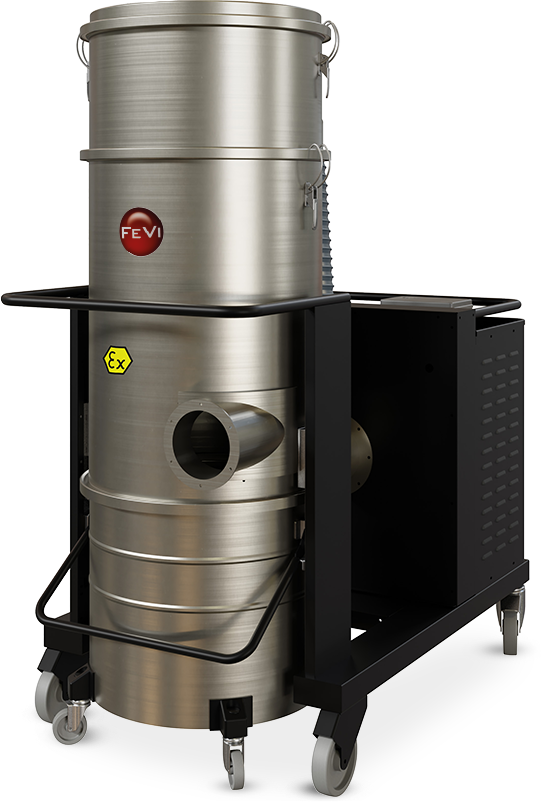


The explosion-protected certified FEVI DTX 2500 AIRCLEAN ATEX industrial dust collector is specifically designed to capture dust-laden air before the dust can spread throughout the working environment.
The official technical marking stated for the range is: II 3G Ex dc h IIB T3 Gc and II 3D Ex h tc IIIC T135 °C Dc IP65. Category 3G corresponds to external use in Zone 2 for gases, vapours or mists, while Category 3D corresponds to external use in Zone 22 for combustible dust.
Commercial communication may therefore refer to: Zone 2 for compatible gases, vapours or mists; Zone 22 for compatible combustible dust; gas group IIB; dust group IIIC; temperature class T3 for gases; declared maximum surface temperature T135 °C for dust; and IP65 protection rating.
Suitability must be verified by comparing the marking with the environmental classification, the characteristics of the substance and the company’s explosion-protection document.
Regulatory clarification regarding internal Zone 20: The documentation also uses the wording “Zone 20/22”, and the FEVI text states that the machine is constructed for internal Zone 20 and external Zone 22. This wording must be confirmed through the EU Declaration of Conformity and the ATEX manual. The 3D marking stated in the table identifies external Zone 22. For Zone 20, European regulations normally associate Category 1D equipment. Recommended cautious wording: “The machine is configured for external use in Zone 2 and Zone 22. Any classification of the internal chamber for Zone 20 must be verified in the EU Declaration of Conformity and in the specific documentation for the supplied configuration.”
Ideal Application: Source capture and extraction of fine, light, and volatile airborne dust in ATEX explosive atmosphere classified zones, connected to hoods, arms, or inline processes.
Key Advantages: AIRCLEAN automatic sequential compressed air pulse-jet cleaning featuring filter isolation solenoid valves, paired with a massive 80,000 cm² filtration surface area.
Model Selection: Heavy-duty 260 kg structure featuring a 4 kW three-phase centrifugal fan for high continuous airflow (2500 m³/h), built entirely with AISI 304 stainless steel.
Not Suitable For: Not suitable for use in external areas classified as ATEX Zone 0, 1, 20, or 21, and for floor collection of heavy solids, debris, or coarse metal swarf.
Product features
- 4 kW centrifugal fan for high airflow (2500 m³/h)
- The configuration is suitable for prolonged industrial operation with scheduled maintenance
- Integrated acoustic silencer to reduce noise
- 3GD certified for external ATEX Zone 2 (Gas) and Zone 22 (Dust)
- The ATEX version is supplied with an AISI 304 stainless-steel lid, filter chamber and container
- Configured for external use in Zone 2 and Zone 22 (Verify internal Zone 20 in the specific manual)
- Dust collector for intercepting and capturing dust at source during production processes
- Option to install and integrate an ATEX-compatible articulated extraction arm
- Dust collector for extracting very fine and airborne dust
- Solenoid system for temporarily closing and isolating the cartridge during cleaning to concentrate the pneumatic action
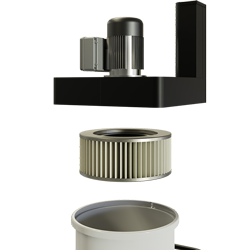
- MULTI-filter system consisting of No. 5 conductive aluminised cartridges (Total surface area of 80,000 cm²)
- Dust collector with automatic AIRCLEAN compressed-air filter cleaning, using a sequential cycle that maintains extraction through the cartridges not involved in cleaning
- The configuration described does not require dedicated external pneumatic connections for filter cleaning
- Type E 150 mm tangential air inlet
- The internal protection installed in front of the filters helps limit the impact of abrasive particles and improve preliminary separation
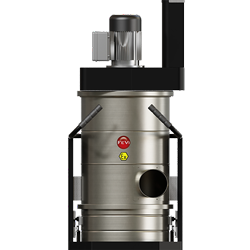
- Panelled fan enclosure designed to reduce noise and simplify external cleaning
- Highly customisable model during the design stage according to the specific requirements of the production line
- Thermal-magnetic switch supplied as standard for electrical protection of the fan
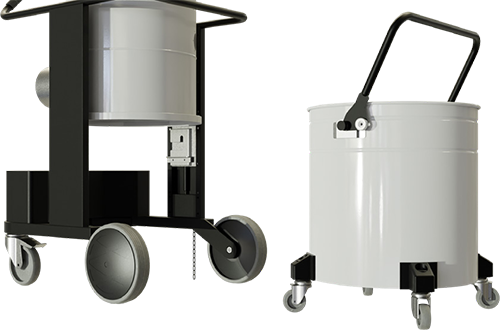
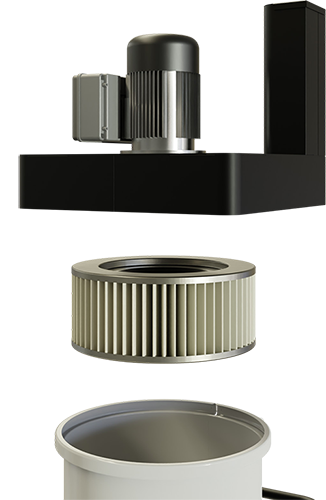
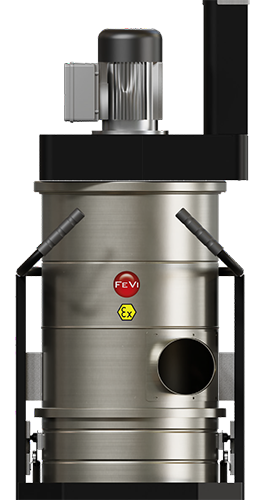
Capturing dust at source
The FEVI DTX 2500 AIRCLEAN ATEX unit can be effectively connected to: extraction hoods; articulated arms; machine enclosures; workbenches; hoppers; material-transfer points; dosing systems; production lines; and machinery that generates dust during its operating cycle. Capture must take place as close as possible to the source. Correct sizing depends on the required airflow, hood dimensions, piping diameter, route length, number of bends and simultaneous operation of the connected points.
Who it is recommended for
The model can be considered for: manufacturing industries; woodworking; the paper industry; plastics processing; the chemical industry; composite-material processing; sanding and grinding; mixing and dosing; transfer of powdered products; production departments where combustible dust is present; and machinery that generates dust continuously. The application must be rigorously assessed at the facility by considering: dust combustibility; particle size; explosion group; minimum ignition temperature; minimum ignition energy (MIE); resistivity; concentration; process temperature; quantity produced; and internal and external ATEX classifications.
Discover the main application sectors
- Mechanical workshops and structured turning departments;
- Surface finishing, grinding and sanding departments;
- Chemical, pharmaceutical and food industries in material-transfer areas;
- Joinery workshops and facilities processing lightweight wood materials;
- Plastic extrusion and moulding lines;
- Paint-production facilities, cement plants and volatile mineral-material dosing operations;
- Craft workstations for component assembly or finishing.
Main applications
Direct connection to production machinery
FEVI DTX 2500 AIRCLEAN ATEX can be connected to machinery that generates dust during the process, particularly when dust production is part of the machine’s normal operating cycle. The airflow of 2500 m³/h and filter surface area of 80,000 cm² make the model suitable for processes with a significant dust load and operating cycles in which reducing manual intervention on the filters is beneficial.
Localised capture through a hood
The dust collector can be connected to a hood positioned above, beside or around the source to intercept the contaminated airflow before it spreads throughout the department. A hood positioned too far from the source or with an excessively large opening requires greater airflow. The capture geometry must therefore be carefully designed together with the machine.
Integration with an articulated extraction arm
An articulated extraction arm can be integrated to position the capture inlet close to the process. The selected arm and connections must be fully compatible with the zone’s ATEX configuration and maintain the required electrical and equipotential continuity throughout the entire system.
Sanding, grinding and material-transfer stations
The model can be considered for workstations that generate dust during sanding, grinding, finishing, abrasive processes and the processing of composites or mineral materials, as well as during the dosing and transfer of powdered products where localised clouds are generated. A correctly positioned hood captures the dust. ATEX compatibility must be established according to the material actually being processed.
Technical Comparisons and Range Configurations
The DTX 2500 family offers several certified configurations designed to address the different behaviours of flammable dust in classified environments.
1. Difference between the AIRCLEAN ATEX, ICLEAN ATEX and ICLEAN + AIR ATEX versions
The three configurations share: a 4 kW fan; airflow of 2500 m³/h; vacuum pressure of 43 mBar; five cartridges; filter surface area of 80,000 cm²; 100-litre drum; stated ATEX marking; 150 mm tangential inlet; and optional HEPA filter. The main difference concerns the cleaning technology.
| Configuration Version | Filter-Cleaning Technology and Action | Selection Criteria and Dust Behaviour |
|---|---|---|
| DTX 2500 AIRCLEAN ATEX | Uses automatic sequential cleaning through compressed-air pulses. | Suitable when dust tends to adhere to the filter material and requires pneumatic impact to promote its release. |
| DTX 2500 ICLEAN ATEX | Uses the patented automatic mechanical ICLEAN system. | Regeneration is performed through timed mechanical action on the cartridges, without using compressed air. |
| DTX 2500 ICLEAN + AIR ATEX | Combines mechanical micro-vibrations with pneumatic compressed-air pulses. | This configuration should be considered when the dust is particularly fine, adhesive, lightweight or difficult to release. Summary selection must be based on the actual behaviour of the dust. |
2. Difference compared with the DTX 2500 BASIC ATEX configuration
| Model Configuration | Primary Filtration System | Cleaning Method and Dust Load |
|---|---|---|
| DTX 2500 BASIC ATEX | Single conventional polyester star filter. | Manual or semi-automatic cleaning. Suitable only when the dust load is moderate and compatible with periodic shutdowns. |
| DTX 2500 AIRCLEAN ATEX | MULTI-filter system with five cartridges (80,000 cm²). | Automatic sequential pneumatic cleaning. Extraction remains active during regeneration, making the configuration suitable for connection to production machinery. |
3. Difference compared with the standard non-ATEX version
The ATEX version retains the main performance characteristics of the standard configuration: 4 kW power; airflow of 2500 m³/h; vacuum pressure of 43 mBar; five cartridges providing a total surface area of 80,000 cm²; and a 100-litre drum. However, the ATEX configuration also includes: official 3G and 3D marking; components consistent with the stated protection; conductive aluminised cartridges; partial AISI 304 stainless-steel construction comprising the lid, filter chamber and drum; IP65 protection rating; specific grounding requirements; and the mandatory use of compatible accessories and piping. A standard dust collector cannot be used in a classified zone simply because it provides similar performance.
4. Structural difference compared with a DTX 1500 ATEX dust collector
The FEVI DTX 2500 AIRCLEAN ATEX provides greater airflow, a larger filter surface area, five cartridges instead of a single star filter, a 100-litre drum compared with the 50-litre drum of the smaller model, a 150 mm inlet and a greater capacity for managing continuous industrial production processes. A DTX 1500 ATEX is more suitable for individual workstations, smaller hoods and less demanding connections. Selection must be based on the calculated airflow requirement and system pressure losses.
5. Fundamental difference compared with an industrial vacuum cleaner
FEVI DTX 2500 AIRCLEAN ATEX is a high-airflow, low-vacuum dust collector. The configuration prioritises airflow and the capture of airborne dust and must therefore not be presented as an industrial vacuum cleaner for heavy materials. A high-vacuum industrial vacuum cleaner is more suitable for: floor cleaning; debris; compact solids; granular materials; heavy swarf; transport through small-diameter piping; and use with manual nozzles.
Request a technical zone assessment
Do you need to capture combustible dust from a machine or a classified production workstation?
Send us the official classification of your zone, the dust safety data sheet (MSDS), the gas or dust group, ignition temperature, quantity produced, required airflow, prepared connection diameter, piping length and operating-cycle duration. Together, we will verify the compatibility of the marking and the most suitable configuration among AIRCLEAN, ICLEAN and ICLEAN + AIR. Contact us to size the most suitable ATEX dust collector for your process.
Technical Data
DTX 2500 ICLEAN ATEX 2-22
| Material to be extracted | Airborne suspended dust |
| Motor | Three-phase centrifugal fan |
| Marking | II 3G Ex dc h IIB T3 Gc / II 3D Ex h tc IIIC T135 °C Dc IP65 |
| Power | 4 kW |
| Voltage | 400 V |
| Frequency | 50 Hz |
| Current | 10 A |
| Airflow | 2.500 m3/h |
| Vacuum pressure | 43 mBar |
| Inlet | Type E Tang. 150 mm |
| Dimensions | 146 x 84 x h188 cm |
| Weight | 260 Kg |
| Collection system | AISI 304 stainless-steel drum |
| Collection capacity | 100 L |
| Filter chamber diameter | Ø 560 mm (AISI 304 stainless steel) |
| Filter type | MULTI-filter with 5x cartridges |
| Filter properties | Aluminised conductive Class M |
| Filter surface area | 80.000 cm2 |
| Cleaning type | Timed automatic mechanical cleaning |
| HEPA filter type | Optional (Does not alter the ATEX marking) |
DTX 2500 AIRCLEAN ATEX 2-22
| Material to be extracted | Airborne suspended dust |
| Motor | Three-phase centrifugal fan |
| Marking | II 3G Ex dc h IIB T3 Gc / II 3D Ex h tc IIIC T135 °C Dc IP65 |
| Power | 4 kW |
| Voltage | 400 V |
| Frequency | 50 Hz |
| Current | 10 A |
| Airflow | 2.500 m3/h |
| Vacuum pressure | 43 mBar |
| Inlet | Type E Tang. 150 mm |
| Dimensions | 146 x 84 x h188 cm |
| Weight | 260 Kg |
| Collection system | AISI 304 stainless-steel drum |
| Collection capacity | 100 L |
| Filter chamber diameter | Ø 560 mm (AISI 304 stainless steel) |
| Filter type | MULTI-filter with 5x cartridges |
| Filter properties | Aluminised conductive Class M |
| Filter surface area | 80.000 cm2 |
| Cleaning type | Automatic sequential compressed-air cleaning (AIRCLEAN) |
| HEPA filter type | Optional (Does not alter the ATEX marking) |
DTX 2500 ICLEAN+AIR ATEX 2-22
| Material to be extracted | Airborne suspended dust |
| Motor | Three-phase centrifugal fan |
| Marking | II 3G Ex dc h IIB T3 Gc / II 3D Ex h tc IIIC T135 °C Dc IP65 |
| Power | 4 kW |
| Voltage | 400 V |
| Frequency | 50 Hz |
| Current | 10 A |
| Airflow | 2.500 m3/h |
| Vacuum pressure | 43 mBar |
| Inlet | Type E Tang. 150 mm |
| Dimensions | 146 x 84 x h188 cm |
| Weight | 260 Kg |
| Collection system | AISI 304 stainless-steel drum |
| Collection capacity | 100 L |
| Filter chamber diameter | Ø 560 mm (AISI 304 stainless steel) |
| Filter type | MULTI-filter with 5x cartridges |
| Filter properties | Aluminised conductive Class M |
| Filter surface area | 80.000 cm2 |
| Cleaning type | Automatic - Micro-vibrations + Compressed air |
| HEPA filter type | Optional (Does not alter the ATEX marking) |
FEVI DTX 2500 AIRCLEAN ATEX FAQ
For which zones is the dust collector configured?
Read the answer
The official 3G and 3D marking confirms conformity and suitability for external use in Zone 2 for gas risks and Zone 22 for combustible-dust risks.
Can it be installed in an external Zone 20?
Read the answer
No. It must not be installed in an external Zone 20 on the basis of the external 3D category. External Zone 20 normally requires higher-category 1D equipment.
What does the reference to internal Zone 20 mean?
Read the answer
It indicates a possible classification of security of the internal chamber during the collection and concentration of dust. This characteristic must be expressly verified in the EU Declaration of Conformity and the specific manual for the supplied machine.
What is the power rating of the dust collector and what power supply does it require?
Read the answer
It uses a 4 kW centrifugal fan and requires connection to a 400 V three-phase power supply.
What is the stated nominal airflow?
Read the answer
The stated airflow is 2500 m³/h, making it suitable for moving large volumes of air and airborne dust.
What vacuum pressure is generated by the centrifugal fan?
Read the answer
The generated vacuum pressure is 43 mBar, a value designed to provide consistent airflow in hood- or arm-based capture systems.
How many filters does it use and what is their total surface area?
Read the answer
The MULTI-filter system uses five separate filter cartridges providing a total filter surface area of 80,000 cm².
What class and properties do the filter cartridges have?
Read the answer
The five cartridges are Class M, with an aluminised surface finish and conductive construction designed to support electrostatic charge dissipation.
How are the cartridges cleaned in the AIRCLEAN ATEX version?
Read the answer
Cleaning is performed fully automatically using timed compressed-air pulses directed into the filters.
Does the general airflow stop during automatic cleaning?
Read the answer
No. The solenoid system temporarily isolates and closes only the individual cartridge undergoing the cleaning cycle, concentrating the impact action while the other cartridges continue to maintain the airflow.
Does the system require an external pneumatic connection or compressor?
Read the answer
The configuration described does not require dedicated external pneumatic connections for cleaning because it independently manages the required air through an integrated circuit. The final documentation will specify the circuit details.
Is a secondary absolute HEPA filtration stage available for this model?
Read the answer
Yes. The secondary HEPA filter is available as an option, but it does not automatically modify the machine’s original ATEX classification.
What is the capacity of the collection drum?
Read the answer
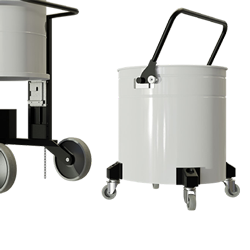
The removable collection drum has a volumetric capacity of 100 litres and is equipped with a lower quick-release system.
Can it be used to collect heavy metal swarf or construction debris?
Read the answer
No. It is not the primary or suitable solution for these materials. The dust collector is designed to handle high airflows containing lightweight and airborne dust; heavy solids or floor cleaning require a high-vacuum industrial vacuum cleaner.
Which machine components are manufactured from stainless steel?
Read the answer
In the stated official ATEX configuration for the range, the lid, upper filter chamber and lower container or drum are manufactured from AISI 304 stainless steel to support the electrical continuity of the system.
Must the external connection accessories be ATEX certified?
Read the answer
Yes. All external components, such as flexible hoses, hoods, articulated arms and metal connections, must be fully compatible with the zone classification and maintain the required electrical grounding continuity.
Is the machine suitable for prolonged factory operating cycles?
Read the answer
Yes. The industrial centrifugal fan and sequential automation of the AIRCLEAN system support prolonged industrial operation, provided that the required maintenance and periodic inspections are carried out.

