



 , Solid
 , Liquid


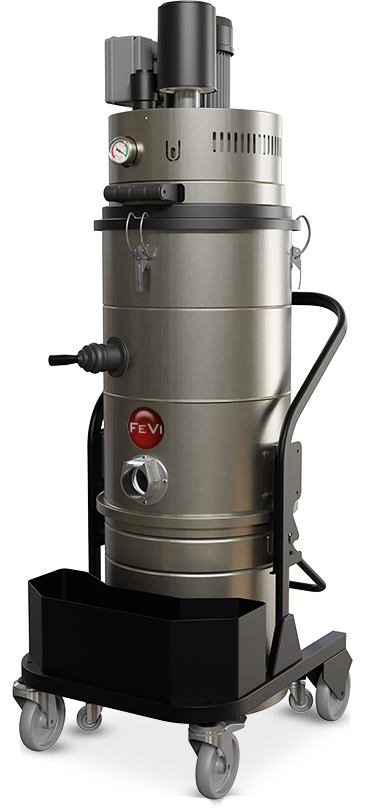
The FEVI BT / WT 753 BASIC industrial vacuum cleaner range uses a three-phase side-channel blower, a solution suitable for applications in which the vacuum cleaner must operate for prolonged periods and with greater continuity than traditional single-phase models.
The blower does not use carbon brushes subject to the normal wear typical of bypass motors. The machine is still subject to the routine maintenance required for filters, seals, hoses, the safety valve and vacuum components.
With a power rating of 3 kW, an airflow of 320 m³/h and a stated operating vacuum pressure of 320 mBar at 50 Hz, the BT / WT 753 BASIC range is designed for industrial operations, residue collection and maintenance activities requiring stable vacuuming performance.
Ideal Application: Designed for prolonged and continuous industrial suction of ordinary dust, dry solid residues, and alternating liquids inside workshops and production departments.
Key Advantages: Heavy-duty motorization with a brushless side-channel blower, a 75-liter quick-release drum, an integrated silencer, and a safety valve calibrated at 250 mBar.
Model Selection: Three-phase (400 V) 3 kW and 100 kg configuration, ideal if you require a structured machine for recurring and heavy-duty work cycles demanding high vacuum performance (320 mBar).
Not Suitable For: Multi-purpose unit for generic residues. It is not suitable for the massive, continuous suction of fine or clogging dust, intensive oil/swarf spills, or use in ATEX areas.
Dual Configuration: Available as the BT version featuring a 60 mm tangential inlet for cyclonic dust separation, or the WT version with a 70 mm central inlet and deflector for liquids.
Filtration & Maintenance: Equipped as standard with a 20,000 cm² antistatic polyester star filter and an integrated mechanical manual shaker system for periodic cleaning.
Who it is recommended for
FEVI BT / WT 753 BASIC is suitable for professionals and companies requiring robust, continuous industrial vacuuming:
Discover the main application sectors
- Mechanical workshops;
- Production departments;
- Metalworking companies;
- Industrial maintenance;
- Manufacturing industries;
- Warehouses and logistics areas;
- Industrial cleaning companies;
- Companies that need to collect ordinary dust and solid residues;
- Activities requiring liquid collection;
- Prolonged applications requiring a three-phase blower.
Main applications
Ordinary dust collection
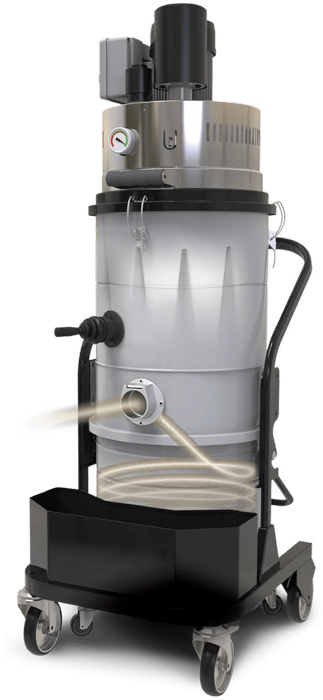
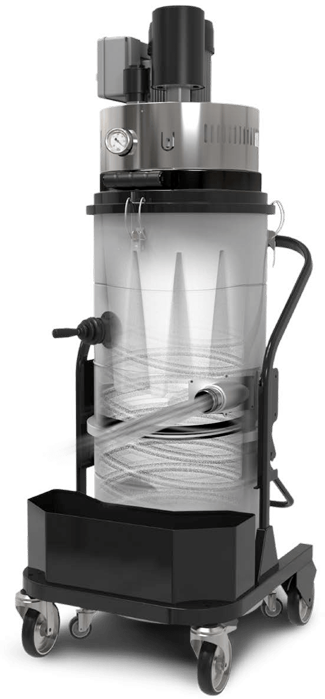
The BT 753 BASIC configuration with a tangential inlet is particularly suitable for collecting dust and dry residues. The flow enters the container from the side and generates a cyclonic movement that helps separate part of the material before it reaches the filter. This solution reduces the direct load on the filter surface compared with a traditional central inlet. For large quantities of fine, lightweight or clogging dust, it is preferable to consider a FEVI model with a dedicated filtration system and automatic filter cleaning.
Solid residue collection
FEVI BT / WT 753 BASIC can collect dry residues, processing waste and solid materials compatible with the hose diameter, inlet and filtration system. The 75-litre drum provides good collection capacity and can be released from the structure to simplify emptying.
Liquid collection
The WT 753 BASIC configuration uses a central inlet with a deflector. The deflector directs the flow towards the lower part of the container, limiting direct contact between the liquid and the filter. This configuration is more suitable when the application involves collecting liquids or alternating dry materials and liquids.
Workshops and industrial maintenance
In workshops, it can be used to collect processing residues, dust, small solids and compatible liquids. For significant quantities of oils, emulsions and metal swarf, it is more appropriate to consider a FEVI industrial vacuum cleaner specifically designed to separate and recover oil and swarf.
Production department cleaning
The three-phase blower makes the model suitable for periodic or prolonged cleaning of floors, machinery, production workstations and processing areas. The choice between BT and WT should be based on whether dust or mixed materials and liquids are predominant.
Why choose FEVI BT / WT 753 BASIC
3 kW three-phase blower: The 3 kW side-channel blower is suitable for prolonged use and provides more stable performance than the single-phase bypass motors used in vacuum cleaners intended for intermittent activities.
Two application configurations: The choice between a tangential inlet and a central inlet makes it possible to adapt the machine to the material being collected: BT for dust and dry materials; WT for versatile use with dry materials and liquids.
Polyester star filter: The polyester star filter provides a standard filter surface area of 20,000 cm², optionally expandable to 30,000 cm². An optional H13 HEPA absolute filter is also available, with a stated efficiency of 99.95% at the MPPS of 0.12 μm.
Integrated manual cleaning: The manual shaking system helps detach some of the dust accumulated on the filter. Cleaning must be carried out regularly, particularly when collecting fine or dusty materials, to limit the performance loss caused by clogging.
75-litre drum: The 75-litre quick-release drum collects significant quantities of material and simplifies emptying operations.
Safety valve: The safety valve protects the blower in the event of a blocked hose or conditions that generate excessive vacuum pressure. The calibration stated in the technical data is 250 mBar.
Integrated silencer: The silencer helps reduce the noise produced by the airflow and blower during operation.
Difference between BT 753 BASIC and WT 753 BASIC
The two versions share the same blower, power, collection capacity and filtration system; the main differences are the position and diameter of the inlet.
FEVI BT 753 BASIC (Dust)
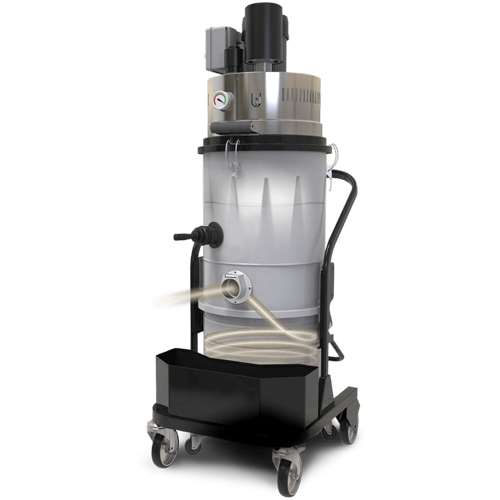
The BT version uses a 60 mm tangential inlet. The side inlet generates a cyclonic movement inside the container, promoting dust separation and reducing the direct load on the filter. It is recommended for:
- Dust and dry residues;
- Granular material;
- Cleaning departments and machinery;
- Collecting compatible solid waste.
FEVI WT 753 BASIC (Liquids and Mixed Materials)
The WT version uses a 70 mm central inlet with a deflector. The flow is directed downwards, helping to prevent liquids from reaching the filter directly. It is recommended for:
- Liquids and mixed residues;
- Alternating dry materials and liquids;
- Versatile cleaning of workshops and departments;
- Operations where versatility is a priority.
Technical Data
BT 753 BASIC
| Material to be collected | Dust and liquids |
| Motor | Three-phase side-channel blower (brushless) |
| Power | 3 kW |
| Voltage | 400 V 3P+E |
| Frequency | 50 Hz |
| Current | 6,7 A |
| Airflow | 320 m3/h |
| Vacuum pressure | 320 mBar – 50 Hz |
| Maximum vacuum pressure (valve) | 250 mBar |
| Inlet | Type B Tang. 60 mm |
| Dimensions | 80x60 h154 cm |
| Weight | 100 kg |
| Collection system | Quick-release drum |
| Collection capacity | 75 L |
| Filter chamber diameter | Ø 460 mm |
| Filter type | Polyester star filter (antistatic Class L) |
| Filter surface area | 20.000 cm2 - 30.000 cm2 optional |
| Cleaning system | Manual shaking |
| HEPA filter type | Optional H13 / 99.95% at MPPS 0.12 μm |
WT 753 BASIC
| Material to be collected | Dust and liquids |
| Motor | Three-phase side-channel blower (brushless) |
| Power | 3 kW |
| Voltage | 400 V 3P+E |
| Frequency | 50 Hz |
| Current | 6,7 A |
| Airflow | 320 m3/h |
| Vacuum pressure | 320 mBar – 50 Hz |
| Maximum vacuum pressure (valve) | 250 mBar |
| Inlet | Type C Cent. 70 mm with deflector |
| Dimensions | 80x60 h154 cm |
| Weight | 100 kg |
| Collection system | Quick-release drum |
| Collection capacity | 75 L |
| Filter chamber diameter | Ø 460 mm |
| Filter type | Polyester star filter (antistatic Class L) |
| Filter surface area | 20.000 cm2 - 30.000 cm2 optional |
| Cleaning system | Manual shaking |
| HEPA filter type | Optional H13 / 99.95% at MPPS 0.12 μm |
How the 753 BASIC range works
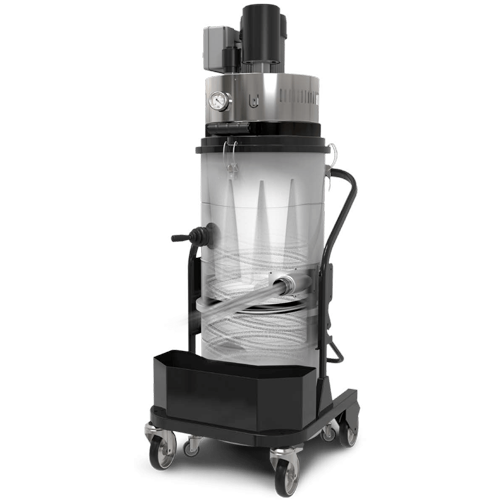
The material is drawn through the hose and conveyed into the 75-litre drum.
In the BT version, the tangential inlet gives the flow a rotating movement, helping the material fall towards the bottom of the container through the cyclonic effect.
In the WT version, the central inlet and deflector direct the material downwards, providing greater protection for the filter when collecting liquids.
The air then passes through the polyester star filter, which retains solid particles, before reaching the side-channel blower. The safety valve activates when the vacuum pressure exceeds the specified value of 250 mBar, while the silencer helps reduce the noise generated by the outgoing airflow.
Difference compared with a single-phase industrial vacuum cleaner
A single-phase industrial vacuum cleaner equipped with bypass motors is suitable for intermittent professional use, frequent movement and environments where only a 230 V power supply is available.
FEVI BT / WT 753 BASIC instead uses a three-phase side-channel blower and is more suitable when:
- The work continues for several consecutive hours;
- The vacuum cleaner is permanently integrated into a department;
- Greater operating continuity without interruptions is required;
- A 400 V three-phase industrial power supply is available;
- The machine must support demanding and recurring industrial operations.
Difference compared with ICLEAN models
ICLEAN models are designed mainly for managing fine dust and use automatic timed filter-cleaning systems.
FEVI BT / WT 753 BASIC is instead a more versatile machine equipped with a three-phase blower, a traditional star filter and manual cleaning. In summary:
- BT / WT 753 BASIC: Prolonged industrial vacuuming, ordinary dust, solids and liquids; / ICLEAN: Specific applications involving fine and lightweight dust;
- BT / WT 753 BASIC: Three-phase side-channel blower; / Single-phase ICLEAN: Traditional bypass motors;
- BT / WT 753 BASIC: Star filter with manual shaking; / ICLEAN: Fully automatic filter-cleaning system.
Selection guide and alternative models
When to choose the BT / WT 753 BASIC range:
- You need a three-phase industrial vacuum cleaner;
- You need to work for prolonged periods and continuous cycles;
- You want a side-channel blower without brushes subject to wear;
- You need to collect ordinary dust, solids or liquids;
- You want a robust, high-capacity 75-litre drum;
- You need a durable machine for workshop or production use;
- You want to select the most suitable inlet configuration, tangential or central;
- You do not primarily need to handle large quantities of fine or clogging dust;
- You do not operate in ATEX-classified areas;
- You do not need to separate oils and emulsions from metal swarf.
When to consider another FEVI model:
ICLEAN model: Consider this solution when the application mainly generates fine dust that tends to clog conventional filters quickly.
PULSE industrial vacuum cleaner: More suitable when standard HEPA absolute filtration, advanced filter cleaning and safer Longopac® continuous bag collection are required.
Single-phase industrial vacuum cleaner: Choose this solution when the work is not continuous or prolonged, or when a three-phase power supply is unavailable.
Industrial vacuum cleaner for oil and swarf: More suitable when the main requirement is to collect, separate and recover oils, emulsions and metal swarf from machine tanks.
ATEX industrial vacuum cleaner: Required for areas classified as having an explosion risk or in the presence of potentially explosive dust, subject to a technical assessment.
Usage recommendations and configuration parameters
Before selecting the industrial vacuum cleaner, we assess the following technical parameters together:
- The material to be collected and the exact prevalence of dust or liquids;
- The volumetric quantity produced and duration of the continuous working cycle;
- The diameter, length and distance of the flexible hose from the collection point;
- The need for direct on-machine extraction;
- The physical characteristics of the dust and any need for an additional HEPA filter;
- The availability of a three-phase power supply on site or any ATEX classification of the environment.
Remember that the choice between the BT and WT versions should not depend on power, which remains the same at 3 kW, but primarily on the predominant material and the type of inlet best suited to your operations.
Do you need to choose between BT 753 BASIC and WT 753 BASIC?
Describe the material to be collected, the presence of liquids, the quantity produced and the duration of the working cycle.
Together, we will assess whether the tangential inlet of the BT 753 BASIC, the central inlet of the WT 753 BASIC or another FEVI industrial vacuum cleaner designed for fine dust, oil and swarf, ATEX applications or higher-airflow requirements is more suitable.
Contact us to configure the industrial vacuum cleaner best suited to your application.
FEVI BT / WT 753 BASIC FAQ
Is FEVI BT / WT 753 BASIC a single-phase or three-phase industrial vacuum cleaner?
Read the answer
It is a three-phase industrial vacuum cleaner powered at 400 V and equipped with a 3 kW side-channel blower.
What is the difference between BT 753 BASIC and WT 753 BASIC?
Read the answer
The BT version uses a 60 mm tangential inlet, ideal for cyclonic dust separation. The WT version uses a 70 mm central inlet with a deflector, optimised to protect the filter when collecting liquids and mixed materials.
Can it collect liquids?
Read the answer
Yes. For applications involving frequent or predominant liquid collection, we recommend the WT configuration with a central inlet and filter-protection deflector.
Is it suitable for fine dust?
Read the answer
It can collect ordinary dust, but it is not the most specific model for large quantities of fine or clogging dust. In these cases, we recommend considering the dedicated ICLEAN or PULSE ranges with advanced filter-cleaning systems.
Can it operate continuously?
Read the answer
Yes. The three-phase side-channel blower is specifically designed for prolonged industrial operation. The effective operating cycle varies according to environmental conditions, the material collected and correct routine maintenance.
What is the drum capacity?
Read the answer
The quick-release collection drum has a capacity of 75 litres.
What type of filter does it use?
Read the answer
It uses a Class L antistatic polyester star filter with a standard filter surface area of 20,000 cm².
Is a HEPA filter available?
Read the answer
Yes. An H13 HEPA absolute filter with a stated efficiency of 99.95% at the MPPS of 0.12 μm is available as an option.
How is the filter cleaned?
Read the answer
The vacuum cleaner features an integrated mechanical manual shaking system, which must be operated while the machine is switched off.
What are the airflow and vacuum pressure values?
Read the answer
The stated airflow is 320 m³/h, with a vacuum pressure of 320 mBar at 50 Hz. The standard safety valve is calibrated at 250 mBar.
Is it an ATEX industrial vacuum cleaner?
Read the answer
No. For classified hazardous areas or potentially explosive dust, a specific ATEX configuration must be requested following a technical assessment.

