


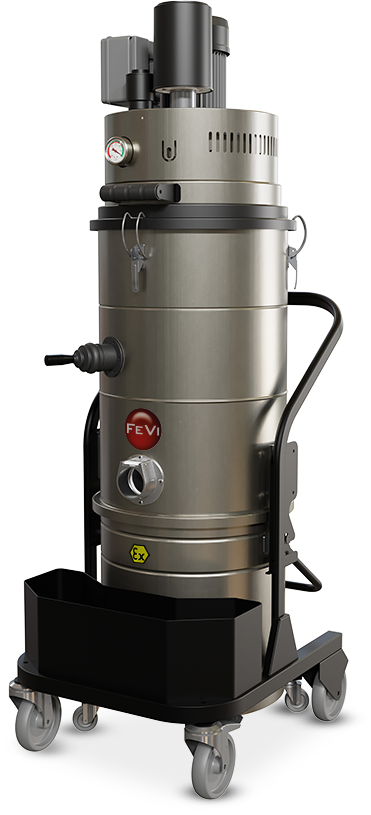


An ATEX industrial vacuum cleaner must be selected according to the classified zone, the type of potentially explosive atmosphere and the characteristics of the material to be collected.
The FEVI WT 753 BASIC ATEX industrial vacuum cleaner range is associated with the following marking: II 3G for atmospheres containing gases, vapours or mists; II 3D for atmospheres containing combustible dust; Gc protection level for gases; Dc protection level for dust; IIB gas group; T3 temperature class for gases; stated maximum surface temperature of 135 °C for dust; IP65 protection rating.
According to the European ATEX classification, 3G/Gc equipment is intended for Zone 2 and 3D/Dc equipment for Zone 22. Final compatibility must be verified against the EU Declaration of Conformity, the certificate or technical file and the user’s hazardous-area classification document.
Ideal Application: Multi-purpose cleaning and maintenance operations in hazardous locations classified as ATEX Zone 2 (Gas) and Zone 22 (Dust), with alternating collection of solids and compatible liquids.
Ideal Application: Multi-purpose cleaning and maintenance operations in hazardous locations classified as ATEX Zone 2 (Gas) and Zone 22 (Dust), with alternating collection of solids and compatible liquids.
Ideal Application: Multi-purpose cleaning and maintenance operations in hazardous locations classified as ATEX Zone 2 (Gas) and Zone 22 (Dust), with alternating collection of solids and compatible liquids.
Not Suitable For: Not suitable for unverified flammable liquid spills, ATEX Zones 0, 1, 20, or 21, or continuous inline collection of massive amounts of ultra-fine or clogging dust.
Who it is recommended for
FEVI WT 753 BASIC ATEX is suitable for companies that need to carry out vacuuming operations in areas classified as Zone 2 or Zone 22 and require a versatile machine for compatible dry materials and liquids. Suitability must not be determined solely on the basis of the business sector: the zone classification, nature of the substance, explosion group, ignition temperature, particle size, resistivity and operating conditions must be known. It is particularly suitable for:
Discover the main application sectors
- Manufacturing industries;
- Chemical plants;
- Food-processing companies;
- Plastic processing;
- Mixing and dosing departments;
- Workshops and maintenance operations in classified areas;
- Collection of combustible dust;
- Cleaning industrial plants and floors;
- Collection of solid residues;
- Collection of compatible liquids;
- Operations requiring antistatic components and equipotential bonding.
BASIC W (Central-inlet configuration)
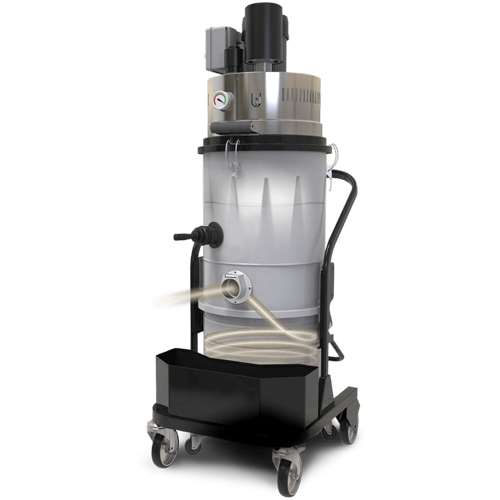
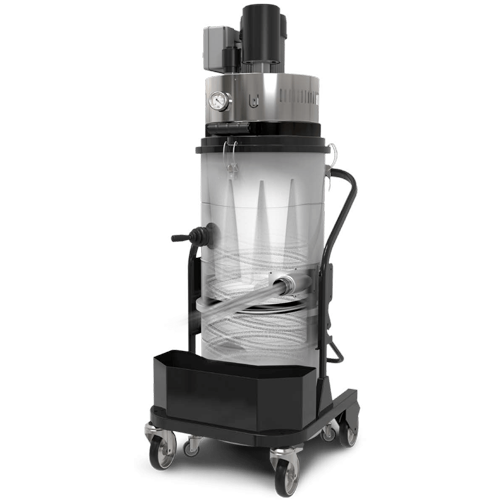
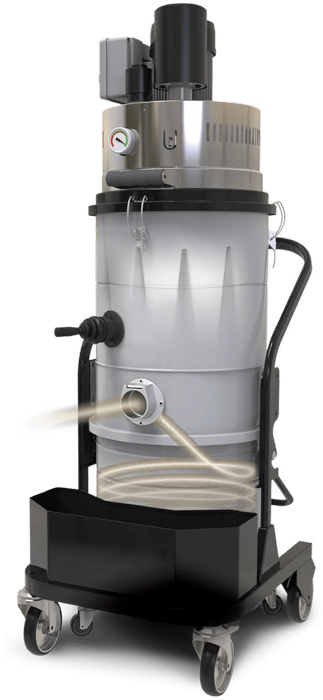
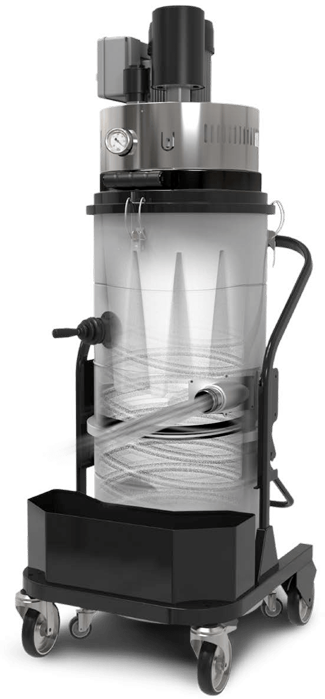
For a versatile industrial vacuum cleaner suitable for collecting different types of material, whether dry or liquid, the preferred inlet configuration is the central inlet. The WT configuration uses a 70 mm central inlet with a deflector. The deflector directs the liquid flow downwards, preventing the filter from becoming wet. This solution makes WT 753 BASIC ATEX more versatile than the BT configuration with a tangential inlet. For dust collection, however, it is less effective than the tangential inlet because the deflector considerably slows the dust flow, making the dust more likely to be drawn towards the filter. ATEX marking does not automatically make the vacuum cleaner suitable for every flammable liquid.
BASIC B (Tangential-inlet configuration)
The best configuration for dust collection is the tangential inlet, as the air velocity and flow entering the collection drum are higher than with conventional central inlets. This promotes the cyclonic effect and therefore provides greater separation of dust from the filter.
Main applications
Collection of combustible dust
FEVI WT 753 BASIC ATEX can be considered for combustible dust compatible with the stated marking and the area classification. The antistatic star filter and metal construction help manage the risk of electrostatic-charge accumulation, provided that the machine, accessories and piping are correctly connected and grounded. For fine, adhesive dust or dust produced in large quantities, the BASIC system with manual cleaning may not be the most effective solution. In these cases, we recommend considering an ATEX model equipped with cartridges and a dedicated automatic cleaning system.
Cleaning classified departments
The model can be used to collect material deposited on floors, machinery, structures, production workstations, dosing areas, packaging areas, systems and components. All accessories introduced into the area—hoses, nozzles, lances, reducers and fittings—must be compatible with the ATEX configuration and electrostatic-dissipation requirements.
Collection of solid residues
The 75-litre drum can collect solid residues, granular material and waste compatible with the inlet, piping and filtration system. Before use, we assess: particle dimensions, specific weight, abrasiveness, temperature, conductivity, risk of impact-generated sparks, possible presence of glowing materials and compatibility with the filter and container. Hot, glowing materials or materials capable of generating an ignition source must not be collected unless the configuration and procedure have been expressly approved.
Collection of compatible liquids
Before collecting liquids, the following must be verified: chemical compatibility with AISI 304 stainless steel, seals and components; possible flammability; liquid temperature; flash point; gas or vapour group; quantity collected; discharge method; grounding requirements; and the limits stated in the manual and ATEX Declaration.
Why choose FEVI WT 753 BASIC ATEX
Configuration for Zones 2 and 22: The stated 3G/3D marking identifies a configuration intended for environments in which an explosive atmosphere is not expected during normal operation or, if it occurs, persists only for a short period. The zones must be classified by the user through the risk assessment and required documentation. The industrial vacuum cleaner must correspond exactly to the zone, substance and operating conditions.
AISI 304 stainless-steel construction: The AISI 304 structure provides strength and good resistance in many industrial applications. Chemical compatibility must be verified when collecting corrosive substances, solvents, aggressive liquids or products that may interact with the steel, seals and internal components.
Side-channel blower: The side-channel blower is suitable for prolonged use and does not use the carbon brushes typically found in bypass motors. This does not mean that the machine is maintenance-free: filters, seals, electrical connections, grounding, safety valve, piping and ATEX components must be checked according to the manual and maintenance schedule.
Class M antistatic star filter: The primary polyester star filter has antistatic properties and is available with a standard surface area of 20,000 cm² or an optional surface area of 30,000 cm², with a stated Class M filtration rating and manual shaking cleaning. The antistatic configuration is essential, but it must operate together with correct electrical continuity throughout the system.
Optional HEPA filter: An optional secondary HEPA filter can be installed when increased filtration efficiency is required. The presence of a HEPA filter does not automatically alter the ATEX classification and does not replace verification of the compatibility of the complete machine.
75-litre ATEX drum: The 75-litre quick-release container allows the collected material to be removed without dismantling the filter chamber. Release, handling and emptying operations must be carried out in accordance with the procedures established for the collected substance and classified environment.
Central inlet with deflector: The central inlet makes WT 753 BASIC ATEX more suitable for versatile use with dry materials and liquids. When the application mainly involves dust, the BT version with a tangential inlet provides more effective cyclonic separation.
Safety valve and silencer: The safety valve protects the blower against excessive vacuum pressure caused, for example, by a blocked hose. The silencer helps reduce the noise generated by the airflow.
Product features
- Three-phase side-channel blower
- Suitable for continuous 24/7 operation without frequent maintenance
- Standard safety valve
- Silencer
- Versatile industrial vacuum cleaner for dust and liquids
- Star filter available with different surface areas and filter media
- Central inlet with deflector
- Integrated manual filter cleaning
- Extremely robust construction
- Version with a 75-litre quick-release collection drum
Difference between WT 753 and BT 753 BASIC ATEX
The two versions share the same blower, power rating, collection capacity and filtration system; the main differences are the position and diameter of the inlet.
FEVI WT 753 BASIC ATEX (Liquids and Mixed Materials)
The WT version has a 70 mm central inlet, internal deflector, greater versatility when collecting liquids, improved management of mixed materials and a reduced cyclonic effect compared with the BT version. It is recommended when the application includes liquids or alternates between dry materials and liquids.
FEVI BT 753 BASIC ATEX (Dust)
The BT version has a 60 mm tangential inlet, cyclonic movement of the material, improved preliminary dust separation, a reduced direct load on the filter and a configuration mainly intended for dry materials. It is recommended when the application primarily involves dust and dry residues.
Practical range overview
| Requirement | Recommended Configuration |
|---|---|
| Dry materials and liquids | WT 753 |
| Versatile use | WT 753 |
| Predominantly dust collection | BT 753 |
| Greater cyclonic effect | BT 753 |
| 400 V three-phase power supply | 753 |
| 230 V power supply | 751 |
| External area with gases/vapours | Verify 3G/Zone 2 marking |
| External area with dust | Verify 3D/Zone 22 marking |
Difference between the 751 and 753 versions
The family includes configurations with two different power supplies. The version covered by this page should be clearly identified as WT 753 BASIC ATEX, avoiding any mixing of 751 data in the introduction.
751 BASIC ATEX Version
Voltage: 230 V; stated power: 2 kW; current: 16 A; airflow: 320 m³/h; available with a WT or BT inlet.
753 BASIC ATEX Version
Voltage: 400 V; stated power: 2.6 kW; current: 6.7 A; airflow: 320 m³/h; available with a WT or BT inlet.
How the system works
The material enters through the central inlet and encounters the deflector, which directs the flow towards the bottom of the drum. Solid particles and compatible liquids are collected in the 75-litre container, while the air passes through the antistatic star filter. The filter retains solid particles and the filtered air continues towards the blower. Electrical continuity between the metal components, hose and accessories helps dissipate electrostatic charges. Correct grounding must be verified before use and during maintenance. When dust accumulates on the filter, the operator stops the machine and performs manual shaking in accordance with the specified instructions.
Comparison with other industrial models
Difference compared with the non-ATEX WT 753 BASIC
The two machines share the general operating concept of the BASIC range: side-channel blower, central inlet with deflector, star filter, manual shaking and 75-litre drum. However, the ATEX version incorporates specific features for classified environments, including ATEX marking, AISI 304 construction, an antistatic filter, components and protective devices compatible with the stated configuration, management of electrical continuity and a dedicated drum and collection system. A standard model must not be used in a classified area simply because it has similar power and performance values.
Difference compared with a model with automatic cleaning
FEVI WT 753 BASIC ATEX uses a star filter with manual cleaning. It is suitable when the dust is not particularly fine or clogging, the quantity of material is manageable, the machine can be stopped periodically and a simple, versatile configuration is preferred. An ATEX model with cartridges and automatic cleaning is preferable when large quantities of fine dust are collected, the filter tends to clog rapidly, vacuuming must remain active for longer periods, the machine is connected to a process and interruptions must be reduced.
Selection guide: When to choose it and alternative models
Choose this configuration when:
- The environment is classified as Zone 2 or Zone 22 and the 3G/3D marking is compatible with the risk assessment;
- You need to collect compatible dry materials and liquids through a central inlet with a deflector;
- A 400 V power supply is available and you require a blower for prolonged operation;
- The dust does not necessarily require automatic cleaning and the antistatic Class M filter is suitable for the substance;
- You require a rigid 75-litre drum and the gas group, temperature class and surface temperature are compatible.
When to consider another FEVI model:
- BT 753 BASIC ATEX: When the application primarily involves dust and you want to promote cyclonic separation.
- 751 BASIC ATEX version: When a 230 V power supply is required and the configuration is compatible with the application and area.
- ATEX industrial vacuum cleaner with automatic cleaning: When significant quantities of fine or clogging dust must be collected and interruptions need to be reduced.
- ATEX dust collector: When the priority is to capture airborne dust from hoods, benches, hoppers or dispersed sources.
- Industrial vacuum cleaner for oil and swarf: When cooling lubricants, emulsions and metal swarf must be collected and separated frequently.
Technical configuration recommendations
Before proposing FEVI WT 753 BASIC ATEX, we assess together: the external ATEX zone, any internal classification of the vacuum cleaner, type of substance, gas, vapour or dust, explosion group, ignition temperature, flash point, material temperature, particle size, conductivity and resistivity, minimum ignition energy, quantity to be collected, operating-cycle duration, presence of liquids, chemical compatibility, need for a HEPA filter, antistatic accessories, grounding system, and discharge and disposal method.
Correct ATEX selection cannot be based solely on the word “ATEX” or the power of the blower: it requires a combined analysis of all risk-related and operating parameters.
Do you need to collect dust or liquids in a classified area?
Send us the zone classification, material type, safety data sheet, quantity to be collected, temperature, operating frequency, presence of gases, vapours or combustible dust and the available power supply.
Together, we will verify compatibility between the application, ATEX marking, filter, inlet and collection system to configure the ATEX industrial vacuum cleaner best suited to your plant.
751 / 753 ATEX Technical Data
BT 751 BASIC ATEX 2-22
| Material to be collected | Dust and liquids |
| Motor | Blower |
| Marking | Zone 20/22 - II 3G Ex dc h IIB T3 Gc II 3D Ex h tc IIIC T 135°C Dc IP65 |
| Power / Voltage | 2 kW / 230 V |
| Frequency / Current | 50 Hz / 16 A |
| Airflow / Vacuum pressure | 320 m3/h / 320 mBar – 50 Hz |
| Maximum vacuum pressure | 200 mBar |
| Inlet | Type B Tang. 60 mm |
| Dimensions / Weight | 80x60 h154 cm / 100 Kg |
| Collection system / Capacity | Quick-release drum / 75 L |
| Filter chamber diameter | Ø 460 mm |
| Filter type / Properties | Polyester star filter / Antistatic Class M |
| Filter surface area | 20.000 cm2 - 30.000 cm2 Opt |
| Cleaning system | Manual shaking |
| HEPA filter type | Optional |
WT 751 BASIC ATEX 2-22
| Material to be collected | Dust and liquids |
| Motor | Blower |
| Marking | Zone 20/22 - II 3G Ex dc h IIB T3 Gc II 3D Ex h tc IIIC T 135°C Dc IP65 |
| Power / Voltage | 2 kW / 230 V |
| Frequency / Current | 50 Hz / 16 A |
| Airflow / Vacuum pressure | 320 m3/h / 320 mBar – 50 Hz |
| Maximum vacuum pressure | 200 mBar |
| Inlet | Type C Centr. 70 mm |
| Dimensions / Weight | 80x60 h154 cm / 100 Kg |
| Collection system / Capacity | Quick-release drum / 75 L |
| Filter chamber diameter | Ø 460 mm |
| Filter type / Properties | Polyester star filter / Antistatic Class M |
| Filter surface area | 20.000 cm2 - 30.000 cm2 Opt |
| Cleaning system | Manual shaking |
| HEPA filter type | Optional |
BT 753 BASIC ATEX 2-22
| Material to be collected | Dust and liquids |
| Motor | Blower |
| Marking | Zone 20/22 - II 3G Ex dc h IIB T3 Gc II 3D Ex h tc IIIC T 135°C Dc IP65 |
| Power / Voltage | 2,6 kW / 400 V |
| Frequency / Current | 50 Hz / 6,7 A |
| Airflow / Vacuum pressure | 320 m3/h / 320 mBar – 50 Hz |
| Maximum vacuum pressure | 220 mBar |
| Inlet | Type B Tang. 60 mm |
| Dimensions / Weight | 80x60 h154 cm / 100 Kg |
| Collection system / Capacity | Quick-release drum / 75 L |
| Filter chamber diameter | Ø 460 mm |
| Filter type / Properties | Polyester star filter / Antistatic Class M |
| Filter surface area | 20.000 cm2 - 30.000 cm2 Opt |
| Cleaning system | Manual shaking |
| HEPA filter type | Optional |
WT 753 BASIC ATEX 2-22
| Material to be collected | Dust and liquids |
| Motor | Blower |
| Marking | Zone 20/22 - II 3G Ex dc h IIB T3 Gc II 3D Ex h tc IIIC T 135°C Dc IP65 |
| Power / Voltage | 2,6 kW / 400 V |
| Frequency / Current | 50 Hz / 6,7 A |
| Airflow / Vacuum pressure | 320 m3/h / 320 mBar – 50 Hz |
| Maximum vacuum pressure | 220 mBar |
| Inlet | Type C Centr. 70 mm |
| Dimensions / Weight | 80x60 h154 cm / 100 Kg |
| Collection system / Capacity | Quick-release drum / 75 L |
| Filter chamber diameter | Ø 460 mm |
| Filter type / Properties | Polyester star filter / Antistatic Class M |
| Filter surface area | 20.000 cm2 - 30.000 cm2 Opt |
| Cleaning system | Manual shaking |
| HEPA filter type | Optional |
FEVI WT 753 BASIC ATEX FAQ
Which ATEX zones is it designed for?
Read the answer
The 3G/Gc and 3D/Dc markings are associated respectively with Zone 2 for gases, vapours or mists and Zone 22 for combustible dust.
Is it suitable for Zone 20?
Read the answer
The 3D/Dc marking does not normally correspond to Zone 20. The reference to Zone 20 should be removed or confirmed through specific certification and marking.
Can it collect flammable liquids?
Read the answer
It can only be considered after verifying the compatibility of the liquid, flash point, gas group, temperature class, construction materials and the conditions established by the manufacturer. It is not automatically suitable for every flammable liquid.
What is the difference between WT and BT?
Read the answer
WT uses a central inlet with a deflector and is more versatile for liquids. BT uses a tangential inlet and is more suitable for dust.
What is the difference between 751 and 753?
Read the answer
The 751 version uses a 230 V power supply; the 753 version uses a 400 V power supply.
What is the power rating of WT 753 BASIC ATEX?
Read the answer
The technical table assigns a power rating of 2.6 kW to the WT 753 version.
What is the airflow?
Read the answer
The stated airflow is 320 m³/h.
What is the drum capacity?
Read the answer
The collection drum has a capacity of 75 litres.
What type of filter does it use?
Read the answer
It uses a Class M polyester star filter with antistatic properties.
How is the filter cleaned?
Read the answer
The filter is cleaned using the integrated manual shaking system.
Is a HEPA filter available?
Read the answer
Yes. Optional HEPA filtration is available and must be configured according to the material and required filtration level.
Is it suitable for large quantities of fine dust?
Read the answer
It is not the preferred configuration for large quantities of fine, clogging dust. In these cases, we recommend an ATEX model with an automatic cleaning system.
Must the accessories be ATEX-compatible?
Read the answer
Hoses, nozzles and accessories must be compatible with the configuration, ensure electrical continuity and not introduce ignition sources.
Is grounding required?
Read the answer
Yes. Equipotential bonding and grounding are essential for dissipating electrostatic charges and must be checked periodically.

