


Solutions for collecting fine dust, fibreglass residues, abrasives, solids, liquids, oils and swarf during construction, maintenance and refitting.
Shipyards and boatyards carry out a wide range of operations on hulls, decks, metal structures, mechanical components and interior spaces. Fibreglass sanding, antifouling removal, filler sanding, composite-material cutting, abrasive blasting,
Read more
welding, painting and engine maintenance generate contaminants with different characteristics. These may include: fine dust from fibreglass and composite materials; dust from fillers, primers, gelcoat and paint; antifouling residues; spent abrasives and blasting waste; metal swarf and fragments; oils and emulsions; water and liquid residues; airborne dust; welding fumes; and vapours from resins, solvents and coating products. There is therefore no single industrial vacuum cleaner suitable for every shipyard operation.
FEVI industrial vacuum cleaners and dust collectors suitable for the shipbuilding and marine sectors
The compatibility shown below is application-based and must be confirmed case by case. Not all models are suitable for combustible dust or ATEX-classified environments.
Criteria for selecting the shipyard system
The selection and correct configuration of FEVI machines must be assessed by analysing three fundamental areas of the shipyard:
1. Type of Residue
Assessment of the substance, whether extremely fine airborne dust, heavy abrasive waste or oily liquids, together with its particle size and the possible presence of liquids.
2. System Variables
Calculation of the hourly quantities produced, piping length and extraction distance, average cycle duration and available power supply.
3. Safety and Containment
Assessment of combustible dust and shipyard areas or compartments requiring specific ATEX classification and marking.
Main applications in shipyards
Sanding fibreglass and composite materials
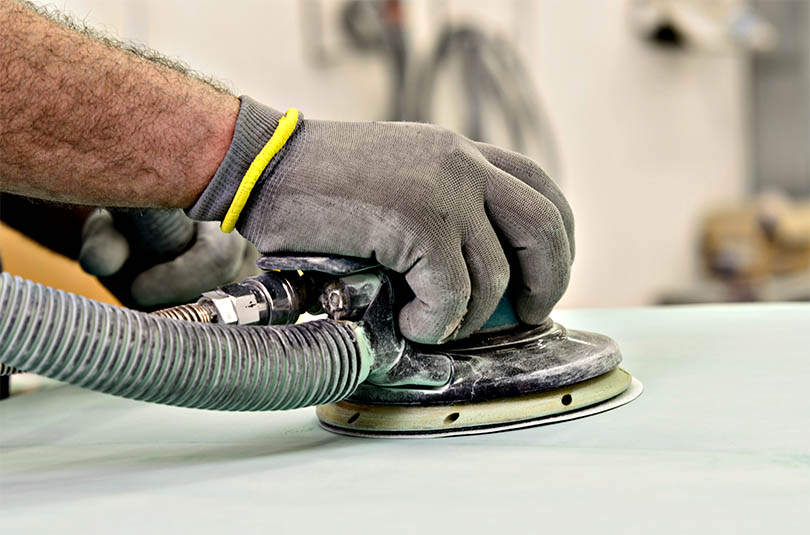
Sanding and cutting fibreglass, resins and carbon fibre generate fine, lightweight dust that settles on structures and remains suspended in the air. Localised operations can be managed by connecting the industrial vacuum cleaner directly to sanders, grinders, cutting tools, milling machines or extraction enclosures. Collection at source reduces dust accumulation on floors and surrounding areas. Composite-material processing can also involve exposure to vapours such as styrene during resin polymerisation: an industrial vacuum cleaner for dust does not replace the ventilation required for vapours.
Sanding fillers, primers and gelcoat
During hull refitting and repair, fillers, undercoats, primers, gelcoat, resins and protective coatings are applied and subsequently sanded. The resulting dust can be extremely fine and may rapidly clog conventional filters. For frequent operations, PTFE-coated filter cartridges, absolute HEPA filtration, automatic filter-cleaning systems and collection through a drum or Longopac are preferable, subject to verification of compatibility with the composition of the removed coating.
Removing antifouling coatings from hulls
Sanding or scraping antifouling coatings generates dust and fragments of toxic paint that must be collected promptly and managed in accordance with strict shipyard procedures, preventing uncontrolled dispersion or washing. The extraction system can be connected directly to the operating tool or used to clean and collect material deposited on the ground.
Abrasive blasting and recovery of heavy abrasives
Abrasive blasting hulls and metal structures generates spent abrasive, rust, detached paint, dust and metal residues. Collecting these heavy materials requires high vacuum pressure, abrasion-resistant piping, suitable inlets, robust containers and, where appropriate, a cyclonic pre-separator. A high-airflow dust collector does not replace a high-vacuum industrial vacuum cleaner for recovering grit or heavy abrasive.
General cleaning and engine-workshop maintenance
During ship construction and refitting, dust, sand, small solids, fragments, processing residues, water and wet dirt can accumulate. A multi-purpose industrial vacuum cleaner for dust, solids and liquids can be used to clean these working areas. In shipyard mechanical workshops, the maintenance of engines, gearboxes, pumps and components generates oils, emulsions, metal swarf and contaminated liquids. When the solid fraction must be separated from the liquid, an industrial vacuum cleaner specifically designed for oils and swarf is preferable.
Technical distinction between collection technologies
To ensure full compliance, FEVI divides shipyard solutions into three separate families:
Industrial Vacuum Cleaner (High Vacuum): Primarily suitable for deposited dust, solid residues, heavy abrasives, swarf, liquids, floor cleaning and direct connection to portable tools through flexible hoses. It prioritises material-conveying force.
Dust Collector (High Airflow / Low Vacuum): Suitable for capturing fine airborne dust when connected to hoods, enclosures, extraction arms, booths or workbenches in open sanding areas. It prioritises the movement of large volumes of air.
Ventilation for specific fumes and vapours: Welding fumes and vapours from paints, solvents, resins or styrene must not be treated as ordinary deposited dust. Welding fumes require localised capture close to the source through dedicated systems. Painting in marine environments, particularly in confined spaces, requires purpose-designed forced ventilation, concentration control and equipment compatible with the fire risk. A conventional industrial vacuum cleaner for dust is not suitable for extracting solvent vapours.
Managing fine fibreglass dust: key parameters
Advanced filtration and automatic cleaning: Frequent sanding of fillers and fibreglass requires cartridges suitable for fine dust, with an adequate filter surface area, PTFE coating and filter-integrity monitoring. Fibreglass dust tends to adhere to filter media, reducing airflow. An automatic cleaning system helps maintain more stable airflow during operation and reduces the frequency of manual intervention. The absolute claim “the filter never clogs” must not be used. The term HEPA alone is not sufficient; the class and efficiency must be verified on the specific machine.
Containment through the Longopac system: The Longopac continuous-bag system can be useful when dust must be collected directly into a continuous bag, limiting dispersion during emptying, creating bag sections of variable length and reducing the operator’s direct contact with fine material. The procedure must nevertheless be carried out using the personal protective equipment (PPE) and methods established by the shipyard.
Hot or incandescent materials: Sparks, hot slag, incandescent residues or dust generated immediately by thermal cutting that could ignite the contents of the drum must not be collected directly. In these cases, mechanical separators, anti-spark systems or specific cooling procedures must be integrated.
Quick configuration selection guide
Dust and composite-material processing
- Localised sanding and onboard hull work: FEVI PULSE 11XM, 11XA or FEVI 220 ICLEAN;
- Frequent sanding with large volumes of fine dust: FEVI 221 PULSE or FEVI 350 ICLEAN;
- Prolonged connection to tools or fixed overhead lines: FEVI TDC30 ICLEAN, or FEVI HDC 355 ICLEAN for more demanding networks;
- Fine suspended airborne dust captured through hoods or arms: FEVI DTX 1500 BASIC for a single workstation or FEVI DTX 2500 AIRCLEAN.
General cleaning, abrasives and workshop maintenance
- Ordinary dust, small solids and mixed liquids: FEVI WM 375 BASIC for single-phase applications or FEVI WT 753 BASIC for three-phase applications;
- Dry residues, sand and lightweight abrasive from blasting: FEVI BT 753 BASIC or the B configuration of the HDC 155 BASIC family;
- Oils, emulsions and metal swarf from engine workshops: FEVI OIL 140 or FEVI 1130 OIL;
- Combustible dust in ATEX-classified areas: FEVI DTX 2500 AIRCLEAN ATEX for airborne dust or pneumatic FEVI S PN ATEX Venturi versions.
Special engineered systems: When several operators work simultaneously or large quantities of heavy abrasive from hull blasting must be collected, using a mobile industrial vacuum cleaner may be impractical. The FEVI technical department develops complete customised centralised systems, including a central vacuum unit, fixed piping network, distributed connection points and dedicated cyclonic pre-separators, as well as specialised extraction systems for welding fumes or forced ventilation for solvent vapours in paint booths, which must never be conveyed into a conventional industrial vacuum cleaner for dust.
Key parameters to verify before configuration
Before recommending the final model, we assess the shipyard variables together: hull type and material, including fibreglass, carbon fibre, wood, steel or aluminium; nature of the waste, such as fine dust, solids, abrasives or liquids; particle size and hourly quantity produced; abrasive bulk density; temperature and spark risk; presence of solvents, styrene or volatile vapours; system parameters, including required airflow or vacuum pressure, piping length, hose diameter and number of bends; connection to a tool or hood; cycle duration; available power supply, whether single-phase, three-phase or compressed air; need for Longopac or absolute HEPA filtration stages; ATEX zone classification; and the layout of open or confined spaces.
Request a sizing assessment for your shipyard
Describe the material being processed, such as fibreglass, carbon fibre or metal, the type of operation, including sanding, antifouling removal or abrasive blasting, the hourly quantities produced, the exact capture point, total piping length, daily operating-cycle duration, the presence of liquids or heavy abrasives and any ATEX classification of the environment. Our engineering team will assess whether the most suitable solution is an industrial vacuum cleaner for fine dust with automatic cleaning, a multi-purpose solids-and-liquids model, a high-airflow dust collector, a machine for oils and swarf or a customised centralised system. Contact us to configure the most suitable solution for your shipyard operations.
Shipyard and Marine Solutions FAQ
Which industrial vacuum cleaner should be used for fine fibreglass dust?
Read more
For localised onboard work or small tools, the compact FEVI PULSE 11XM or 11XA models and FEVI 220 ICLEAN can be considered. For larger quantities and intensive continuous sanding, the higher-capacity FEVI 350 ICLEAN, TDC30 ICLEAN or HDC 355 ICLEAN models are recommended.
Is a secondary absolute HEPA filter always mandatory?
Read more
No. Filtration must be selected according to the actual particle size, the chemical composition of the dust and the specific shipyard risk assessment. For extremely fine and airborne dust, an absolute HEPA filter provides an important second level of protection for preserving health within the department.
Which type of industrial vacuum cleaner should be connected to an orbital sander?
Read more
A compact single-phase model is sufficient for a single sander used for occasional localised work. For prolonged operating cycles, fixed preparation stations or the simultaneous use of several tools, three-phase blower models or correctly sized centralised systems are preferable.
What is the fundamental difference between an industrial vacuum cleaner and a dust collector?
Read more
An industrial vacuum cleaner prioritises operating vacuum pressure to physically collect deposited material, including solids, liquids and abrasives, and transport it through a hose. A dust collector prioritises airflow, moving large volumes of air to capture suspended dust through hoods or extraction arms.
Can a FEVI DTX dust collector be used to collect heavy blasting grit?
Read more
No. It is not the correct technology. DTX models are high-airflow dust collectors designed to capture airborne and volatile dust. Removing metal grit or heavy spent blasting abrasive requires a high-vacuum industrial vacuum cleaner, preferably combined with a pre-separator.
Which industrial vacuum cleaner should be used for antifouling removal?
Read more
A model specifically designed for fine dust, with PTFE and HEPA filtration, must be connected directly to the removal tool or used to collect deposited residues. The chemical composition of the removed coating must always be verified before selecting the filter and disposal procedures.
Can resin vapours, styrene or solvents be extracted using a conventional industrial vacuum cleaner?
Read more
No. This is strictly prohibited. Toxic vapours and volatile organic solvents cannot be treated as ordinary deposited dust and require dedicated industrial forced-ventilation systems, concentration monitoring and compatible specialised equipment.
Which machine should be selected to collect water, sludge and wet dirt onboard?
Read more
The multi-purpose solids-and-liquids models FEVI WM 375 BASIC, single-phase, FEVI WT 753 BASIC, three-phase with central inlet and deflector, or HDC W 155 BASIC can be considered. The configuration must be selected according to operating duration, quantities and extraction distance.
Which industrial vacuum cleaner should be used in internal engine-maintenance workshops?
Read more
FEVI OIL 140 is suitable for collecting and handling large volumes of fluids, with discharge through an integrated electric pump. FEVI 1130 OIL is more suitable for demanding and continuous applications due to its 3 kW three-phase blower and rapid reverse-airflow discharge.
Is an ATEX-certified industrial vacuum cleaner always required inside a shipyard?
Read more
ATEX equipment is mandatory only when the risk assessment and official classification of the environment, particularly in confined spaces, identify a potentially explosive atmosphere. The machine marking must be compatible with the substance group and temperature.
Can a centralised shipyard sanding system be installed?
Read more
Yes. A custom-designed centralised system is the ideal choice when several operators or workstations must be served simultaneously, or when significant linear distances along hulls make moving mobile industrial vacuum cleaners impractical.

