


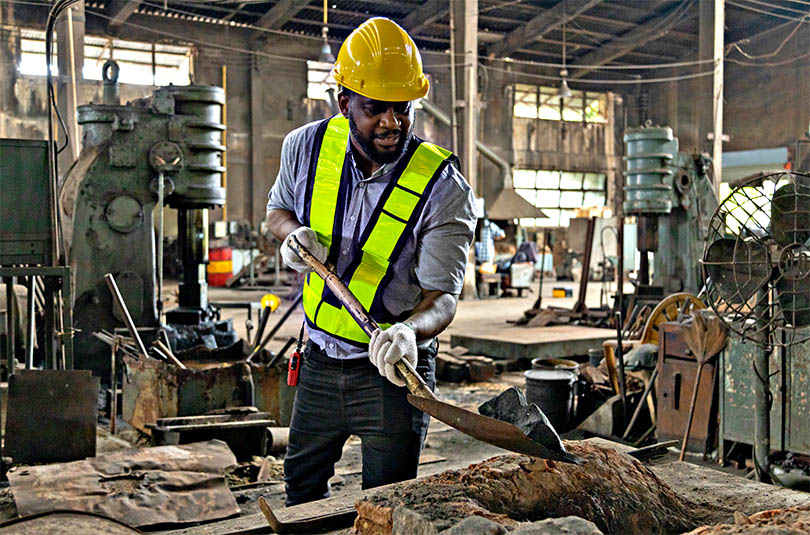
Heavy-duty solutions for collecting mill scale, metal dust, flakes, abrasive residues, heavy solids, oils and swarf during production and maintenance.
Steelmaking and metallurgical plants handle heavy, abrasive materials and, during certain process stages, materials at high temperatures. During the operations of production, rolling, drawing, cutting, grinding, handling and maintenance,
Read more
the following may be generated: mill scale and oxide flakes; iron and steel dust; metal residues; slag; swarf; granular material; coal and coke dust; refractory residues; oils and coolant emulsions; sludge; grinding dust; welding or thermal-cutting fumes; and hot or potentially incandescent material. The ideal system configuration must be defined according to particle size, density, abrasiveness, temperature, quantity, extraction distance and residue composition. No single industrial vacuum cleaner is suitable for every area of the plant.
FEVI industrial vacuum cleaners and dust collectors suitable for the steel industry
The compatibility shown below is application-based. Final performance and reinforced internal configurations must be validated in accordance with the bulk density of the residues and the plant’s thermal map.
Criteria for selecting the steel-industry extraction system
The selection and correct configuration of FEVI machines must be structured by analysing three fundamental areas of the plant:
1. Physical State and Temperature
Assessment of the presence of heavy abrasive flakes, extremely fine dust, emulsified liquids or hot and potentially incandescent materials.
2. System Layout
Calculation of hourly accumulation volumes, steel-piping length and diameter, linear pressure losses and the simultaneous-use factor.
3. Safety and Exposure
Mapping of pulmonary-accumulation risks, including siderosis, gas monitoring and ATEX classification for combustible fine coal or coke dust.
Managing mill scale and rolling flakes
Mill scale, also known as rolling scale, consists mainly of oxides formed on the surface of iron and steel during hot processing. It can detach during rolling, drawing, forging, product handling, straightening, brushing, cooling or line maintenance. Its composition includes different iron oxides and other substances originating from the steel, lubricants and production areas. It must therefore not be considered a uniform or contaminant-free material.
Heavy coarse mill scale: Larger flakes are heavy, abrasive, irregular and sometimes sharp materials that can rapidly wear hoses and bends and are difficult to convey through long lines. For their collection, one should prioritise high operating vacuum pressure, abrasion-resistant piping, tangential inlets, robust rigid containers, replaceable internal protection and, where necessary, pre-separators structured for forklift handling.
Fine oxide dust: The mechanical processing of mill scale also generates a fine fraction consisting mainly of metal oxides. This part reaches the filter rapidly and requires cartridges with a PTFE membrane, high filter surface area, continuous automatic cleaning systems and absolute HEPA filtration. Prolonged inhalation of iron-oxide dust and fumes can lead to pulmonary accumulation and a pneumoconiosis known as siderosis: the composition must always be assessed according to the specific alloy.
Applications and stages of metallurgical production
Raw-material handling and coke plants
Ores, coal, coke, fluxes and recycled materials generate dust during unloading, transport on belts, dosing, crushing, screening or filling hoppers. To collect material deposited on the floor, a high-vacuum industrial vacuum cleaner is required, while for airborne dust clouds, a hood connected to a dust collector is necessary. Coal and coke produce combustible fine dust: their presence requires a specific ATEX assessment of areas where an explosive cloud may form.
Furnaces and high-temperature melting areas
Areas near furnaces contain dust, refractory residues, slag, oxides and hot waste. A standard industrial vacuum cleaner must never collect incandescent material or material exceeding the thermal limits of filters and seals. Real temperature, presence of sparks, cooling time and the thermal resistance of every component must be considered, integrating special high-temperature systems designed on a bespoke basis where necessary.
Rolling, drawing and brushing
These processes generate mill scale, flakes, metal dust, abrasive fragments, water, damp material, sludge and process oils. Collecting dry mill scale generally requires a different configuration from that necessary for sludge or oily residues. Brushing machines, shot-blasting machines and grinding machines produce fine abrasive dust: an industrial vacuum cleaner is suitable for deposited material, while a dust collector is required for suspended clouds.
Cutting, grinding and CNC machining
Saws, shears, lathes and machining centres produce offcuts, swarf, metal particles, oils, emulsions and sludge. Dry residues can be collected with an industrial vacuum cleaner for solids, while fluid mixtures require specific OIL models capable of separating the solid fraction from the liquid one. Dry grinding and metal grinding produce fine dust requiring advanced filter surfaces, automatic cleaning and verification of the alloy's combustibility.
Aligning technical equipment: Industrial Vacuum Cleaner vs Dust Collector
To operate in full safety, FEVI workshop and site systems must clearly distinguish the nature of the contaminant:
Deposited dust: Can be collected effectively using a high-vacuum industrial vacuum cleaner connected to suitable piping and accessories.
Suspended airborne dust: Must be intercepted at source using hoods, casings, articulated extraction arms or workbenches connected to a high-airflow dust collector.
Welding fumes and thermal-cutting gases: Welding and cutting fumes must not be treated as ordinary dust. They must be captured as close as possible to the emission point using specific hot-fume systems (extraction torches, dedicated arms or hoods). Composition varies according to the material (stainless steel, galvanised or alloyed steel) and generates different hazardous contaminants.
Process gases and ignition sources: Carbon monoxide (CO), sulphur dioxide (SO₂), combustion gases and other gaseous contaminants are not handled using common dust-collection units. They require engineered forced ventilation, constant atmospheric monitoring, dedicated extraction and specific procedures for confined spaces.
Classification of FEVI industrial systems
Our engineered responses for the steelmaking sector are divided into four main configurations:
- High-Vacuum Industrial Vacuum Cleaner: The appropriate tool for removing heavy mill scale, flakes, heavy solids, granular material, and for cleaning beneath lines and along conveyors and elevators. It generates the vacuum force necessary to overcome height differences and pressure losses in long, narrow-diameter piping.
- Fine-Dust Vacuum Cleaner: Specific configuration for metal-oxide dust, grinding, sanding, brushing or dry shot-blasting dust. Uses advanced cartridges and continuous cleaning systems to prevent permanent accumulation of fine, clogging particles. Connects directly to machine tools.
- High-Airflow Dust Collector: Intended for suppressing volatile dust clouds at hoppers, loading/unloading points, screens, mixers, transfer areas and grinding benches that require high airflow volumes. Does not collect flakes or heavy solids from the floor.
- Centralised Facility System: Implemented when several areas or cabinets must be served simultaneously over long distances, with several simultaneous operators. The system coordinates a heavy-duty fixed central vacuum unit connected to abrasion-resistant piping networks, collection separators and controlled discharge into Big Bags or hoppers.
Wear-protection and filtration systems for the steel industry
Wear-resistant structure and tangential inlets: Mill scale, flakes and metal fragments rapidly damage standard ducting. FEVI uses thick abrasion-resistant polyurethane or reinforced-rubber piping that resists crushing. The tangential inlet imparts a continuous rotating movement to the airflow inside the chamber, providing preliminary separation of the heaviest particles before they reach the filter. Structural points directly struck by the flow (inlets, bends, cyclone walls) are protected with interchangeable wear plates or Vulkollan linings to preserve the structure.
Class M filtration, PTFE and ICLEAN cleaning: Ordinary or coarse dust is effectively handled by a star filter with manual or semi-automatic cleaning. For extremely fine dust, cartridges with a PTFE membrane limit penetration and facilitate sediment release, assisted by the automatic ICLEAN cleaning system that operates cyclically to maintain stable airflow. Absolute secondary HEPA filters are applied in the presence of hazardous alloys or contaminants identified by the risk assessment.
Regulatory framework and ATEX explosion risk
Cement or pure-cement dust is generally not classified as combustible; similarly, stable pure iron dust or steel mill scale does not present an intrinsic explosion risk. The ATEX risk in steelmaking plants is instead concentrated in departments that use, transport or store: coal, lignite, pet coke, alternative fuels, biomass, shredded plastic materials or other combustible carbon-based or organic products capable of forming explosive atmospheres when dispersed in air. An ATEX industrial vacuum cleaner is not required automatically for common iron dust or steel mill scale; it must be assessed in departments where coal, pet coke, alternative fuels or other combustible substances may form explosive atmospheres. In these areas, the marking of the selected unit, whether the FEVI DTX 2500 AIRCLEAN ATEX centrifugal dust collector or the FEVI S PN ATEX pneumatic range, must be rigorously compared with the zone classification, dust group (IIIB or IIIC) and ignition temperature of the actual material.
Storage and recovery of secondary raw materials
Mill scale, iron-rich dust and certain smelting by-products can be successfully recovered or reintroduced into the steelmaking process when their chemical composition, absence of oil contamination, moisture and particle size allow it. European technical documents recognise that mill scale, dust and sludge with sufficient iron or carbon content may be assessed as secondary raw materials, but the actual possibility depends on the composition of each individual flow. Industrial vacuum cleaning facilitates separate collection at source but does not automatically make the material reusable. In the presence of significant volumes of heavy abrasive material, FEVI integrates the industrial vacuum cleaner with dedicated pre-separators, hoppers, forklift-compatible tipping containers or controlled discharge systems into Big Bags, reducing manual loads and safeguarding the integrity of primary filters.
Quick configuration selection guide
Mill scale, solids and maintenance
- Recovery of coarse mill scale and heavy flakes from the floor: FEVI HDC B 155 S BASIC combined with thick abrasion-resistant hoses and replaceable internal plates;
- Fine metal-oxide dust or dry grinding residues: FEVI TDC30 ICLEAN (three-phase) or FEVI HDC 355 ICLEAN (for long piping and multiple operators);
- General workshop cleaning and modest quantities of fluids (230 V): FEVI WM 375 BASIC (or FEVI BT / WT 753 BASIC for prolonged three-phase use).
Suspensions, fluids and ATEX areas
- Capturing airborne clouds from grinding workstations or hoppers: FEVI DTX 1500 BASIC for a single source or the automatic FEVI DTX 2500 AIRCLEAN;
- Emptying of CNC machine tools and oil/swarf separation: FEVI OIL 140 with single-phase pump or FEVI 1130 OIL with three-phase airflow-reversal discharge;
- Coal, pet-coke or biomass storage departments (Zone 22): FEVI DTX 2500 AIRCLEAN ATEX for airborne dust or FEVI S PN ATEX for localised cleaning;
- Hot or potentially incandescent material from furnaces: Requires a special high-temperature configuration with settling chambers and preliminary separation of hot particles (no automatic connection to standard models).
Key parameters to verify before configuration
Before defining the proposal, we assess the steel-plant variables together: installation area and production stage; nature of the waste, including mill scale, oxide dust, slag, swarf or fluid; particle size, density and abrasiveness of the residue; actual temperature and risk of sparks or incandescent material; presence of oils, water or corrosive pickling acids; metal-alloy composition; line parameters, including length/diameter of abrasion-resistant piping, bends, vertical height differences, and pressure losses; operating hours and simultaneity of extraction points; required discharge type, including drum, hopper, Longopac or Big Bag; and ATEX zone classification.
Request a sizing assessment for your steelmaking facility
Do you need to collect mill scale, dust or residues inside a steelmaking or metallurgical plant?
Describe the specific process stage in detail, such as rolling, charge handling or maintenance, the exact type of material to be collected, dust particle size, hourly quantity produced, actual residue temperature, linear distance and total piping run, duct diameter, presence of liquids, emulsions or emulsified oils, any ATEX classification of the departments and the required discharge method. Our engineering department will assess the correct vacuum-pressure and airflow parameters, the configuration of Vulkollan abrasion-resistant protection, filtration class and the most suitable collection or pre-separation systems. Contact us to configure the perfect extraction system for your plant.
Steelmaking Plant Solutions FAQ
Which industrial vacuum cleaner should be used for coarse mill scale?
Read more
For coarse mill scale and heavy rolling flakes, the three-phase FEVI HDC B 155 S BASIC is preferable. It is configured specifically for high operating vacuum pressure, equipped with a tangential inlet and combined with abrasion-resistant flexible piping and replaceable internal plates.
Which industrial vacuum cleaner should be selected for fine mill-scale dust?
Read more
For the management of the fine fraction consisting of airborne metal oxides, units from the ICLEAN range, such as the FEVI TDC30 ICLEAN or FEVI HDC 355 ICLEAN, are indicated, equipped with PTFE filter cartridges and continuous automatic cleaning systems.
Do mill scale and ordinary iron dust present the same chemical nature?
Read more
Not exactly. Mill scale is a complex oxide layer formed on the metal surface exclusively during hot industrial processing (forging, rolling) and is present as flakes or oxide dust. Ordinary iron dust instead originates from cold mechanical processes such as grinding, sharpening or cutting.
Can rolling flakes and mill scale be recovered?
Read more
Yes. European technical documents recognise that mill scale and steelmaking dust with a high iron content and without substantial heavy oil contamination can be assessed as secondary raw materials and reintroduced into the destination production process.
What is the fundamental difference between an industrial vacuum cleaner and a dust collector in a steelworks?
Read more
An industrial vacuum cleaner operates at high vacuum pressure to collect heavy solids, flakes, granules and material deposited on floors through narrow suction pipes. A dust collector instead operates at high airflow to capture and filter light airborne dust clouds through hoods or carters.
Can a FEVI DTX centrifugal dust collector collect heavy flakes from the floor?
Read more
No, it is not the correct technology. The FEVI DTX range is designed for the airborne capture of light volatile dust in suspension and generates high airflow but lower operating vacuum pressure, insufficient to lift and convey heavy solids accumulated on the floor.
Which FEVI model should be selected in the presence of very long piping networks?
Read more
For conveying heavy materials over long distances, the two-stage high-vacuum blower of the FEVI HDC 155 S BASIC model is used. If the main contaminant is fine or volatile airborne dust, FEVI HDC 355 S ICLEAN is selected.
Is it permitted to collect slag and refractory residues from furnaces?
Read more
No, this is strictly prohibited with standard machines. Hot residues and incandescent slag compromise the integrity of filters and seals and can trigger fires inside the drum. Material must be left to cool, or a special high-temperature configuration must be implemented.
Which industrial vacuum cleaner should be used for maintenance of fluid sumps in internal workshops?
Read more
For medium to large CNC sumps in departments equipped only with a single-phase supply, the FEVI OIL 140 unit equipped with a liquid-discharge electric pump is indicated. For prolonged and continuous three-phase operating shifts, the FEVI 1130 OIL industrial vacuum cleaner with reverse-airflow discharge is more appropriate.
Do steelmaking plants and steelworks always require ATEX-certified machinery?
Read more
No. An ATEX configuration is not required for ordinary iron dust or stable steel mill scale. It becomes mandatory only in departments where combustible materials such as coal, lignite, pet coke or biomass are stored or conveyed and can form explosive atmospheres dispersed in air.
Can common fine iron dust be considered explosive?
Read more
No, not intrinsically. Combustibility depends strictly on the chemical composition of the alloy, the particle size, airborne concentration and process temperatures. Not all iron-based dust presents the same flammability behaviour.
Which industrial vacuum cleaner should be used in the presence of fine coal or coke dust?
Read more
In these ATEX-classified areas, a compliant configuration must be adopted: to capture fine dust in suspension, the FEVI DTX 2500 AIRCLEAN ATEX centrifugal dust collector is used, while for localised cleaning, the pneumatic FEVI S PN ATEX line is used.
Is the installation of an absolute secondary HEPA filter always necessary?
Read more
No. The filtration class and safety stage must be chosen according to the actual particle size of the dust, chemical composition of the alloys and the specific threshold limit values (TLV) established for the department.
Is a standard industrial vacuum cleaner for dust capable of treating welding fumes?
Read more
No, hot fumes and thermal-cutting gases cannot be treated as ordinary dust and require dedicated localised capture systems (extraction torches, articulated arms or specialist fume extractors with suitable filters) positioned as close as possible to the emission source.
When is it genuinely useful or recommended to add a pre-separator?
Read more
The use of an in-line cyclonic pre-separator is highly recommended when the residue is highly abrasive, when the quantities collected would fill the machine drums within minutes, or when steel material is to be sent directly for recovery, separating it from spent dust.

