


Solutions for machining centres, mitre saws, milling machines, sanding machines and production lines for windows, doors and profiles.
Torni, fresatrici, centri di lavoro CNC, rettificatrici, trapani, segatrici e macchine transfer producono residui molto differenti per forma, peso, granulometria e stato fisico. Durante le lavorazioni meccaniche possono essere presenti: oli da taglio; emulsioni lubrorefrigeranti; trucioli metallici; particelle solide; morchie;
Read more
residui fangosi; polveri fini da rettifica; polveri da smerigliatura; piccoli sfridi metallici; liquidi nelle vasche; sporco depositato intorno alle macchine; nebbie oleose disperse nell’aria e fumi e gas prodotti dalla saldatura. La scelta dell’aspiratore industriale ideale deve partire rigorosamente dalle caratteristiche del materiale realmente prodotto.
FEVI solutions for oils, emulsions and metal swarf
The compatibility shown below is application-based. Final performance and configurations must be validated according to fluid viscosity and swarf type.
Criteria for selecting the workshop extraction system
The selection and correct configuration of FEVI machines must be defined by analysing three fundamental areas of the metalworking department:
1. Physical State of the Waste
Assessment of the presence of coolant fluids, wet or dry metal swarf, high-density sludge on the bottom of machine sumps or fine abrasive dust.
2. Conveying Parameters
Calculation of hourly solid quantities, flexible-hose length, pressure losses, discharge height and the available power supply.
3. Safety and Containment
Mapping of the flammability risk associated with fine metal dust, including aluminium and magnesium, and verification of the need to capture aerosols, oil mist or fumes.
Analysis of the main residues generated by mechanical machining
Cutting oils and coolant emulsions: Machining fluids, including neat oils, water-based emulsions and synthetic or semi-synthetic fluids containing additives, are used to cool the tool and workpiece, reduce friction and temperature, lubricate the cutting area, assist swarf removal and improve the final machining quality. Chemical compatibility, viscosity, temperature and fluid condition must be verified before collection.
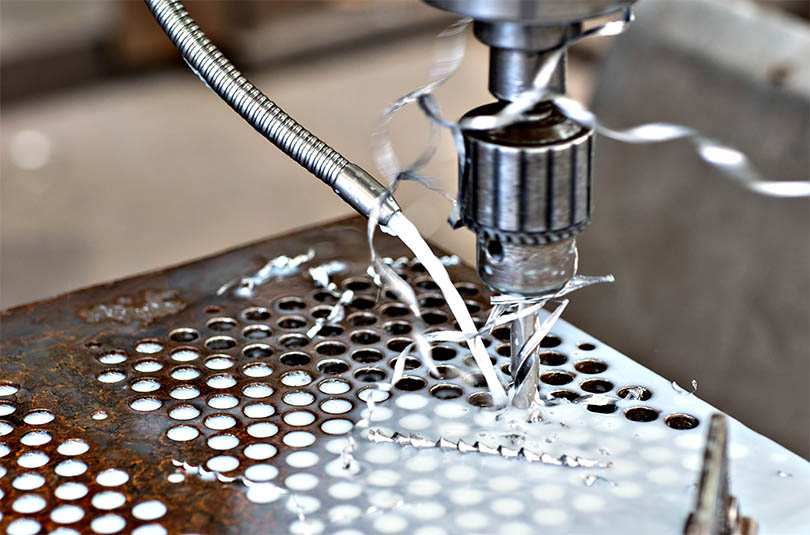
Metal swarf and dense sludge: Turning, milling, drilling and sawing generate short, long, thin, thick, sharp, tangled, dry or oil-soaked swarf. Long and tangled swarf can obstruct hoses and pumps. High-density sludge, slurry, abrasive residues and degraded oil mixed with emulsion settle at the bottom of machine sumps. These materials require greater vacuum pressure than a fluid mixture, and the solution must be selected by considering density, viscosity and extraction distance.
Fine dust from dry grinding and sanding: Grinding, polishing and deburring generate extremely fine metal and abrasive dust. These applications require an adequate filter surface area, continuous cartridge cleaning, PTFE membranes and, where appropriate, absolute HEPA filters. An industrial vacuum cleaner for oils and swarf must never be used as the primary solution for large quantities of fine dry dust.
Collecting and treating oils and swarf from CNC machine sumps
CNC machining-centre sumps must be emptied periodically to remove swarf and deposits, check the condition of the fluid, clean the bottom of the sump and eliminate accumulated degraded sludge. FEVI OIL collection units simultaneously extract the liquid and solid fractions, conveying them towards the separation system. Initial filtration takes place through a stainless-steel mesh basket that retains coarse swarf and metal offcuts, while a 300-micron nylon filter captures smaller particles.
The separated liquid collected in the tank can be discharged into a container, transferred to an external treatment system or returned to the machine tool. Mechanical separation facilitates fluid recovery but does not automatically guarantee that the emulsion is suitable for reuse. Before recirculation, the contamination level, remaining particle size, percentage concentration of the emulsion, presence of bacterial contamination and any alteration of the chemical additives must be carefully assessed.
Industrial vacuum cleaners for liquids vs oil-mist separation systems
Oils and coolant emulsions may be present as liquids in machine sumps, direct splashes or airborne aerosols and oil mist. Industrial vacuum cleaners from the FEVI OIL and SUBOIL ranges are designed exclusively to collect liquids, swarf and sludge present inside machine sumps or deposited on surfaces. They do not replace an airborne oil-mist separator. Mist generated by turning, milling and grinding requires a specific extraction system designed to capture the aerosol continuously and directly from the enclosed CNC machine. Exposure to machining fluids can occur through both skin contact and inhalation of microscopic mist, making the use of a dedicated air separator essential.
Functional comparison: FEVI OIL 140 vs FEVI 1130 OIL
When to choose FEVI OIL 140
- Only a 230 V single-phase power supply is available;
- The machine sumps contain large quantities of fluid liquid;
- Maximum useful fluid capacity of 140 litres and up to 35 litres of swarf are required;
- Fast, forced discharge through an independent auxiliary electric pump is required;
- High instantaneous airflow is more important than continuous operation over several shifts.
When to choose FEVI 1130 OIL
- A 400 V three-phase power supply is available in the workshop;
- The machine must operate over prolonged and continuous industrial cycles using a side-channel blower;
- The 100-litre tank capacity is considered optimal for the machine fleet;
- A pneumatic discharge system using airflow reversal is preferred, without electric pumps;
- A structured unit for permanent and stable integration into production departments is required.
Combustible metal dust and ATEX classification
Not all metal dust is combustible under the same workshop conditions. Fine dust from certain metals, including aluminium, titanium and magnesium, can cause violent fires or explosions when finely divided, airborne and dispersed at sufficient concentrations in the presence of an ignition source. The need for an ATEX explosion-protected configuration must be determined by considering: the specific metal and alloy; particle size; quantity; concentration; minimum ignition energy (MIE); cloud and layer ignition temperatures; electrical conductivity; process type; external ATEX zone; internal classification of the industrial vacuum cleaner; and any presence of liquids. When the facility risk assessment identifies a classified area, our certified special units can be used: the pneumatic FEVI S PN ATEX Venturi range, suitable for the localised collection of conductive group IIIC dust in Zones 22 or 21 because it has no electric motors; the FEVI DTX 2500 AIRCLEAN ATEX centrifugal dust collector for suspended combustible dust; or the three-phase FEVI WT 75 BASIC ATEX range for compatible solids and liquids. Remember that hoses, connections and accessories must maintain complete electrical continuity and grounding.
Incompatible materials and prohibited conditions
It is strictly prohibited to collect the following using a standard workshop configuration: incandescent swarf, live sparks, hot slag from thermal cutting, chemical solvents, petrol, volatile flammable liquids, unverified corrosive substances or reactive mixtures. The collection of aluminium, magnesium or titanium requires a specific preliminary technical assessment. The method used to extinguish or inert the drum must also be defined according to the specific metal, as certain combustible metal powders can react dangerously with water, generating heat and flammable hydrogen gas.
Quick configuration selection guide
Machine-sump emptying and fluid maintenance
- Emptying CNC machine sumps using single-phase power: FEVI OIL 140;
- Emptying CNC machine sumps and prolonged cycles using three-phase power: FEVI 1130 OIL;
- Collecting liquids with automatic progressive discharge: Custom-designed configuration from the SUBOIL range, subject to technical validation of discharge head, pump flow rate and the dual-float system;
- Cleaning workshop floors and collecting occasional small solids using 230 V power: FEVI WM 375 BASIC.
Grinding, oil mist and process fumes
- Fine dust from dry grinding, metal grinding or deburring: FEVI TDC30 ICLEAN, or FEVI HDC 355 ICLEAN for very long piping;
- Suspended fine metal dust captured through hoods or arms: FEVI DTX 1500 BASIC for a single source or FEVI DTX 2500 AIRCLEAN;
- Airborne oil mist and coolant aerosols: A dedicated coalescing oil-mist separator connected to the CNC enclosure must be installed. It must not be automatically connected to OIL models;
- Welding fumes and torch gases: These require dedicated localised capture systems for hot fumes, including extraction torches, purpose-designed arms or extractors with suitable filters, positioned as close as possible to the emission source.
Key parameters to verify before configuration
Before defining the proposal, we assess the workshop variables together: type of machine tool and usable sump capacity; nature of the fluid, including neat oil or water-based emulsion, and its viscosity and temperature; hourly quantities of liquids and solids; metal alloy of the swarf, its shape, whether short or long and tangled, and the presence of fine abrasive sludge; frequency of operations and required discharge height or distance; piping diameters and bends; electrical supply, whether 230 V or 400 V; possible presence of oil mist, hot fumes or sparks; ATEX zone classification; and metal-dust group.
Request a configuration assessment for your workshop
Describe the type of operating machine tool, the volumetric capacity of the fluid sump, the composition of the coolant used, the material and geometric shape of the swarf produced, the estimated quantity of solids, any dense sludge deposited on the bottom, the linear extraction distance, the frequency of emptying operations and the preferred discharge method, whether by pump or airflow reversal. Our engineering department will assess whether your requirements are best met by an industrial vacuum cleaner from the OIL range, a special SUBOIL configuration, a multi-purpose solids-and-liquids model, an industrial vacuum cleaner for fine dust with automatic ICLEAN cleaning or a dedicated airborne-capture system for fumes and mist. Contact us to configure the ideal industrial vacuum cleaner for your workshop.
Mechanical Workshop Solutions FAQ
Which industrial vacuum cleaner should be used to collect oils and metal swarf?
Read more
FEVI OIL 140 is suitable for quickly emptying medium and large CNC machine sumps in departments equipped only with a single-phase power supply. When the workshop has a three-phase supply and prolonged, continuous operating shifts are required, the optimal choice is the FEVI 1130 OIL blower-powered industrial vacuum cleaner.
What is the main difference between FEVI OIL 140 and FEVI 1130 OIL?
Read more
FEVI OIL 140 is a single-phase unit with a 140-litre liquid tank, a 35-litre solids basket and forced discharge through an integrated 220 l/min electric pump. FEVI 1130 OIL is a three-phase blower-powered unit with a 100-litre tank that discharges fluids pneumatically by reversing the airflow, without auxiliary electric pumps.
What is the function of the separator basket integrated into OIL models?
Read more
The stainless-steel mesh basket acts as a primary mechanical filter. It retains coarse swarf, metal fragments and machining offcuts, immediately separating them from the liquid component, whether oil or emulsion, which falls by gravity into the lower tank.
What is the purpose of the optional 300-micron nylon filter, and what does it provide?
Read more
It helps retain metal microparticles and finer residues that pass through the solids-basket mesh. It mechanically filters the collected liquid but does not chemically regenerate it or automatically make it ready for reuse without laboratory checks.
Can emulsion or neat oil collected from machine sumps always be reused immediately?
Read more
No. Immediate reuse is not automatic. It depends on the fluid’s microbiological contamination, the particle size of the remaining suspended residues, the correct percentage concentration of the water-based emulsion, the stability of the additives and the tolerance requirements of the CNC machine tool.
Which type of industrial vacuum cleaner should be used to remove dense sludge from the bottom of machine sumps?
Read more
Abrasive sludge and settled metal slurry have a high density and require machines capable of generating high operating vacuum pressure to overcome hose resistance. The accessories and unit, such as the HDC range or three-phase blowers, must be selected according to viscosity and total piping length.
Can an industrial vacuum cleaner from the OIL range be used to collect fine dry dust?
Read more
FEVI 1130 OIL is equipped with an internal Class M cartridge that permits occasional workshop cleaning of ordinary dust. However, where large quantities of extremely fine dust from dry grinding or metal grinding are present, specialist TDC30 or HDC ICLEAN models must be used.
Can a conventional commercial wet-and-dry vacuum cleaner replace a professional FEVI OIL model?
Read more
No. A conventional multi-purpose wet-and-dry vacuum cleaner does not integrate the specialist industrial systems used in FEVI OIL models, including the solid-liquid mechanical separator basket, fluid-resistant filters, maximum-level electric float switches, integrated discharge pumps or reverse-flow discharge systems.
Which machine FEVI is suitable for dry-grinding operations?
Read more
For deposited fine abrasive dust or direct machine-mounted connection, the high-vacuum three-phase FEVI TDC30 ICLEAN and FEVI HDC 355 ICLEAN units are preferable. They are equipped with HEPA/PTFE cartridges and continuous automatic cleaning systems.
Which system should be installed to capture airborne dust generated by frequent metal grinding?
Read more
This scenario requires the high airflow of a centrifugal dust collector connected to hoods, downdraught tables or open machine enclosures. FEVI DTX 1500 BASIC is suitable for individual localised workstations, while FEVI DTX 2500 AIRCLEAN is designed for intensive industrial processes.
Can an industrial vacuum cleaner from the OIL range collect and purify airborne oil mist?
Read more
No, absolutely. Oil mist and airborne coolant aerosols are microscopic airborne contaminants requiring a specific mist separator or coalescer installed directly on the CNC enclosure. They cannot be collected by a unit designed for liquids inside machine sumps.
Which FEVI system should be implemented for workshop welding fumes?
Read more
Hot welding fumes and toxic gases require dedicated localised capture systems, including specialist fume extractors with suitable filters connected to extraction torches, articulated arms or purpose-designed hoods positioned as close as possible to the arc-emission point.
Do mechanical workshops and metalworking operations always require ATEX-certified machinery?
Read more
No. An ATEX configuration is not required for ordinary mechanical machining of steel or stable metals. Safety marking becomes mandatory only when the facility risk assessment identifies the presence and formation of finely divided combustible dust dispersed in air, such as during intensive aluminium or magnesium processing.
Does fine dust generated by grinding or sanding aluminium require an ATEX industrial vacuum cleaner?
Read more
Finely divided aluminium dust can be highly combustible and explosive. The need for an ATEX machine, such as the FEVI DTX 2500 AIRCLEAN ATEX centrifugal dust collector for airborne dust or FEVI S PN ATEX pneumatic units, depends on particle size, concentration, ignition sources and the official classification of the environment.

