


Solutions for machining centres, mitre saws, milling machines, sanding machines and production lines for windows, doors and profiles.
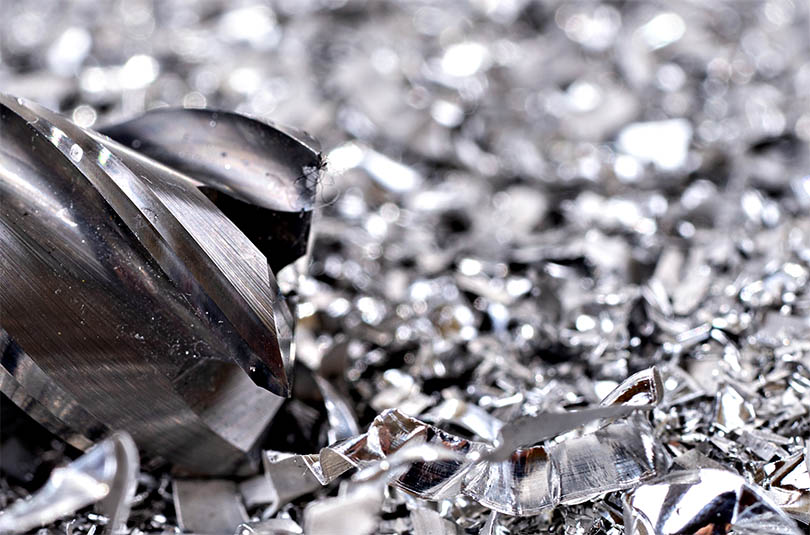
The processing of aluminium and PVC profiles, components, windows and doors generates residues with different shapes, weights and behaviours. Cutting, milling, drilling, sanding and finishing operations can produce: metal swarf; curls and fragments; plastic offcuts; fine dust; lightweight airborne dust;
Read more
residues mixed with oil or coolant emulsion; material deposited inside machinery; and bulky waste generated by profile cutting. To optimise workshop efficiency, two main requirements must be distinguished: the mechanical collection of swarf and the airborne capture of the volatile dust generated. These residues can be captured directly from CNC machining centres, mitre saws, cutting machines, milling machines and other production equipment.
FEVI solutions compatible with aluminium and PVC processing
The compatibility shown below is purely application-based. The final configuration must be confirmed case by case according to the type of dust, liquid or zone classification.
Criteria for selecting the extraction system
The correct industrial system must be configured by analysing three fundamental areas of the window and door production department:
1. Nature of the Residue
Assessment of the material being processed, whether aluminium or PVC, its particle size, the bulk density of the swarf and the presence of coolant liquids.
2. System Requirements
Calculation of the hourly quantities produced, piping length, total cycle duration and the need for localised capture through a hood or machine enclosure.
3. Risk Assessment
Verification of the potential combustibility of fine dust generated during post-processing and any environmental classification required under the ATEX directives.
Aluminium and PVC generate different residues
Coarse aluminium swarf: Cutting and milling operations can generate small chips, metal curls, fragments, irregularly shaped residues, sharp particles and material mixed with coolant. These residues require good operating vacuum pressure, piping with a suitable diameter and a robust container capable of withstanding the material’s bulk density. When the swarf is dry and relatively coarse, an industrial vacuum cleaner for solids can be used. When it is mixed with oil or emulsion, a model specifically designed for oils and swarf should be selected.
Fine aluminium dust: Sanding, brushing, grinding, polishing and abrasive-finishing operations produce very fine particles. Fine aluminium dust can create a fire or explosion risk. The need for an ATEX configuration depends on the characteristics of the dust and the classification of the environment. Particle size affects the risk, but it is not the only parameter: composition, concentration, minimum ignition energy (MIE) and process characteristics must be assessed together.
PVC swarf and offcuts: Processing PVC profiles generates lightweight chips, offcuts, fragments, plastic curls, dust from milling or sanding and small bulky cuttings. Lightweight offcuts behave differently from fine dust: the former primarily require airflow and volumetric collection capacity, while the latter require advanced filtration, filter-cleaning systems and an assessment of combustibility risks. PVC dust may also present a fire or explosion risk under certain conditions. The suitability of the industrial vacuum cleaner must therefore be verified using the actual material and must not be assumed in advance.
IMPORTANT WARNING: Do not use water or wet collection systems that have not been specifically designed for fine or reactive aluminium dust. Finely divided aluminium dust can react with water or moisture, generating heat and flammable hydrogen gas. It is therefore incorrect to recommend a conventional wet vacuum cleaner or a standard water separator as a general solution. The correct system must be defined after a careful assessment of the material and process.
Applications in window and door manufacturing departments
CNC machining centres
Machining centres for profiles can simultaneously generate swarf, small fragments and dust. The extraction system can be connected to the machine enclosure, tool area, lower sump, a dedicated discharge point or centralised piping. The choice between an industrial vacuum cleaner and a dust collector depends primarily on the nature of the residue: swarf and solids require vacuum pressure, while lightweight airborne dust requires high airflow.
Mitre saws and sawing machines
Cutting aluminium and PVC often generates lightweight material projected at very high speed. The capture point must be positioned as close as possible to the cutting blade and must take into account the direction in which the swarf is expelled, the quantity of material, the diameter of the collection inlet, air velocity, flexible-hose length and the possible presence of fine dust.
Milling machines, drilling machines and welding lines
These machines produce swarf with widely varying dimensions. For long piping runs or relatively heavy swarf, a high-vacuum industrial vacuum cleaner should be prioritised. The overall production of windows and doors involves several simultaneous sources, including profile cutting, milling, PVC weld processing, finishing and offcut management. It is therefore often necessary to combine several technologies rather than using a single model for the entire department.
Surface sanding and grinding
These processes mainly generate fine and lightweight dust. The most suitable solution requires extraction directly from the tool, the use of a capture hood or a downdraught table, combined with an industrial vacuum cleaner for fine dust or a dust collector with an ATEX safety configuration where required.
Technology classification: Industrial Vacuum Cleaner, Dust Collector or Offcut Extractor
To identify the correct workshop machine, FEVI divides the available solutions into three separate families:
- Industrial Vacuum Cleaner (High Vacuum): The most suitable choice for collecting metal swarf, fragments, solid residues, material deposited inside or around machinery and for general floor cleaning. It operates efficiently with small-diameter piping and allows material to be conveyed over linear distances.
- Dust Collector (High Airflow / Low Vacuum): The ideal technology for capturing fine airborne dust. It is connected to open hoods, protective enclosures, articulated extraction arms, mitre saws or sanding machines, moving large volumes of air to prevent dust clouds from spreading throughout the department.
- Offcut Extractor (High Airflow / Filter Bag): The architecture designed to collect lightweight cuttings, thin PVC offcuts, film and bulky plastic fragments with a low bulk density generated by continuous cutting operations. The FEVI RVS range was developed for this purpose and connects directly to production machinery. It is not suitable for fine dust or heavy metal swarf.
Quick configuration selection guide
Scenarios in non-classified areas (No ATEX)
- Dry aluminium or PVC swarf for cleaning floors or machinery: FEVI BT 753 BASIC, or FEVI HDC 155 BASIC for long or demanding piping runs;
- Continuous, lightweight and bulky PVC offcuts collected directly from machinery: FEVI RVS;
- Deposited fine dust collected directly from tools: FEVI TDC30 ICLEAN, or FEVI HDC 355 ICLEAN for more demanding requirements;
- Suspended airborne dust captured through hoods or arms: FEVI DTX 1500 BASIC or standard FEVI DTX 2500 AIRCLEAN.
Scenari in aree regolamentate o con rischi
- Suspended fine or combustible dust in Zone 22: FEVI DTX 2500 AIRCLEAN ATEX 2-22, suitable for group IIIC aluminium and PVC dust;
- Localised collection of conductive dust in pneumatic Zone 21 or 22 applications: FEVI S PN ATEX or the three-phase FEVI BT / WT 75 BASIC ATEX range;
- Non-conductive PVC dust, group IIIB, in Zone 22: FEVI BSL 120 BASIC ATEX 22, subject to verification of thermal compatibility and the 20-litre capacity;
- Wet swarf mixed with oil or coolant emulsion: FEVI OIL 140 with pump discharge or FEVI 1130 OIL with reverse-flow discharge;
- Projects for complex departments: When several machines or mitre saws operate simultaneously, the FEVI technical department designs shared piping networks and customised centralised systems rather than automatically applying a single mobile model.
Key parameters to verify before configuration
Before recommending the final model, we assess the workshop variables together: nature of the material, whether aluminium, PVC or a mixture; type of waste, such as fine dust, heavy swarf, bulky offcuts or liquids; particle size and hourly quantity produced; presence of coolants or water-based emulsions; risk of sparks or elevated process temperatures; dust-risk values, including Kst, Pmax, MIE and electrical conductivity; ATEX zone classification and dust group, IIIB or IIIC; system parameters, including required airflow or vacuum pressure, piping length and diameter, number of bends and simultaneous collection points; collection system; and drum-emptying method.
Request a sizing assessment for your workshop
Do you need to collect dust, swarf or offcuts generated by aluminium or PVC processing?
Describe the processed material, type of machine tool, residue generated, dust particle size, hourly quantity produced, possible presence of cutting oil or coolant emulsion, total piping length, average cycle duration and ATEX classification of the environment. Our design department will assess whether your requirements are best met by a high-vacuum industrial vacuum cleaner, a high-airflow dust collector, a dedicated offcut extractor, a model for oils and swarf or a special configuration for reactive metal dust. Contact us to size the most suitable extraction system for your machinery.
Aluminium and PVC Solutions FAQ
Which industrial vacuum cleaner is required for aluminium swarf?
Read more
For completely dry swarf and the cleaning of machinery or production departments, three-phase FEVI BT 753 BASIC or FEVI HDC 155 BASIC blower models can be considered. When the swarf is wet or immersed in oil and coolant emulsion, the dedicated FEVI OIL 140 or FEVI 1130 OIL workshop models must be used.
Is aluminium dust explosive?
Read more
Yes. Fine aluminium dust can become explosive when it is finely divided, airborne and dispersed in sufficient concentrations in the presence of an ignition source. The technical assessment must always consider particle size, concentration, minimum ignition energy (MIE) and process characteristics together.
Does every type of aluminium processing require an ATEX industrial vacuum cleaner?
Read more
No. Coarse swarf generated by cutting and very fine dust generated by sanding or abrasive finishing present completely different risk levels. The need for an ATEX-marked machine depends exclusively on the department’s risk assessment and the official classification of the working environment.
Can dust generated by milling or sanding PVC be combustible?
Read more
Yes. Some types of finely divided PVC dust can form combustible or explosive atmospheres under certain conditions. It is essential to analyse the characteristics of the actual product being processed and the operating-cycle data before selecting the industrial vacuum cleaner.
Can fine aluminium dust be collected using water as a suppression medium?
Read more
No, not with a conventional wet vacuum cleaner or standard water separator. Fine aluminium dust can react chemically with water or residual moisture, generating heat and flammable hydrogen gas. Any wet or immersion-based system must be specifically designed using suitable inerting fluids.
What is the fundamental difference between an industrial vacuum cleaner and a dust collector?
Read more
An industrial vacuum cleaner operates at high vacuum pressure to convey and collect solids, swarf, dense liquids and material deposited on floors through narrow hoses. A dust collector operates at high airflow to capture and extract lightweight airborne dust through hoods, machine enclosures or extraction arms.
Which FEVI system should be installed on a mitre saw?
Read more
The choice depends on the nature of the waste. Capturing swarf projected at high speed and solid fragments requires the high vacuum pressure of an industrial vacuum cleaner. Capturing a cloud of lightweight and airborne dust requires the high air volume provided by a dust collector.
Which industrial vacuum cleaner should be combined with a CNC machining centre for profiles?
Read more
For dry swarf, three-phase blower models from the BT or HDC BASIC range are preferred. For swarf saturated with coolant emulsion, a model from the OIL range is more suitable. Where extremely fine airborne dust is present, a solution with automatic ICLEAN cleaning or an ATEX safety configuration must be implemented.
Can the FEVI RVS offcut extractor be used for aluminium?
Read more
No. It is not the correct or primary choice. FEVI RVS is specifically developed to collect lightweight, very bulky waste, strands and offcuts with a low bulk density, typically generated by PVC processing, the textile industry or packaging operations. It is not designed for heavy metal swarf.
Is the compact FEVI BSL 120 ATEX suitable for collecting aluminium dust?
Read more
Not automatically. The model’s standard marking covers non-conductive dust group IIIB, whereas most aluminium metal dust is conductive and requires compatibility with group IIIC. The complete marking must always be verified in advance.
Which FEVI model is most suitable for suspended aluminium dust?
Read more
Within Zone 22, the most appropriate model is the FEVI DTX 2500 AIRCLEAN ATEX centrifugal dust collector, which is officially certified for conductive dust group IIIC and is equipped with automatic pneumatic cartridge cleaning.
Can the same industrial vacuum cleaner be used alternately for aluminium and PVC?
Read more
Mixed use of the machine is strongly discouraged unless a rigorous internal procedure for cleaning and inspecting the filters is followed. The two materials have completely different physical behaviours and explosion risks. Accidental mixing of the residues can complicate their correct management, recovery and the ATEX assessment of the department.

