


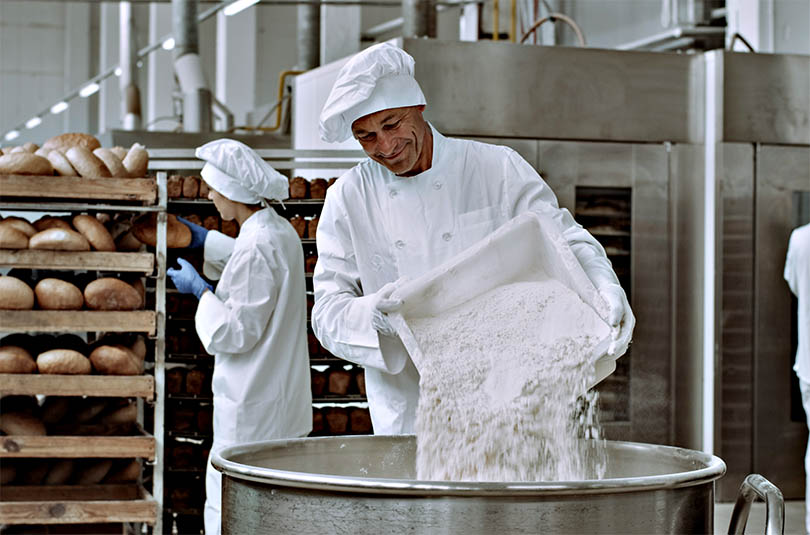
Solutions for collecting flour, sugar, spices, cereals, solid residues and liquids in production, packaging and maintenance departments.
In the food industry, the management of dust, solid residues and liquids must be integrated into the facility’s hygiene procedures. Flour, sugar, cocoa, powdered milk, starches, spices, coffee, cereals and other ingredients can accumulate on floors, machinery, structures and packaging lines. Under certain conditions, some of these powders can also form potentially explosive atmospheres. Industrial vacuum cleaning contributes to the removal of dust and residues and can be integrated into the facility’s cleaning and self-monitoring procedures, in line with the requirements of European food-hygiene regulations based on HACCP principles. However, it does not replace washing, disinfection and microbiological-control activities.
Criteria for configuring the cleaning system
The correct technological selection of FEVI units must be carried out by analysing three essential operating areas of the facility:
1. Substance Analysis
Assessment of residue properties, including fine airborne dust, heavy granular cereals, liquid spillages and damp mixtures.
2. Safety and Regulations
Identification of potentially explosive and flammable atmospheres and classification of departmental ATEX zones in accordance with European Directives.
3. Hygiene Management
Definition of the required filtration levels, company hygiene procedures, discharge system and allergen risks.
Applications of FEVI industrial vacuum cleaners
Our machines can be fully configured to meet the specific requirements of food-production lines:
- Clean floors, overhead structures and machinery affected by localised accumulations;
- Collect deposited food dust before it spreads throughout the working environment;
- Remove dry or damp residues from mixers, hoppers and packaging machines;
- Collect compatible liquids, sugar solutions and accidental spillages;
- Capture suspended airborne dust directly during dosing or transfer processes;
- Operate safely inside areas classified as presenting an ATEX explosion risk;
- Limit cross-contamination between the facility’s production departments;
- Manage the collected material in a more controlled manner that supports correct disposal.
Types of residues and contaminants to be managed
Fine and lightweight food dust
Many processes generate airborne dust, including flour, sugar, cocoa, powdered milk, starch, semolina, spices, thickeners, coffee powder, dehydrated ingredients, supplements and premixes. These materials can disperse easily and rapidly clog conventional filters. When the quantity is significant, filter cartridges with a specific coating and timed automatic cleaning systems are preferable.
Cereals, granules and solid residues
Processing and packaging departments may contain cereals, seeds, rice, dried pasta, product fragments, crumbs, husks, granular material and packaging residues. These materials require industrial vacuum cleaners with piping and inlets suitable for their specific dimensions, bulk density and actual hourly conveying quantity.
Liquids and damp residues
Some processes require the collection of water, beverages, sugar solutions, washing residues, fluid mixtures, compatible process liquids or accidental spillages. Compatibility must be verified by considering composition, temperature, viscosity and the possible chemical aggressiveness of the liquid towards the vacuum cleaner’s construction materials.
Suspended airborne dust
Loading, dosing, mixing, sieving and transfer operations generate dust clouds. In these cases, using an industrial vacuum cleaner on the floor is not sufficient. A dust collector must be connected directly to hoods, extraction arms, hoppers, mixers, sieves or automatic packaging lines.
Vacuum cleaning and hygiene: clarification of the activities
Industrial vacuum cleaning removes solid residues, dust and compatible liquids, but it does not automatically eliminate bacteria, mould, allergens, microorganisms, chemical contamination, biofilm or residues that adhere strongly to surfaces. Conventional washing, disinfection, sanitising, rinsing, microbiological verification and allergen-control procedures must therefore be carried out after vacuum cleaning. Industrial vacuum cleaning contributes to the removal of dust and residues and can be successfully integrated into the facility’s cleaning and self-monitoring procedures without making absolute sanitising claims.
Reducing cross-contamination and allergen risks
In departments processing different products, preventing dust and residues from being transferred from one area to another is a priority. The FEVI configuration may include: an industrial vacuum cleaner dedicated to each individual department; hoses and accessories identified using dedicated colours; separate containers; defined emptying procedures; Longopac systems; tools dedicated to allergens; and separate routes for the collected material and finished product. Coynco offers accessories in different colours to simplify department identification and significantly reduce the risk of cross-use.
Features to assess during configuration
Easy-to-clean construction: The machine must be capable of being cleaned in accordance with the facility’s procedures. The accessibility of the surfaces, absence of dead areas or accumulation points, geometry of the container, ease of disassembly, construction materials, seals, surface roughness of the metalwork, resistance to detergents, filter-removal method and discharge system must all be assessed in advance.
AISI 304 or AISI 316 stainless steel: Coynco offers industrial vacuum cleaners and dust collectors that can be configured in AISI 304 or AISI 316 stainless steel for the food industry. However, the presence of stainless steel alone does not constitute food-contact certification. Before selection, it is necessary to verify which components are manufactured from stainless steel, whether the material comes into direct contact with the product, the internal finish, welds, seals, hoses, accessories, chemical detergents used and the documentation required by the company.
Filtration and collection systems: The filter class must be selected according to particle size and dust hazards. Options may include a polyester star filter, Class M cartridge, HEPA and PTFE cartridge or secondary HEPA filter, combined with manual, semi-automatic, automatic ICLEAN or automatic AIRCLEAN cleaning systems. An efficiency value of 99.995% must not be generically attributed to every HEPA filter: the class, efficiency and test point must be taken from the documentation for the specific machine. Collection may take place through a quick-release drum, stainless-steel container, Longopac or filter bag, depending on the disposal requirements.
Food-industry application areas and sectors
Bakeries, pasta factories and confectionery production
Environments characterised by flour, semolina, starch, dried-dough residues, crumbs, cereals, sugar and cocoa. Many of these organic powders, particularly sugar, flour and cocoa, are combustible when finely dispersed in air. The choice between a standard and an ATEX model must be based on the department classification. Sugar, cocoa and powdered milk require particular attention because of the combination of fine particle size and potential explosion risk.
Coffee roasting and processing
Management of coffee beans, fragments, coffee powder, roasting residues and dust deposited on machinery and floors. The material temperature must be carefully verified before collection. It is strictly prohibited to collect incandescent residues or materials that are still capable of creating a thermal ignition source.
Flour mills and cereal processing
Flour, semolina, starch and cereal dust can form stable combustible clouds. In these applications, the ATEX assessment, effectiveness of grounding, use of conductive accessories and protected collection systems are central elements of the configuration.
Dairy production, spices and packaging
Collection of powdered milk, whey, dry ingredients and airborne aromatic spices that are difficult to contain, together with the cleaning of packaging lines, including spilled product, packaging fragments and residues beneath conveyor belts and packaging machines. Dust and liquids require different configurations or expressly selected multi-purpose industrial vacuum cleaners.
Food dust and ATEX explosion risk
Flour, sugar, starch, cocoa, powdered milk, spices, coffee and many other food products can be combustible when finely divided and dispersed in air. This does not mean that every food-production facility must automatically use an ATEX machine. The requirement depends on the characteristics of the dust, concentration, particle size, quantity, cloud frequency, ventilation, ignition sources, zone classification and conditions inside the industrial vacuum cleaner. Directive 1999/92/EC regulates the classification of workplaces with potentially explosive atmospheres, while Directive 2014/34/EU concerns equipment. When the risk assessment identifies a potentially explosive atmosphere, the industrial vacuum cleaner must have a marking and category compatible with the zone and substance present.
FEVI industrial vacuum cleaners suitable for the food industry
The compatibility indicated is application-based. The final configuration must be verified by considering hygiene requirements, material, cleaning procedure and ATEX classification.
| FEVI Model | Technical Configuration and Filtration | Recommended Application in the Food Industry |
|---|---|---|
| FEVI PULSE 11XM / 11XA | 1100 W single-phase motor; HEPA and PTFE cartridge; safe Longopac collection. 11XM version with manual cleaning / 11XA version with automatic cleaning. | Compact single-phase industrial vacuum cleaners for laboratories, packaging, small production lines and localised operations in non-ATEX areas. Verify the compatibility of the accessories with food-industry procedures. |
| FEVI 220 ICLEAN | Single-phase power supply; compact structure; two HEPA and PTFE cartridges; timed automatic ICLEAN cleaning and 20-litre drum. | Suitable for fine dust, including flour, starches and dry ingredients, in non-classified areas where frequent operations and high mobility are required. |
| FEVI 350 ICLEAN | Three single-phase motors; three HEPA and PTFE cartridges; fully automatic ICLEAN cleaning system and 50-litre drum. | More suitable than FEVI 220 ICLEAN when dust quantities, operating duration, department size and the required autonomy increase in non-ATEX areas. |
| FEVI 221 PULSE | HEPA filtration; PULSE cleaning system; protected collection in a Longopac continuous bag. Compact structure. | Suitable when limiting fine-dust dispersion during bag replacement is important. Non-ATEX model for compatible materials. |
| FEVI TDC30 ICLEAN | 3 kW three-phase side-channel blower; three HEPA and PTFE cartridges; automatic ICLEAN cleaning. Collection through a drum or Longopac. | Designed for prolonged processes, permanent connection to process machinery, fixed workstations and non-ATEX dosing and packaging systems. |
| FEVI HDC 355 ICLEAN | 5.5 kW three-phase side-channel blower; three HEPA and PTFE cartridges; integrated automatic cleaning systems. | Solution developed for large facilities, long piping runs, high pressure losses, simultaneous connections and prolonged production cycles. |
| FEVI WM 375 BASIC | Multi-purpose single-phase industrial vacuum cleaner for ordinary dust, solid residues, granular materials and compatible liquids. | General maintenance operations in non-classified food-production departments where large quantities of fine dust are not present. |
| FEVI BT / WT 753 BASIC | Three-phase blower unit designed for more prolonged applications than single-phase models, handling ordinary dust, solids and liquids. | General cleaning and frequent connections in non-classified departments. The BASIC range is not the primary solution for large quantities of fine and clogging dust. |
| FEVI BSL 120 BASIC ATEX 22 | Single-phase brushless motor; 3D marking for Zone 22; AISI 304 stainless-steel structure; antistatic Class M filter; 20-litre drum. Optional HEPA filter. | Specifically included for additive manufacturing and dry combustible dust. Suitable for localised operations involving flour, sugar and spices in Zone 22. Not suitable for liquids. |
| FEVI WT 75 BASIC ATEX | Three-phase side-channel blower; 3G and 3D marking for Zones 2 and 22; AISI 304 stainless-steel construction; 75-litre drum and antistatic star filter. Optional HEPA filter. | Suitable when greater capacity, prolonged use and the ability to manage both dry materials and compatible liquids are required in a classified area. |
| FEVI S PN ATEX | Compressed-air Venturi system without an electric motor. Versions for Zones 2-22 or Zones 1-21; conductive aluminised Class M filter; 50-litre stainless-steel drum. | Suitable for classified departments where a pneumatic network capable of supplying approximately 1500 litres per minute at a pressure of between 4 and 6 bar is available. |
| FEVI DTX 2500 AIRCLEAN ATEX 2-22 | High-airflow dust collector (2500 m³/h) with a 4 kW fan; five conductive cartridges; automatic AIRCLEAN cleaning; 100-litre drum and partial AISI 304 construction. | Specifically designed to capture suspended combustible food dust through hoods, extraction arms, mixers, hoppers, sieves or packaging lines. |
Quick configuration selection guide
Scenarios in non-classified areas (No ATEX)
- Small quantities of fine dust: Consider FEVI PULSE 11XM, FEVI PULSE 11XA or FEVI 220 ICLEAN;
- Larger quantities of fine dust: Consider FEVI 350 ICLEAN or FEVI 221 PULSE;
- Prolonged cycle or continuous machine connection: Consider FEVI TDC30 ICLEAN;
- Ordinary dust, solids and mixed liquids: Consider FEVI WM 375 BASIC or FEVI BT / WT 753 BASIC.
Scenarios in regulated or hazardous areas
- Localised cleaning of combustible dust in Zone 22: Consider FEVI BSL 120 BASIC ATEX 22;
- Mixed dust and liquids in Zone 2 and Zone 22: Consider FEVI WT 75 BASIC ATEX or the pneumatic FEVI S PN ATEX 2-22 range;
- Combustible dust in critical Zone 21 environments: Consider FEVI S PN MAXI ATEX 1-21;
- Suspended dust from mixers, hoppers or packaging machines: Consider the FEVI DTX 2500 AIRCLEAN ATEX dust collector. Standard FEVI DTX 1500 BASIC and DTX 2500 AIRCLEAN dust collectors can be considered only in non-classified areas;
- Custom-designed centralised systems: When a mobile industrial vacuum cleaner is impractical or several points must be served, a centralised system with a central vacuum unit, piping network, distributed connection points and separator can be considered.
Key parameters to verify before configuration
Before recommending the final model, we assess the food-process variables together: product matrix and particle size; quantity, moisture content and temperature of the residue; presence of liquids or fluid mixtures; combustibility parameters, including the Kst value and cloud or layer ignition temperatures; ATEX zone classification; department layout and allergen-risk map; frequency of use and operating hours; need for machine-mounted collection; HEPA-filter requirements; construction materials and compatibility with the chemical detergents used; and the need for colour-coded accessories or direct product contact.
Request a food-industry configuration assessment
Do you need to collect dust or residues in a food-production facility?
Describe the type of product being processed, the nature of the material to be collected, the hourly quantity produced, the possible presence of fine airborne dust, the ATEX classification of the department, the presence of liquids, the operating-cycle duration, the required emptying method and the facility’s internal hygiene protocols. Our technical department will assess the motor configuration, filtration class, stainless-steel construction, collection system and the most suitable colour-coded accessories. Contact us to configure the ideal FEVI industrial vacuum cleaner for your food-production process.
Food Industry Solutions FAQ
Which industrial vacuum cleaner is required for flour?
Read the answer
It depends on the quantity, particle size and department classification. An ICLEAN model can be considered in a non-classified area. When the dust can generate an explosive atmosphere, a compatible ATEX configuration is required.
Does all food dust require an ATEX industrial vacuum cleaner?
Read the answer
No. The requirement depends exclusively on the risk assessment and environmental classification, not simply on the dust being of food origin.
Is sugar dust combustible?
Read the answer
Yes. Sugar dust that is finely dispersed in air can cause fires or explosions. Concentration, particle size, ignition sources and department classification must be carefully assessed.
Is a stainless-steel industrial vacuum cleaner automatically suitable for food applications?
Read the answer
No. The surface finish, welds, seal materials, conductive accessories, cleaning procedures and technical documentation for components that may come into contact with the product must all be carefully verified.
Is an absolute HEPA filter always required?
Read the answer
No. The filtration class and safety stage must be selected according to the specific type of dust, particle size, occupational-exposure limits (TLV) and company hygiene procedures.
Does a HEPA filter eliminate bacteria and microbiological contamination?
Read the answer
An absolute filter mechanically captures microparticles according to its efficiency class, but it does not replace the facility’s chemical disinfection and sanitising protocols.
Which industrial vacuum cleaner should be used for large quantities of fine dust in non-ATEX areas?
Read the answer
FEVI PULSE 11XM and 11XA, FEVI 220 ICLEAN, FEVI 350 ICLEAN, FEVI 221 PULSE or FEVI TDC30 ICLEAN can be considered, selecting the optimal configuration according to the quantities and operating-cycle duration.
Which industrial vacuum cleaner should be used inside Zone 22?
Read the answer
FEVI BSL 120 BASIC ATEX 22 can be considered for compact, targeted operations involving dry dust. For more prolonged operating cycles and mixed dry and liquid materials, FEVI WT 75 BASIC ATEX is suitable.
Which industrial vacuum cleaner should be used in Zone 21 environments?
Read the answer
The compressed-air Venturi FEVI S PN MAXI ATEX 1-21 version can be considered, subject to verification of the machine marking against the substance and system classification.
Which industrial vacuum cleaner should be used to collect food liquids?
Read the answer
FEVI WM 375 BASIC, FEVI BT / WT 753 BASIC or specific ATEX versions for dust and liquids can be considered, subject to prior verification of fluid chemical compatibility and the facility’s hygiene requirements.
When is an industrial dust collector specifically required?
Read the answer
A dust collector is required when the contaminant or dust is suspended in the air and must be actively captured at source through a hood, articulated arm or flexible connection directly to the process machine.
Can the collected food product be recovered and reused?
Read the answer
Only when the production process, container, filter and accessory characteristics and emptying procedures guarantee the required purity level. Vacuum collection alone does not automatically ensure that the product remains suitable for food reuse.

