


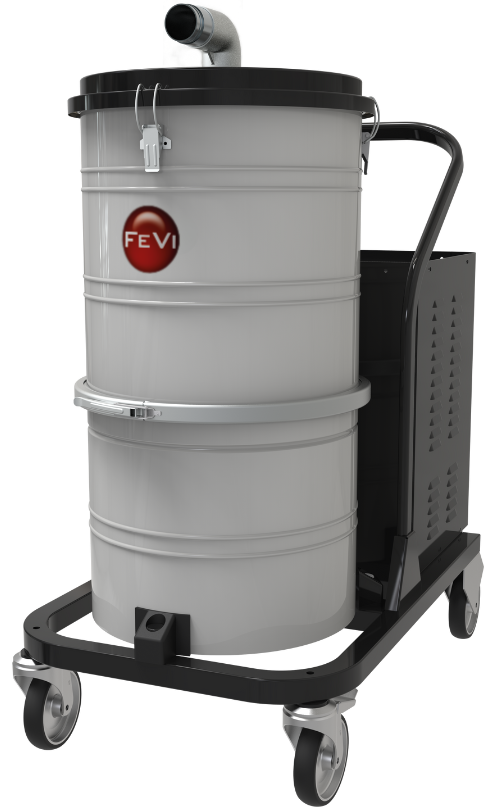

 , Scraps & clippings


The FEVI RVS range stands out for its robust construction, designed for continuous operation and efficient collection of lightweight and bulky materials, allowing it to be easily integrated into automated production cycles.
Offcuts are often produced continuously and locally near: cutting machines; die-cutting machines; textile machinery; packaging lines; packaging-production systems; paper and cardboard machinery; plastic-film processing lines; automated cutting systems.
The industrial vacuum cleaner can be connected directly to the point where the waste is generated, helping to limit accumulation around the machine and maintain a tidier production area.
The correct configuration depends on the volume of material produced, the collection distance, the piping diameter and the continuity of the process. In the textile sector, in addition to managing offcuts, it helps reduce fine dust and maintain a healthier working environment for operators. The use of filter bags also enables environmentally responsible and separated waste management, supporting the company’s environmental sustainability.
Ideal Application: Direct inline integration with cutters, die-cutters, and packaging lines in the Textile, Packaging, and Paper industries for the continuous suction of light clippings and bulky waste.
Key Advantages: Space optimization thanks to waste collection and compaction directly inside 120-liter continuous TNT filter bags, paired with an integrated 13,000 cm² Class M secondary safety filter.
Model Selection: Robust 114 kg configuration featuring a 2.2 kW side-channel blower (available in both 230 V single-phase and 400 V three-phase layouts), ideal for providing constant airflow (320 m³/h) and high vacuum (300 mBar).
Not Suitable For: Specialist unit engineered exclusively for dry waste with low specific weight. It is not suitable for vacuuming liquids, heavy debris, or massive amounts of fine dust without automatic systems.
This FEVI range addresses the challenges of industrial sectors with customised solutions designed to improve production quality and ensure smooth and safe operation. The FEVI RVS range is also available in an ATEX-certified version intended for environments with potentially explosive atmospheres.
Materials that can be collected
The range can be considered for materials with a low bulk density, such as: fabric offcuts; textile fibres and residues; cotton; paper; cardboard; packaging offcuts; plastic film; lightweight plastic cuttings; lightweight wood offcuts; compatible thin and bulky residues. FEVI RVS is specifically developed for lightweight and bulky materials and must not be confused with an industrial vacuum cleaner for heavy debris, liquids or large quantities of fine dust.


Main features
- Single-phase or three-phase side-channel blower
- Suitable for continuous 24/7 operation without maintenance
- 3GD certified for ATEX Zones 2 and 22
- ATEX 2-22 versions are supplied as standard with an AISI 304 stainless-steel lid, filter chamber and container
- Industrial vacuum cleaner for lightweight and bulky materials
- Designed for the textile, packaging and paper industries
- Material collection in filter bags
- Secondary safety filter
Who it is recommended for
FEVI RVS is suitable for production facilities requiring a powerful vacuum unit for prolonged operation and structured machine-tool maintenance. It is recommended for:
Discover the main application sectors
- Maintenance departments;
- Industrial companies;
- Craft workshops;
- Warehouses;
- Professional cleaning companies;
- Companies looking for a high-capacity single-phase industrial vacuum cleaner;
- Environments without large quantities of fine dust or highly specialised applications.
Application sectors
Textile industry
Cutting and processing fabrics can generate offcuts, fibres and lightweight residues that tend to accumulate rapidly. Collection close to the machine allows the offcuts to be conveyed directly into the collection system, reducing the need for frequent manual intervention.
Packaging industry
Packaging and packing-production lines can generate: plastic-film offcuts; trimming edges; paper; cardboard; labels; residues from flexible materials. Continuous collection helps prevent the offcuts from interfering with machine movements or becoming dispersed throughout the department.
Paper and paper-converting industry
Cutting, trimming and die-cutting produce lightweight but bulky waste. A dedicated industrial vacuum cleaner transports these materials into a collection bag without requiring open containers close to the production line.
Plastics and wood
The system can be considered for plastic film, thin offcuts and lightweight plastic residues. Compatibility must be verified by considering shape, dimensions, electrostatic charge, temperature and potential combustibility. FEVI RVS can also be considered for lightweight wood offcuts and residues with a low bulk density. For fine dust, compact sawdust or large quantities of wood chips, it is necessary to assess whether a dust collector, an industrial vacuum cleaner for dust or a centralised system would be more appropriate.
How it works
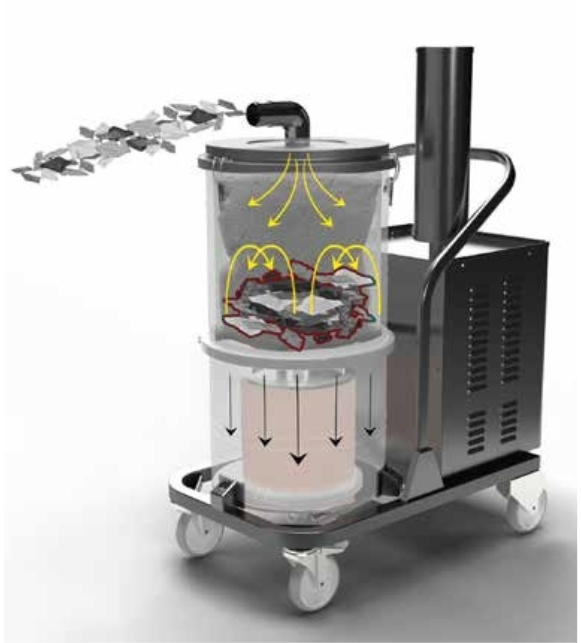
OFFCUT COLLECTION: The material is captured close to the machine and transported through the piping.
CONVEYING INTO THE BAG: The airflow carries the offcuts into the non-woven fabric collection filter bag.
MATERIAL ACCUMULATION AND COMPACTION: The lightweight waste accumulates and is retained inside the bag, reducing dispersion into the environment and simplifying emptying and cleaning.
SAFETY FILTRATION: The air passes through the secondary filtration system supplied as standard, which is designed to retain the residual dust fraction accompanying dusty materials during collection. The bag must be replaced or emptied according to the volume reached and the procedures established for the material.
Why choose an industrial vacuum cleaner specifically designed for offcuts
Management of bulky materials: Lightweight offcuts can rapidly fill a conventional rigid container. Collection in filter bags makes better use of the available volume and simplifies removal of the accumulated material.
Connection to the machine: FEVI RVS can be integrated directly into the machine or connected through dedicated piping. This configuration captures the waste at the point where it is produced, before it accumulates in the working area.
Side-channel blower: The range uses side-channel blowers available in single-phase or three-phase configurations. Selection must be based on: cycle duration; quantity of offcuts; distance from the machine; piping pressure losses; available power supply; required airflow and vacuum pressure. The blower is suitable for prolonged operation, subject to maintenance and periodic inspections in accordance with the applicable instructions.
Collection filter bag and safety filter: The material is conveyed into a non-woven fabric filter bag. The RVS range has a stated collection capacity of 120 litres, combined with a secondary Class M safety filter. The secondary filter helps retain the dust fraction that may accompany the offcuts during collection. The presence of this filter does not make the machine equivalent to a specialist industrial vacuum cleaner for fine dust. When the dust fraction is significant, the required filtration system must be assessed separately.
ATEX versions available: The range also includes ATEX configurations for environments classified as Zones 2 and 22, with 3G and 3D marking. The ATEX version must be selected only after verifying: the environmental classification; material characteristics; potential combustibility; presence of gases, vapours or dust; temperature; electrical continuity of the hose and accessories; and the ATEX documentation of the system.
FEVI RVS
FEVI RVS is the range solution dedicated to collecting lightweight and bulky offcuts. It is available in different power and supply configurations, including: single-phase; three-phase; high-airflow; high-vacuum; and ATEX versions for Zones 2 and 22. All configurations use a non-woven fabric filter bag, a filter chamber and a secondary Class M safety filter.
Technical Comparisons and Configuration Selection
The industrial vacuum cleaner in the RVS range must be selected according to the geometric and physical characteristics of the waste generated on the production line.
1. When to choose an industrial vacuum cleaner specifically designed for offcuts rather than another solution
| Department Requirement or Scenario | Recommended FEVI Range Solution |
|---|---|
| The material is lightweight, the waste is bulky, production is continuous and a rigid container would fill too rapidly, requiring collection in a filter bag positioned away from the production area. | FEVI RVS industrial vacuum cleaner for offcuts |
| The residual material consists mainly of suspended or deposited fine dust rather than flexible production cuttings or offcuts. | Industrial vacuum cleaner for dust or ICLEAN model |
| The main priority is capturing fine airborne dust in the working environment through extraction hoods or multiple collection points. | Dust collector |
| Dense residues, heavy and compact waste or metal swarf generated by machine tools must be handled and transported. | Industrial vacuum cleaner for heavy solids or OIL range |
| Several production machines simultaneously generate shaped offcuts and a shared extraction network with a single discharge point is required. | Centralised system |
Technical Data
| Material to be collected | Lightweight and bulky offcuts |
| Motor | Side-channel blower |
| Power | 2,2 kW |
| Voltage | 230 V (Three-phase 400 V configurations also available) |
| Frequency | 50 Hz |
| Current | 16 A |
| Airflow | 320 m3/h |
| Vacuum pressure | 300 mBar |
| Maximum vacuum pressure | 200 mBar |
| Inlet | Type B 60 mm |
| Dimensions | 100x60 h135 cm |
| Weight | 114 Kg |
| Collection system | Non-woven fabric collection bag |
| Collection capacity | 120 L |
| Filter chamber diameter | Ø 460 mm |
| Filter type | Cartridge |
| Filter properties | Secondary Class M safety filter |
| Filter surface area | 13.000 cm2 |
How to choose the configuration
Before defining the correct model, we assess together all the structural parameters of the application: type of material; offcut dimensions; bulk density; hourly production quantity; process continuity; distance from the collection point; piping diameter; number of bends; possible compaction; available power supply; airflow or vacuum-pressure requirements; presence of dust; **ATEX** risk; and waste-disposal or recovery method.
The **ATEX** configuration for environments classified as Zones 2 and 22, with 3G and 3D marking, requires a joint assessment of the system’s conformity, including verification of piping conductivity.
Request an on-machine feasibility assessment
Send us the type of material, the hourly quantity produced, the geometric dimensions of the offcuts, the linear distance from the machine, the diameter of the piping you intend to use, the average cycle duration and the environmental classification. Together, we will assess the required airflow, vacuum pressure, single-phase or three-phase motor configuration and the collection system best suited to your lines. Contact us to configure a customised industrial vacuum cleaner for offcuts for your production line.
FEVI RVS FAQ
What are industrial offcuts?
Read the answer
They are cuttings, strands and bulky geometrically shaped residues generated during the cutting, trimming, die-cutting and processing of fabrics, paper, cardboard, plastic film and other flexible materials.
What is the difference between offcuts and dust?
Read the answer
Offcuts generally have macroscopic dimensions, a very low bulk density and a high volume. Dust consists of fine microparticles and requires completely different filtration and filter-cleaning technologies.
Which materials can FEVI RVS collect?
Read the answer
It can be configured to collect lightweight offcuts from fabric, fibres, cotton, paper, cardboard, labels, plastic film and lightweight plastic or wood cuttings.
Can it be connected directly to automated production machinery?
Read the answer
Yes. FEVI RVS is specifically designed for machine-mounted integration or direct connection to continuous production and die-cutting lines.
How are the offcuts collected and managed inside the unit?
Read the answer
The collected material is conveyed directly into a non-woven fabric filter bag, which optimises the available space and simplifies removal.
What is the volumetric capacity of the collection bag?
Read the answer
The standard configurations in the RVS range have a stated usable collection capacity of 120 litres.
Is a single-phase version available?
Read the answer
Yes. The RVS range includes both single-phase 230 V and three-phase 400 V configurations, depending on the facility’s electrical requirements.
Is a certified version available for areas with an explosion risk?
Read the answer
Yes. Specific **ATEX** configurations are available for environments classified as Zone 2 for gases and Zone 22 for combustible dust, identified by 3G and 3D markings.
Can FEVI RVS collect and filter fine dust?
Read the answer
The secondary Class M filter safely retains the dust fraction accompanying the offcuts. For the large-scale or exclusive collection of fine dust, we recommend considering a dedicated industrial vacuum cleaner for dust or a dust collector.
Can the FEVI RVS range be used to collect liquids?
Read the answer
No. This range is developed exclusively for dry, lightweight offcuts, cuttings and materials. The collection of fluids is prohibited.
Can the machine support continuous multi-shift operating cycles?
Read the answer
Yes. As it is equipped with a side-channel blower without components subject to rapid wear, it is suitable for prolonged operation, provided that the unit is correctly sized and undergoes the required maintenance inspections.

