




Turning, milling, grinding and drilling operations generate mixtures consisting of: cutting oils; coolant emulsions; metal swarf; solid particles; machining residues; light sludge.
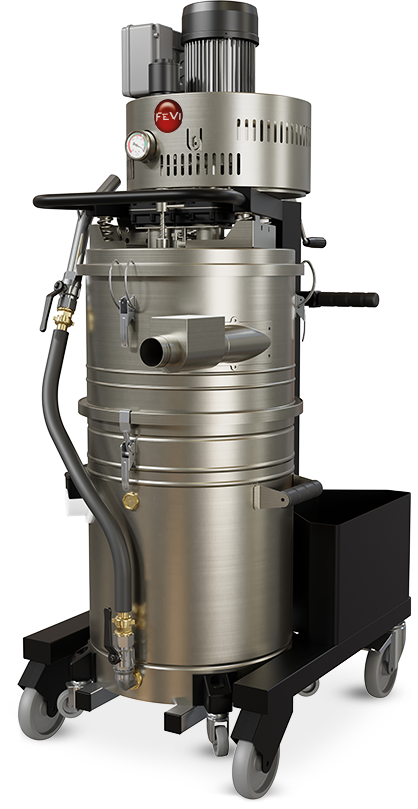
The FEVI 1130 OIL industrial vacuum cleaner for oil and swarf is designed to meet the specific requirements of the metalworking industry.
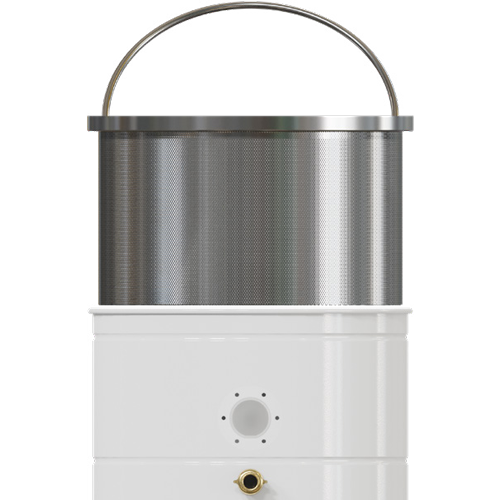
The machine collects the mixture directly from the machine-tool sump. The separator basket retains the larger swarf and solid residues. The separated liquid collects in the 100-litre tank, while the automatic liquid shut-off system stops the industrial vacuum cleaner when the maximum liquid level is reached. Separation simplifies residue management and the potential recovery of the liquid. Its suitability for reuse must nevertheless be verified according to the degree of contamination and the requirements of the machine tool.
Ideal Application: Emptying and maintenance of medium-sized sumps on lathes, milling machines, and CNC centers, providing immediate mechanical separation of cooling oils and emulsions from coarse metal swarf.
Key Advantages: Ultra-fast automatic fluid discharge via reverse airflow pressurization (no electric pump needed), stainless steel separator basket, and a heavy-duty worm-screw drum lifting system.
Model Selection: Heavy-duty industrial three-phase (400 V) configuration featuring a 3 kW side-channel blower and 100-liter tank, ideal for prolonged operations requiring high operating vacuum (250 mBar).
Not Suitable For: Specific machine engineered for oil and swarf; it is not suitable for continuous large volumes of ultra-fine dust, flammable liquid spills, aggressive solvents, or ATEX hazardous areas.
Main features
- 3 kW three-phase side-channel blower, suitable for prolonged operation and without commutator motors
- Versatile industrial vacuum cleaner for dust and liquids, designed for the metalworking industry
- Reverse-flow system for liquid discharge, without an auxiliary electric pump
- Aluminised conductive Class M cartridge filters with a surface area of 13,000 cm²
- Automatic vacuum shut-off through an electric float switch when the maximum fill level is reached
- Extremely robust supporting structure and drum-lifting system with forks and worm screw
- Compact design for excellent manoeuvrability combined with robust construction
- The internal protection helps limit direct contact between the liquid and the filter cartridge
- Semi-automatic filter cleaning through a pneumatic-mechanical shaking piston
- Integrated stainless-steel mesh basket for separating metal swarf from liquids
This model is particularly versatile because it is also equipped with a dust filter. Its filter cartridge allows the occasional collection of ordinary dust and dry residues present in production areas, without requiring the purchase of a dedicated industrial vacuum cleaner.
Who it is recommended for
FEVI 1130 OIL is suitable for industrial environments requiring a powerful vacuum unit for prolonged operation and structured machine-tool maintenance. It is recommended for:
Discover the main application sectors
- Mechanical workshops;
- Maintenance departments;
- Industrial companies;
- Craft workshops;
- Warehouses;
- Construction sites;
- Professional cleaning companies;
- Applications requiring the alternating collection of solids and liquids;
- Companies looking for a high-capacity single-phase industrial vacuum cleaner;
- Environments without large quantities of fine dust or highly specialised applications.
Main applications
Emptying machine-tool sumps
FEVI 1130 OIL can be used to collect the contents of sumps on lathes, milling machines, CNC machining centres, grinding machines, industrial drills, sawing machines and other machine tools. The 100-litre capacity makes it possible to manage medium-sized sumps or perform several operations before discharge.
Collection of coolant emulsions
The model can collect emulsions containing swarf and residues generated during machining. The mesh basket separates the coarser solid material, while the liquid is conveyed into the tank. Before use, the following must be verified: emulsion composition, temperature, viscosity, compatibility with seals and construction materials, presence of aggressive substances, quantity to be collected, and swarf dimensions and shape.
Collection of cutting oils
FEVI 1130 OIL can be used to collect compatible cutting oils during maintenance and sump-emptying operations. It must never be used for solvents, flammable liquids or chemicals that are not expressly compatible with the machine.
Collection of metal swarf
The stainless-steel mesh basket separates the swarf from the collected liquid. Before defining the configuration, we assess together: swarf material, length, shape, quantity, presence of sharp elements, tendency to become tangled, possible abrasiveness, and hose diameter and length. Very long or stringy swarf may require specific procedures to prevent accumulation inside the hose or inlet.
Why choose FEVI 1130 OIL
3 kW three-phase blower: It uses a 3 kW side-channel blower powered at 400 V. The blower is suitable for prolonged industrial use and does not use the carbon brushes typical of single-phase commutator motors. The machine nevertheless requires periodic maintenance and checks on: the filter cartridge, seals, lifting system, inlet valve, float switch, reverse-flow circuit, piping and separator basket. The unit requires regular routine inspection cycles.
100-litre tank and separator: The collection system provides a liquid capacity of 100 litres, making it suitable for emptying significant quantities of oil or emulsion. The weight of the liquid must be considered during handling and discharge. The stainless-steel mesh basket provides coarse separation between swarf and liquid, simplifying removal of solid residues, separate management of the swarf, inspection of the collected material, potential recovery of the fluid and maintenance of the tank. The specific solids capacity of the basket is not stated in the technical documentation and must not be invented.
Efficient reverse-flow discharge: FEVI 1130 OIL does not use an electric pump to empty the tank. The collected liquids are discharged simply and efficiently through the reverse-flow system, which uses the air generated by the blower to expel the collected liquid, offering a faster solution compared to conventional gravity-drainage systems. It allows the tank to be emptied without tilting it, avoids manually removing the full container, transfers the liquid into another vessel and reduces emptying time. The actual discharge speed depends on viscosity, hose length, transfer height and the characteristics of the liquid.
Class M cartridge with semi-automatic cleaning: The system includes a Class M cartridge with a surface area of 13,000 cm² for the occasional collection of dry residues. Cleaning is performed through a semi-automatic system with a pneumatic-mechanical piston that helps release dust accumulated on the filter surface. Before publication, the manual or commercial data sheet should specify whether the system requires an external pneumatic connection or is operated through an integrated circuit.
Filter protection and flap valve: The internal protection installed in front of the cartridge helps reduce the impact of residues, protect the filter against abrasive materials, limit liquid carry-over and distribute the airflow, allowing the machine to switch between liquids and ordinary dust without replacing the filter. The internal protection helps limit direct contact between the liquid and the filter cartridge. The 60 mm tangential inlet generates a rotating movement and the flap valve closes the circuit during reverse-flow discharge.
Drum-lifting system: The robust mechanism with forks and worm screw allows the container to be lowered and raised. The system facilitates access to the tank, removal of the basket, maintenance, inspection and cleaning of the internal components.
How the operating cycle works
1. Vacuuming: The blower generates the vacuum pressure required to draw oil, emulsion and swarf through the tangential inlet. The separator basket retains the larger solid residues, while the liquid collects at the bottom of the tank.
2. Automatic shut-off: When the liquid reaches the maximum level, the electric float switch is activated and automatically switches off the industrial vacuum cleaner, preventing the tank from being overfilled.
3. Fluid discharge: Once the discharge hose has been prepared, the airflow is reversed. The air generated by the blower pressurises the container and pushes the liquid outwards.
Technical Comparisons and Range Configurations
The FEVI industrial vacuum cleaner range includes machines with motor configurations and discharge solutions designed for the specific requirements of workshops.
1. Difference between FEVI 1122 OIL, 1130 OIL and 1155 OIL
All three models use the same 100-litre tank, 13,000 cm² cartridge, automatic shut-off and reverse-flow discharge system.
| Range Model | Motor Specifications and Values | Recommended Operating Application |
|---|---|---|
| FEVI 1122 OIL | Power: 2.2 kW; Power supply: 230 V single-phase; Current: 16 A; Airflow: 320 m³/h; Vacuum pressure: 220 mBar (Maximum 300 mBar); Weight: 130 kg. | Suitable when a standard 230 V power supply is required and its performance is sufficient for the application. |
| FEVI 1130 OIL | Power: 3 kW; Power supply: 400 V three-phase; Current: 6.7 A; Airflow: 320 m³/h; Vacuum pressure: 250 mBar (Maximum 320 mBar); Weight: 130 kg. | The intermediate three-phase configuration, providing higher operating vacuum pressure than the 1122 model. |
| FEVI 1155 OIL | Power: 5.5 kW; Power supply: 400 V three-phase; Current: 10.4 A; Airflow: 520 m³/h; Vacuum pressure: 250 mBar (Maximum 320 mBar); Weight: 151 kg. | Suitable when higher airflow is required or when distance, piping diameter and the quantity of material increase. |
2. Technological differences compared with FEVI OIL 140
| Structural Parameter | FEVI 1130 OIL | FEVI OIL 140 |
|---|---|---|
| Motor Unit | 3 kW three-phase side-channel blower (400 V). Designed for prolonged industrial operating cycles. | Three single-phase commutator motors (230 V). Configuration intended for frequent but non-continuous operations. |
| Tank Capacity | 100 litres for liquids. | 140 litres for liquids, with a stated solids-basket capacity of 35 litres. |
| Emptying Mechanism | Clean, automatic discharge through reversal of the airflow generated by the blower, without a pump. | Accelerated mechanical discharge through an integrated electric pump rated at 220 litres per minute. |
| Standard Filtration | Class M cartridge with a surface area of 13,000 cm² and semi-automatic cleaning. Suitable for occasional collection of ordinary dust. | 300-micron nylon filter supported by oleophobic foam and a Class M hydrophobic-oleophobic cartridge. |
3. Difference compared with a versatile industrial vacuum cleaner
A versatile industrial vacuum cleaner for dust and liquids can collect different materials, but the classic architecture is devoid of dedicated systems for: separating swarf from oil; filtering the liquid; automatically stopping vacuuming at the maximum level through an electric float switch; discharging the liquid through an integrated pump; and managing solids and liquids separately. FEVI 1130 OIL is instead designed specifically and exclusively for workshops and machine-tool maintenance.
Application advantages and benefits
Using the FEVI 1130 OIL industrial vacuum cleaner provides several benefits in the workshop:
- Cost savings: Recovering coolant fluids can reduce the costs associated with purchasing new cutting oils and emulsions.
- Improved product quality: Effective and consistent cleaning of machine-tool sumps supports more precise, higher-quality machining operations.
- Environmental sustainability: Controlled separation and reuse of fluids contribute to more environmentally responsible resource management.
Technical Data
| Material to be collected | Oil and coolant emulsions containing metal swarf |
| Motor / Unit technology | Three-phase side-channel blower without brushes |
| Total rated power | 3 kW |
| Voltage / Frequency | 400 V / 50-60 Hz |
| Current draw | 6,7 A |
| Maximum airflow | 320 m3/h |
| Operating vacuum pressure | 250 mBar |
| Maximum vacuum pressure | 320 mBar |
| Vacuum inlet | Type B tangential 60 mm + integrated flap valve |
| Overall dimensions | 80 x 64 x h165 cm |
| Total empty weight | 130 kg |
| Liquid discharge system | Pneumatic airflow reversal without an electric pump |
| Liquid container capacity | 100 L |
| Solid-residue separator | Stainless-steel mesh basket, capacity not stated |
| Maximum-level shut-off | Electric float switch with automatic shut-off |
| Drum-lifting mechanism | Supporting structure with forks and worm screw |
| Filter chamber diameter | Ø 460 mm |
| Installed filter type | Safety filter cartridge |
| Filter properties and class | Aluminised conductive Class M |
| Total filter surface area | 13.000 cm2 |
| Filter-cleaning system | Semi-automatic through a pneumatic-mechanical piston |
Selection guide: When to configure this model
Choose FEVI 1130 OIL when:
- You need to collect oils and emulsions containing swarf and want to separate the solid material;
- You require a 100-litre tank and have a 400 V three-phase power supply available;
- You are looking for a side-channel blower for prolonged industrial use;
- You want to discharge the liquid automatically without an additional electric pump;
- You want the option of occasionally collecting ordinary dust;
- An airflow of 320 m³/h and a vacuum pressure of 250 mBar are suitable for the application;
- You require a semi-automatic piston-operated filter-cleaning system.
Consider another FEVI model when:
- FEVI 1122 OIL: When a three-phase power supply is unavailable and a 230 V configuration is required;
- FEVI 1155 OIL: When higher airflow is required or more demanding piping must be used;
- FEVI OIL 140 / 200: When capacities of 140 or 200 litres are required and electric-pump discharge is preferred;
- High-vacuum model: When heavy sludge, dense residues or high-density grinding sludge must be collected;
- ATEX industrial vacuum cleaner: When the liquid, dust or workshop environment requires specific explosion-proof marking.
Configuration recommendations and preliminary assessment
Before selecting the machine, we assess together all the operating parameters of your facility: type of oil or emulsion; viscosity; temperature; machine-tool sump capacity; average quantity to be collected per cycle; swarf material, shape and length; presence of sludge; frequency of operations; duration of the operating cycle; linear distance from the sump; length and diameter of the flexible hose; discharge height; actual possibility of recovering the liquid; chemical compatibility with the construction materials; and available electrical power supply.
Request a feasibility assessment for your workshop
Do you need to empty machine-tool sumps and separate oil from swarf?
Describe the type of machine, sump capacity, coolant used, and the quantity and shape of the swarf produced. Together, we will assess whether FEVI 1130 OIL is the most suitable solution or whether a configuration with greater airflow, capacity or vacuum pressure would be preferable. Contact us to select the oil and swarf industrial vacuum cleaner best suited to your workshop.
FEVI 1130 OIL FAQ
What is FEVI 1130 OIL?
Read the answer
It is a three-phase industrial vacuum cleaner specifically designed to collect and separate oils, coolant emulsions and metal swarf generated by machine tools.
What is the power rating of the blower?
Read the answer
The model uses a robust 3 kW three-phase side-channel blower.
What electrical power supply does it require?
Read the answer
It requires a 400 V three-phase industrial power supply.
What is the rated airflow?
Read the answer
The stated airflow for the three-phase motor configuration is 320 m³/h.
What are the operating and maximum vacuum-pressure values?
Read the answer
The operating vacuum pressure is 250 mBar and the maximum vacuum pressure reaches 320 mBar.
What is the capacity of the liquid tank?
Read the answer
The machine’s main tank can hold up to 100 litres of liquid.
How are oil and swarf separated?
Read the answer
Swarf and metal offcuts are retained by a stainless-steel mesh basket, while the separated liquid collects in the lower tank.
How is the collected liquid discharged?
Read the answer
Discharge takes place by reversing the airflow generated by the blower, which pressurises the container and expels the fluid through the dedicated hose.
Does it use an auxiliary electric discharge pump?
Read the answer
No. FEVI 1130 OIL does not require an additional electric pump; it uses the air generated by the blower to discharge the liquids.
What happens when the tank is completely full?
Read the answer
The electric float switch detects the maximum level and automatically stops vacuuming, protecting the blower.
What type of safety filter does it use?
Read the answer
It uses an aluminised conductive Class M filter cartridge with a total surface area of 13,000 cm².
How is the cartridge filter cleaned?
Read the answer
Cleaning is performed through an integrated semi-automatic system using a pneumatic-mechanical piston to shake the cartridge.
Can it also collect dry workshop dust?
Read the answer
Yes. It can occasionally collect compatible ordinary dust and dry residues. However, it is not specifically designed for large quantities of fine dust.
Can the collected coolant be reused?
Read the answer
The coarse separation performed by the basket facilitates recovery, but possible reuse must be verified according to the contamination level and the requirements of the machine tool.
Can it collect flammable liquids or volatile solvents?
Read the answer
No. The collection of flammable substances is prohibited unless a configuration expressly certified and approved for the specific fluid and operating environment is used.
Is it suitable for prolonged multi-shift industrial operation?
Read the answer
Yes. The three-phase side-channel blower is suitable for prolonged and continuous operation, la soluzione corretta è eseguire i controlli e la manutenzione periodica indicati nel manuale.

